Key takeaways
- Chronological lists your jobs newest first and is the right default for most people. Combination adds a short skills block above the same dated history. Functional pushes the history into the background.
- Many recruiters distrust functional resumes and some parsers handle them poorly, so use one only if a combination resume cannot do the job.
- Employers and dates stay on the page in every format. A format changes what the reader meets first, never the facts.
- Choose by asking what a stranger would need explained. If your recent jobs already show the fit, chronological is enough.
In this guide
- The three formats at a glance
- Chronological: your jobs first
- Functional: skills first, and why it is distrusted
- Combination: a skills block over a dated history
- One history, written three ways
- Applicant tracking systems and each format
- How to choose your format
- Fixes for awkward histories
- Mistakes that cost interviews
- A checklist before you send it
- Where SnugCV fits
- Keep going
Every resume guide eventually asks you to choose between chronological, functional and combination, and few explain how to choose. The three formats answer one question: what should a reader meet first on your page? Your jobs, your skills, or a short version of both. Your employers, dates and achievements stay the same in all of them.
This guide shows what each format looks like, what it is good at, where it can hurt you and who it suits. It includes one made-up person's work history written out all three ways, so you can compare real text instead of diagrams, a plain account of why functional resumes have a bad reputation, and a decision guide you can run in a couple of minutes.
Format is the order of the content. For the look of the page, meaning template, font and spacing, see how to choose your resume template, font and section order.
The three formats at a glance
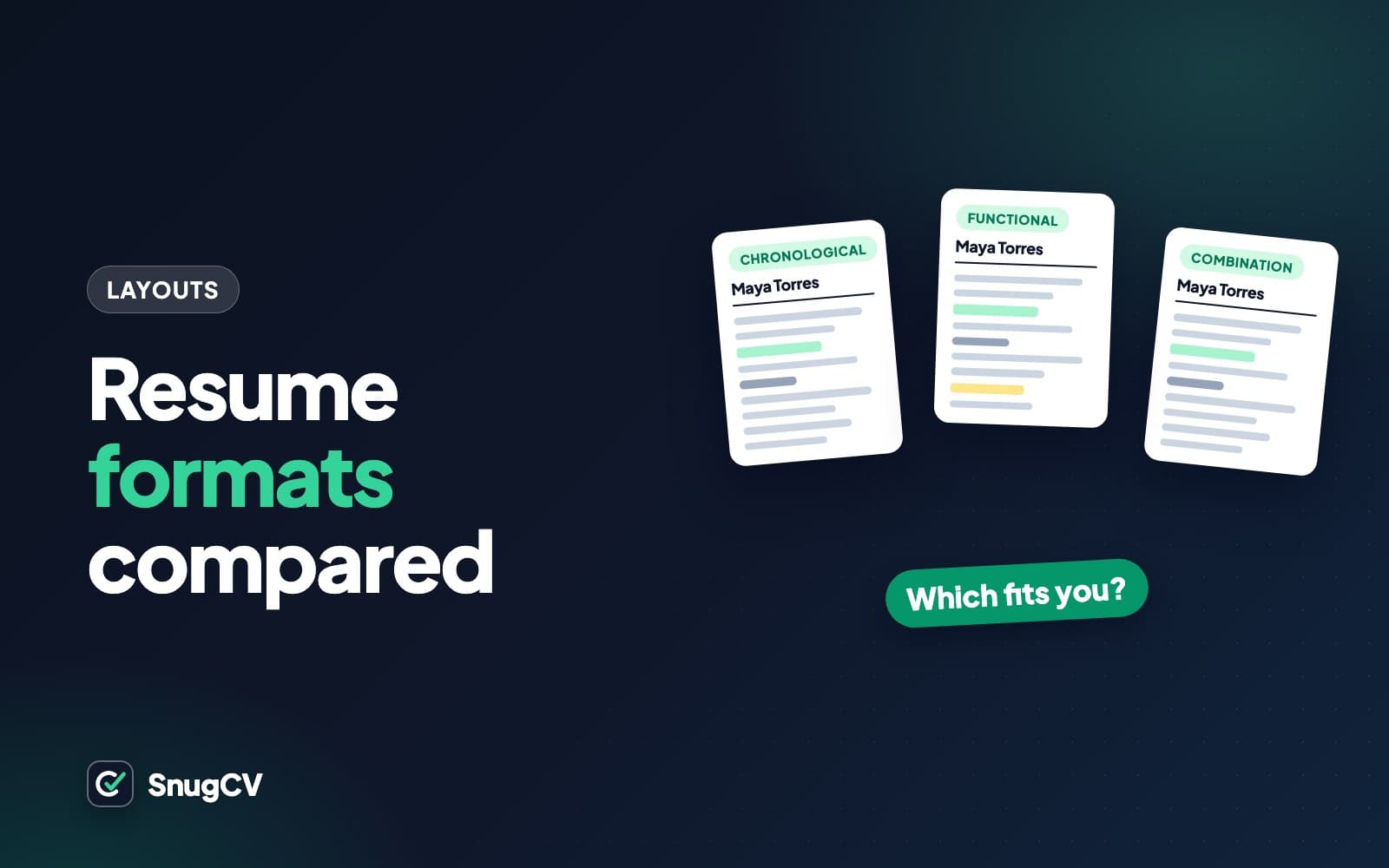
A resume format is the order your information appears in, and the part that gets the most room. Here they are as page thumbnails, each labeled with what it leads with.
Chronological
Summary, then jobs from newest to oldest with bullets under each. Education below.
Functional
Summary, then skill groups with bullets drawn from any job. A short list of employers near the bottom.
Combination
Summary, a short block of key skills, then the full dated work history under it.
| Chronological | Functional | Combination | |
|---|---|---|---|
| Leads with | Your most recent job | Groups of skills | A short skills block, then your jobs |
| Work history | Full, with bullets under each job | A short list of employers, often without bullets | Full, with bullets under each job |
| Other names | Reverse-chronological | Skills-based | Hybrid |
| Fits best | Steady history that already shows the fit | Few people, see below | A history that needs a short translation |
| Main risk | Shows gaps and an unrelated recent job | Reads as hiding something and can parse poorly | Repeats itself and runs long |
Two names cause confusion. Reverse-chronological is another name for chronological, because the newest job comes first. Hybrid is another name for combination. If a template uses either word, you know what is inside it.
Format is the order, layout is the page
Format and layout are separate decisions, and mixing them up explains most of the confusion about two-column templates. Any of the three formats can be drawn in one column or two.
One column
One reading path from the top of the page to the bottom, for a person and for a parser.
Two columns
A side strip for contact details, skills and languages, with experience in the wider column.
People read both without trouble. Some resume parsers read a page line by line straight across, which can fold a side strip into the middle of your job entries. Many systems handle columns well, and you cannot see which kind an employer uses, so a single column is the lower-risk choice for an online form. ATS-friendly resume covers layout rules in more detail.
Chronological: your jobs first
A chronological resume lists your work history from the most recent job backward, with bullets under each job. Education and skills sit below or beside it. It is the format most employers expect, and for most people it is the right one.
A reader opening your resume wants to know who you are professionally, and the fastest answer is your latest title, employer and dates. Everything after that is evidence. There is nothing to decode and nothing to wonder about.
It suits people whose next job continues the last one. A staff nurse moving up to charge nurse, an electrician who went from apprentice to journeyman at one contractor, a teacher changing districts, an accountant with steady titles, a store associate promoted to department lead. In each case the history is the argument.
Chronological works well when
- Your last one or two jobs are close to the job you want
- Your titles, or your responsibilities, grew over time
- You are applying through an online form, where the dated structure is what the software expects
- You want the simplest resume to write and to keep up to date
It falls short when
- Your most recent job is unrelated and sits in the prime spot
- A gap or a run of short jobs is easy to see and has no explanation
- Your best experience is old and pushed down the page
- You are changing fields and the reader has to translate your job titles
Chronological does not mean listing every job you have had. A common rule of thumb is to cover roughly the last ten to fifteen years in detail and to squeeze older roles down to a title, an employer and the years. How long should a resume be goes through what to cut. The bullets under each job are where the work happens, and resume bullet points covers how to write them.
Functional: skills first, and why it is distrusted
A functional resume groups your experience under skill headings, such as customer care, scheduling or training, and fills each group with achievements taken from any job. Employers and dates sit in a short list, usually near the bottom. Some versions drop the dates altogether.
It was designed for people whose timeline works against them: long breaks, many short jobs, a career that changed direction. That is the appeal. The trouble is what the format asks of the reader.
Career sites that cover formats repeat the same warning. Job-Hunt.org says employers do not rate the functional format highly because it is hard to tell what work happened where, and that recruiters generally respond poorly to it. Coursera's guide to resume types describes it as not very ATS-friendly, because the software is typically built to scan the chronological format.
Three things go wrong with it.
- The reader cannot tell where you did what. A bullet that says you trained new hires could come from a six-year management job or a two-week stint, and the format does not say which.
- The format has a reputation. Readers who have seen many resumes tend to associate a skills-first layout with a timeline someone wanted to hide, and some will assume it before they read a word. That may be unfair to you, and it is still the reader you are writing for.
- Parsers may struggle. Many systems build a candidate record out of dated job entries. When skills are cut away from the jobs and dates behind them, the software has less to attach them to. Most of what is written about this comes from resume services and software vendors rather than from published tests, so hold the details loosely. The direction of the advice is consistent across sources.
When a functional resume can still make sense
There are a few cases. Most of your relevant experience comes from outside paid jobs, such as volunteering, a family business, projects or study, and your job titles would mislead a reader. Or you are returning after a very long break and your last paid job is far from the one you want.
Even then, a combination resume does the same job with fewer risks, because it gives you the same skills block and keeps the dated history in view. If you still decide on a functional layout, make it as safe as you can.
Making a functional resume safer
0 of 4 done
Those four changes turn a functional resume into a combination resume, and that is usually the better document.
Combination: a skills block over a dated history
A combination resume, also called hybrid, opens with a short block of key skills or selected achievements, then gives a full chronological work history. The reader gets the fit in the first third of the page and the proof directly underneath it.
Translate
You are changing fields
Your recent jobs are in another area, but the work overlaps: a restaurant manager applying to operations, a teacher applying to corporate training, a military logistics specialist applying to a distribution center. See career change resume.
Lead with scope
You are moving up
You want a more senior role in the same field and need budgets, team size or results to show first: a shift lead aiming for supervisor, a staff accountant aiming for senior accountant.
State the real job
Your titles undersell you
Your title said assistant, but you ran the schedule, the vendors and the training. The skills block says what the title does not, and the dates keep it honest.
The weakness of the format is length and repetition. A skills block that restates every bullet below it turns one page of content into two. The fix is to make the block carry something the bullets do not: grouping, scope, or the single strongest line of proof.
Writing the skills block
Each line in the block names a skill group and points to proof that appears in the history below. Here is a made-up example, written for a warehouse team lead applying for a logistics planner job.
- 1
Inventory control: ran daily cycle counts across 4,000 locations at Northline Distribution and kept accuracy above the site target.
Group with a workplace
A skill name, a place a reader can find in the history below and one concrete detail. Numbers here are made up.
- 2
Labor planning: built weekly shift plans for a team of 14 across two docks, with same-day cover for call-outs.
Group with scope
Scope (14 people, two docks) is the part a reader cannot get from a job title.
- 3
Safety and equipment: certified forklift operator, trained new hires on dock safety procedures.
Group with a credential
Credentials belong in the block when the posting asks for them, and each one should also appear in your certifications section.
Three rules keep the block honest. Every line has to be backed by a job entry below it. No line should repeat a bullet word for word. And the lines should be ordered by what the posting cares about most, which is where skills for a resume and how to find the keywords in a job description come in.
One history, written three ways
The clearest way to compare formats is to hold the facts still. Here is Dana Okafor, a made-up applicant. She worked in restaurants for almost twelve years and is applying for an operations coordinator job at a property management company. Her history:
Aug 2012 to Feb 2015, server at Harbor Diner
Served up to 12 tables at a time and balanced a cash drawer at close.
Mar 2015 to Jun 2018, shift supervisor at Lakeside Grill
Led closing shifts of 8 to 10 staff, counted the till, prepared the daily deposit and handled guest complaints on the floor.
Jun 2018 to Mar 2024, assistant manager at Lakeside Grill
Built schedules for 30 staff, ordered from nine vendors, ran weekly inventory, trained about 20 new hires a year and kept inspection and maintenance records.
Apr 2024 to now, part-time bookkeeper and scheduler at Okafor Landscaping
A relative's six-person landscaping crew. Reconciles invoices monthly and builds the weekly crew schedule.
Education and certification
A.A.S. in Hospitality Management, Lakeshore Community College, 2012. ServSafe Food Protection Manager certification.
The posting asks for scheduling and coordination, purchasing from vendors, records and budgets, and training staff on safety rules. Dana has done all of it, in restaurants. The three versions below use exactly the same facts. Only the order and the proportions change.
Version 1: chronological
Version 1: chronological (example, made-up person)
Dana Okafor
Cleveland, OH | dana.okafor@example.com | 555-0142
Summary
Restaurant assistant manager with nine years in supervisory roles, including scheduling, purchasing and staff training, moving into property operations. Experienced in vendor coordination, inventory records and safety compliance.
Experience
Part-time bookkeeper and scheduler, Okafor Landscaping, Cleveland, OH. Apr 2024 to present
- Reconcile invoices, payments and vendor bills each month for a six-person crew.
- Build the weekly crew schedule around client appointments and weather.
Assistant manager, Lakeside Grill, Cleveland, OH. Jun 2018 to Mar 2024
- Built weekly schedules for 30 staff across two shifts and covered same-day call-outs.
- Ordered from nine vendors, ran weekly inventory counts and kept food cost within the owner's target.
- Trained about 20 new hires a year on opening, closing and safety procedures.
- Kept health inspection and equipment maintenance records current.
Shift supervisor, Lakeside Grill, Cleveland, OH. Mar 2015 to Jun 2018
- Led closing shifts of 8 to 10 staff, counted the till and prepared the daily deposit.
- Handled guest complaints on the floor.
Server, Harbor Diner, Cleveland, OH. Aug 2012 to Feb 2015
- Served up to 12 tables at a time and balanced a cash drawer at close.
Education
A.A.S., Hospitality Management, Lakeshore Community College, 2012
Certification
ServSafe Food Protection Manager
Version 2: functional
Version 2: functional (example, same person, same facts)
Dana Okafor
Cleveland, OH | dana.okafor@example.com | 555-0142
Summary
Hospitality professional with nine years in supervisory roles, including scheduling, purchasing and staff training, moving into property operations.
Scheduling and coordination
- Built weekly schedules for 30 staff across two shifts and covered same-day call-outs.
- Built the weekly crew schedule for a six-person landscaping business around client appointments and weather.
- Led closing shifts of 8 to 10 staff.
Vendors and records
- Ordered from nine vendors, ran weekly inventory counts and kept food cost within the owner's target.
- Reconciled invoices, payments and vendor bills each month.
- Counted the till and prepared the daily deposit. Kept health inspection and equipment maintenance records current.
Training and safety
- Trained about 20 new hires a year on opening, closing and safety procedures.
- Handled guest complaints on the floor.
- ServSafe Food Protection Manager certified.
Work history
- Assistant manager, Lakeside Grill, 2018 to 2024
- Shift supervisor, Lakeside Grill, 2015 to 2018
- Server, Harbor Diner, 2012 to 2015
- Part-time bookkeeper and scheduler, Okafor Landscaping, 2024 to present
Education
A.A.S., Hospitality Management, Lakeshore Community College, 2012
Read the first bullet under Training and safety and ask where it came from. Was it the management job, or the supervisor job before it? A reader has to guess. Many functional resumes drop the dates from the work history as well, which makes the guessing worse. This version is already a generous one.
Version 3: combination
Version 3: combination (example, same person, same facts)
Dana Okafor
Cleveland, OH | dana.okafor@example.com | 555-0142
Summary
Restaurant assistant manager with nine years in supervisory roles, including scheduling, purchasing and staff training, moving into property operations.
Key skills
- Scheduling and coordination: weekly schedules for 30 staff across two shifts, same-day cover for call-outs, and a weekly crew schedule for a six-person landscaping business.
- Vendors and records: nine vendors, weekly inventory counts, monthly invoice reconciliation, health inspection and maintenance records.
- Training and safety: about 20 new hires trained a year, ServSafe Food Protection Manager certified.
Experience
Part-time bookkeeper and scheduler, Okafor Landscaping, Cleveland, OH. Apr 2024 to present
- Reconcile invoices, payments and vendor bills each month for a six-person crew.
Assistant manager, Lakeside Grill, Cleveland, OH. Jun 2018 to Mar 2024
- Built weekly schedules for 30 staff and covered same-day call-outs.
- Ordered from nine vendors, ran weekly inventory counts and kept food cost within the owner's target.
- Trained about 20 new hires a year on opening, closing and safety procedures.
Shift supervisor, Lakeside Grill, Cleveland, OH. Mar 2015 to Jun 2018
- Led closing shifts of 8 to 10 staff, counted the till and prepared the daily deposit.
Server, Harbor Diner, Cleveland, OH. Aug 2012 to Feb 2015
Education
A.A.S., Hospitality Management, Lakeshore Community College, 2012
Certification
ServSafe Food Protection Manager
Notice what the combination version did with the space. The skills block moved up, so the bullets under each job could shrink, and the whole resume stays on one page. That trade is how a hybrid avoids the repetition problem.
What each version tells a reader
| A reader asks | Chronological | Functional | Combination |
|---|---|---|---|
| What does she do now? | Clear, in the first entry | Buried in a list | Clear, in the first entry |
| Where did she do this? | Under each job | Not stated | Under each job, and named in the skills block |
| How long did she do it? | Each date range | Dates in the list, no link to the bullets | Each date range |
| Does she have the skills the posting names? | Found by reading the bullets | Found in the first third | Found in the first third |
| Is anything hidden? | No | Looks like it, whether or not it is | No |
For Dana, the combination version is the pick. Her relevant skills come from restaurant work, and a property manager reading the chronological version would have to translate that. The skills block does the translating, and the dated jobs below it keep her credible. If she were applying to be a restaurant general manager, the chronological version alone would be right, because the same history needs no translation there.
Applicant tracking systems and each format
An applicant tracking system, or ATS, is the software many employers use to receive and organize applications. What is an ATS covers the basics. What matters for format is what a resume parser tries to do with your file. How any one product does it varies and employers do not publish their settings, so what follows is the broad shape that most share.
- 1
Read the text
The parser pulls text out of your file. Text in images or odd boxes may be missed.
- 2
Find the sections
It looks for headings such as Experience, Education and Skills.
- 3
Build job entries
It tries to group each title, employer and date range with the lines below it.
- 4
Fill a profile
The result is a record a recruiter can search and sort.
Step three is the one that favors dated job entries. A chronological or combination resume hands the parser exactly that structure. A functional resume separates skills from the jobs, so the software may have skills floating without a job to attach them to.
| Format | How it lines up with a typical parser | What to watch |
|---|---|---|
| Chronological | Matches the dated job entries most systems are built around | Keep dates in one consistent style |
| Combination | Matches, as long as the skills block is plain text and the jobs keep their dates | Do not let the skills block become a table or a graphic |
| Functional | Skills are separated from the jobs they came from | Keep employer, title and dates together on the page |
No format guarantees anything. A person still reads the resume, and often a person reads it first. Whatever the format, a few habits make a parser's job easier.
Do
- Use plain headings: Summary, Experience, Education, Skills, Certifications
- Write every date range in the same style, for example Mar 2019 to Aug 2023
- Keep title, employer and dates together at the top of each job entry
- Put skills in a plain text list or short lines, not star ratings or bars
- Follow the file type in the posting, and use a file with real selectable text
Avoid
- Clever headings such as My journey or What I bring
- Contact details or dates placed inside icons, text boxes or images
- Dates on one side of the page and the job they belong to on the other
- A skills block drawn as a graphic
- A file that is a scan or a photo of a printed page
How to choose your format
Run these questions in order. Most people stop at the first one.
- 1
Do your last jobs show the fit?
If a stranger can see you are right for the role from your two most recent jobs, use chronological.
- 2
Does the fit need translating?
If the relevant work sits in another field, an older job or under a modest title, use combination.
- 3
Is there a gap to explain?
Keep the dates in either format and add one true line. Do not use the format to hide it.
- 4
Still tempted by functional?
Test whether a combination resume does the same job. It almost always does.
The table below maps common situations to a starting point. Treat these as starting points. Your own history may need a mix.
| Your situation | Start with | Why | Watch for |
|---|---|---|---|
| Same field for years, steady titles (a bus driver, a dental hygienist, a staff accountant) | Chronological | The history is the proof | Trim jobs older than the last ten to fifteen years |
| Promoted within one employer (retail associate to store manager) | Chronological, with the titles stacked under one employer | Growth shows without repeating the company name | Do not repeat the same bullets under each title |
| Changing fields with real overlap (restaurant manager to operations) | Combination | The skills block translates, the dates keep it credible | Do not claim skills you cannot show |
| Recent graduate with internships and part-time work | Chronological or combination, education near the top | There is little history, so coursework and projects carry weight | Keep it to one page |
| Returning after caring for family, an illness or study | Chronological or combination with one line for the break | A reader sees a plain timeline and the skills | Do not leave a span of years unexplained |
| Many short contracts or seasonal jobs (travel nurse, film crew, farm work) | Chronological with grouped entries | One heading for the run of jobs, each with its own dates | Keep each contract's dates |
| Moving up in the same field | Combination | Scope and results lead, the history confirms | Be specific with numbers you can back |
| Leaving the military | Combination | Duties get translated into civilian wording | Keep ranks, dates and units accurate |
| Academic, research or some medical roles | A CV | The field has its own conventions, see CV vs resume | Follow the department's examples |
Formats you will hear about that are not on this list
Career sites mention a few other names. A targeted resume is any of the three formats tailored to one posting, which is the habit why tailor a resume for each job argues for. Infographic and video resumes are specialist tools for design, media and a few client-facing fields. They need a plain text version behind them if you apply through a form. A mini resume is a business-card-sized summary for job fairs and events. None of these replaces a standard format for an ordinary application.
Fixes for awkward histories
Most people have a part of their history that does not fit a template. Each of these can be handled without hiding anything.
Stack the titles
Promoted within one employer
Put the employer once, then each title with its own dates beneath it. A reader sees growth at a glance, and you avoid repeating the company name three times.
Group the run
Many short contracts
Use one heading, such as Contract and seasonal work, then list each placement with its own dates and one line each. Keep the dates. A group heading shortens the page without removing any facts.
Judge it honestly
A job that lasted a few weeks
If other jobs cover those months and the stint adds nothing, many people leave it off. If leaving it off would create a visible gap, keep it. Either way, never move a date to make the timeline tidy.
Treat it as a job
Self-employed or freelance
Give it a title (freelance photographer, owner of a cleaning business), dates, and bullets about clients, jobs completed and what you handled. A reader needs to see it was work.
Label it
Unpaid or volunteer work
Put relevant volunteer work in the experience section, labeled as volunteer, with dates and what you did. It counts as experience when it was real work.
Use the skills block
Your best work is old
A combination resume lets you pull a strong older achievement up front while the dated history shows where it belongs. The reader sees both.
Gaps need one line, written plainly. Compare these.
Before
2022 to 2023: Unemployed
After
2022 to 2023: Full-time caregiver for a family member. Renewed CPR certification and completed a bookkeeping course.
Only list what is true. A plain reason reads as a decision, and the one concrete detail shows you stayed in touch with your field.
Before
A blank year between two jobs with no explanation
After
2019: Relocated to Tucson. Seasonal work at a garden center while looking for a permanent role.
A reader can accept a move and a stopgap job. A blank year invites guesses.
Mistakes that cost interviews
Do
- Start with chronological and move only when your history needs help
- Keep every employer and date visible, in every format
- Make the skills block in a combination resume add something the bullets do not
- Explain a gap in one true line, then move on
- Change the summary and the order of skills for each posting, and keep the format steady
Avoid
- Choose functional so a reader cannot see how long you worked somewhere
- Drop dates, employers or titles to make a timeline look smoother
- Repeat the same sentence in the skills block and in a bullet
- Mix formats inside one page, such as a skill list in the middle of your jobs
- Stretch a date, round a month up or change a title to fit a format
A checklist before you send it
Format check
0 of 7 done
Where SnugCV fits
SnugCV tailors the wording of a resume to a posting and leaves the history alone. You upload your resume once to build a profile, paste a job posting and get a tailored version in about a minute. The summary is rewritten, the skills are reordered to match the posting and the bullets are reworded in its language, with a note on every change. Employers, titles, dates and education are copied unchanged, so your history reads the same in every tailored version.
The Classic template is a single column, and the section order is a setting, so a recent graduate can put Education above Employment history. How to tailor your resume to a job posting in about a minute shows the whole flow.
Keep going
Once the format is chosen, the top of the page is the next lever, and resume summary examples shows how to write it for any field. If you are changing fields, career change resume goes deeper on translating old work into a new posting's language, and ATS-friendly resume covers the file and layout rules in full.
Questions people ask
Which resume format is best?
For most people, chronological. Readers expect it, it is the easiest to scan and it works with how most resume software is built. Combination is the better choice when you are changing fields or moving up and need your skills to show before the reader reaches your job titles. Functional is rarely the best choice.
Is a functional resume ever a good idea?
Rarely. It can help when your relevant experience comes from outside paid jobs and your titles would mislead. Even then a combination resume gives you the same skills block while keeping dated jobs in view, which removes most of the risk. If you do use a functional layout, keep every employer, title and date on the same page.
Will an applicant tracking system read a functional resume?
Often yes, with a risk of lost context. Many systems build a record from dated job entries, and a layout that separates skills from the jobs behind them gives the software less to attach them to. How a given employer's system behaves is not public, so there is no guarantee either way. A dated work history is the safer shape.
Is a combination resume the same as a hybrid resume?
Yes. Career sites use the two names for the same thing: a short block of key skills or achievements followed by a full chronological work history. If a template calls itself hybrid, check that the dated jobs are on the page with bullets under them, because that is what makes it a combination format.
How do I handle a gap in my work history?
Keep the dates, and add one true line if the gap is more than a few months, such as caring for a family member, study or a move. Showing years instead of months is a common and honest way to shorten the look of a short gap. Do not stretch a date to cover it. A reader can accept a gap with a reason more easily than a hidden one.
Should I use a two-column resume template?
Columns are a layout choice, separate from format. People read them fine. Some parsers read straight across the page and can mix a side strip into the middle of your jobs, so a single column is the lower-risk choice for online forms. If you send your resume to a person directly, a clean two-column layout is fine.
Do I need a different format for each job?
Not usually. Most people keep one format and change the content for each posting: the summary, the order of the skills and which bullets get the most room. Switch format only when your situation changes, for example when you start applying in a new field and a skills block would help the reader.
Was this guide helpful?
Get the free resume checklist and new guides
Twenty checks to run before you send a resume, as a one-page PDF. After that, a short email when new guides go up, at most once a week.