Key takeaways
- No experience rarely means nothing to show. School work, volunteering, informal jobs, clubs, teams and projects all count when you describe what you actually did.
- Lead with your strongest section: education for students and recent graduates, a skills section backed by evidence for adults with no formal jobs.
- Write each bullet as an action with a detail you can count or name, and label informal work for what it was instead of giving it a job title it never had.
- Keep it to one page in a plain layout, with a short summary that names the kind of job you want.
In this guide
- You have more to show than you think
- What goes on the page, and in what order
- Writing each section
- Three full example resumes
- Formatting a resume that has little on it
- What to leave off
- If the page still looks thin
- Tailoring a first resume to a posting
- Common mistakes and a final check
- Where SnugCV fits
- Keep going
An employer who posts an entry-level job expects applicants with little to show. What they look for is evidence that you can turn up, learn and finish what you start. A first resume puts that evidence on one page, even when none of it came from a paycheck.
This guide covers what counts as experience, what order to put things in, and how to write each section. It includes three full example resumes as text, for a high school student, a recent graduate and an adult with no formal work history, plus shorter experience sections for six other kinds of work. Every person and place in the examples is made up. Use them for their shape and fill them with your own true material. When you are ready to match a resume to a specific posting, how to find the keywords in a job description shows how.
You have more to show than you think
Experience on a resume means anything that shows you doing something that matters to the job: being responsible for something, finishing something, working with other people, learning a tool. Pay is one source of that. It is far from the only one.
What you made
School work and projects
A group project with a presentation, a science fair entry, a long research paper, a yearbook layout, a shop-class build, a coding assignment.
Where you gave time
Volunteering
A food pantry, an animal shelter, a hospital information desk, a place of worship's kitchen, a park clean-up, tutoring younger children.
What you were relied on for
Family and household
Regular care of a sibling or relative, running a household's appointments and errands, cooking for a family, helping in a family shop or on a farm.
What people paid you for
Informal paid work
Babysitting, lawn mowing, snow shoveling, dog walking, tutoring, washing cars, selling at a market stall, helping a neighbor move.
What you did with others
Clubs, teams and leadership
Treasurer of a club, team captain, band section leader, scouts or cadets, student council, running an event.
What you learned on your own
Self-taught skills
An online course with a finished project, editing videos, repairing bikes or phones, learning a language, running a small online shop.
Not everything on that list belongs on every resume. A reader cares most about the items that connect to the job in front of them. Start by digging up the material, then choose.
Questions to dig up material (answer each in one plain sentence)
0 of 12 done
Most resume bullets begin life as one of those answers. Write them all down before you decide what goes on the page.
What goes on the page, and in what order
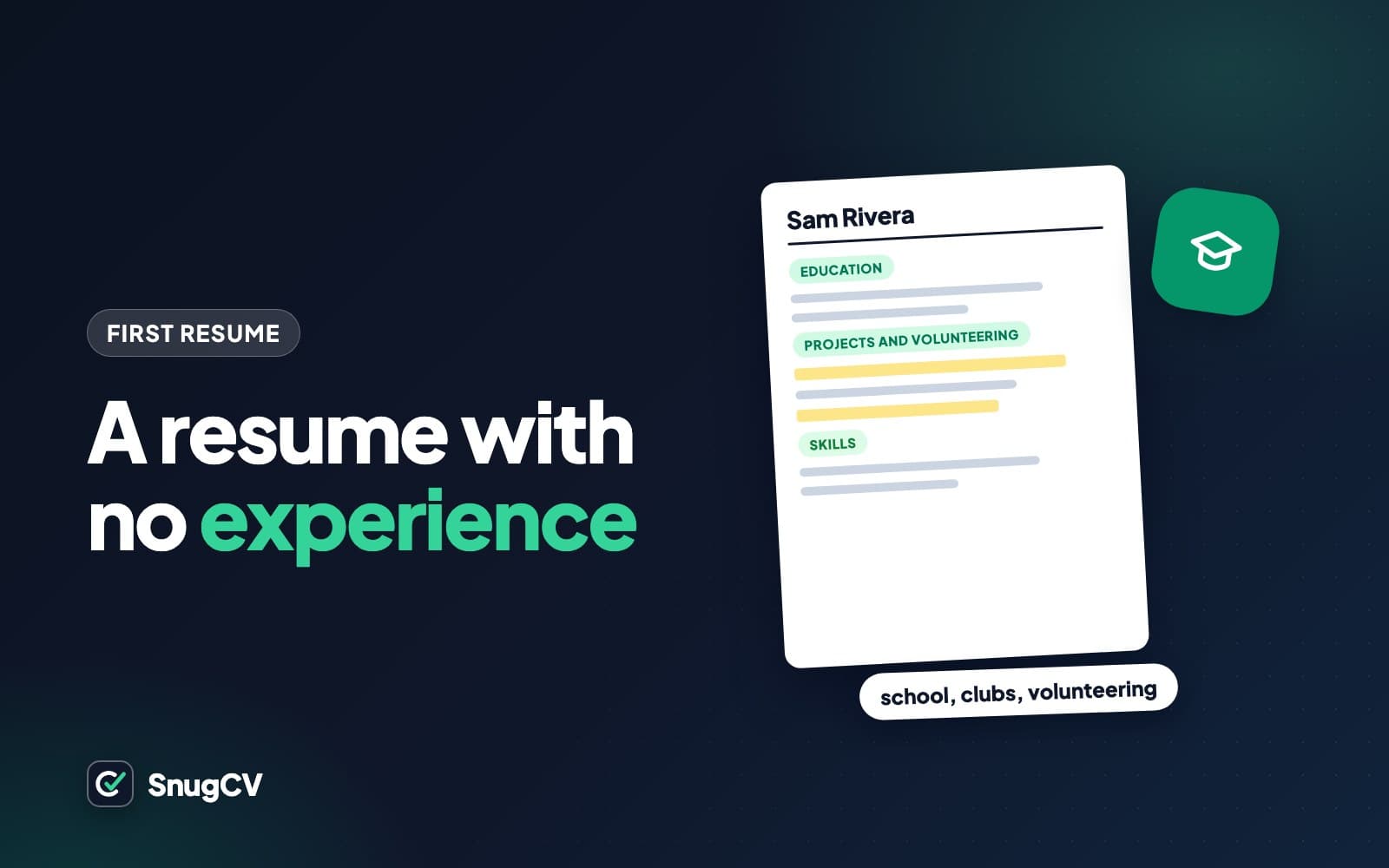
The order should put your strongest evidence where a reader looks first. For a student or recent graduate that is education. For an adult with no formal work, it is a skills section backed by examples.
| Position | High school student | Recent graduate | Adult with no formal work history |
|---|---|---|---|
| 1 | Header | Header | Header |
| 2 | Short summary | Short summary | Short summary |
| 3 | Education | Education | Key skills, each with a real example |
| 4 | Activities and leadership | Projects or lab and research work | Volunteer and community experience |
| 5 | Volunteering or informal work | Work, volunteering and internships | Family business or informal work |
| 6 | Skills | Skills | Training and certificates |
| 7 | Awards, if any | Activities | Education |
Header
Maya Torres
Summary
Skills
Experience
Education
- 1Education sits right after the header and summary, with the school, the expected graduation date and any detail that matters for the job.
- 2Activities, volunteering and any work follow, each with two or three short bullets.
- 3Skills close the page, short and specific, each one something the entries above can back up.
Writing each section
Once the order is set, each section has its own small craft. Here they are one at a time, with before-and-after rewrites from several fields.
The header: small details that get noticed
Your header needs a name, a phone number you answer, a professional email address and a city. A link to a profile or portfolio is optional, and only worth including when it shows relevant work.
Before
xXgamerboi2008Xx@mail.com
After
maya.reyes@mail.com
An email address made of your name is easy to read aloud and nobody has to guess who it is. If yours is an old username, make a new address for job applications.
Leave off a photo, a street address and your date of birth. In the United States and several other countries a photo is not expected on a resume, and a city is enough. Conventions differ elsewhere, which CV vs resume covers. Record a plain voicemail greeting as well, because employers do call.
Summary or objective
With little experience, the summary does the job a job title does for someone else: it tells the reader what you are and what you want. A formula that works: who you are right now, plus two things you can do that the page backs up, plus the kind of job you are after. An objective states only what you want, and a summary states what you offer. For a first resume, one sentence of each works well, as long as the offer is backed up below.
Before
Hard-working student looking for an opportunity to grow with a company and gain experience.
After
High school junior who has worked the school concession stand for two seasons and babysits for three families. Reliable, friendly and quick with cash and change, and looking for a part-time job in retail or food service.
Every claim in the second version has a line below it that proves it.
Before
Recent graduate seeking an entry-level position where I can utilize my skills.
After
Recent business graduate who coordinated events and managed the budget for a student club. Organized and careful with detail, applying for an office assistant role.
It names the degree, two real things done, and the target job.
Before
Looking to start working again after many years at home.
After
Dependable and calm under pressure, with several years of daily care for a family member and weekly volunteering at a community pantry. Completing a home health aide course and applying for personal care roles.
The years at home become the evidence. Nothing is hidden and nothing is inflated.
Before
Interested in the trades and willing to learn.
After
Recent graduate of a high school woodworking and construction program, with a finished shed build and a year of weekend help on a family renovation. Applying for carpentry apprenticeships.
Willing to learn is assumed for an apprentice. Showing what you have already built is the stronger signal.
For more examples across fields, see resume summary examples.
The experience section when you have no jobs
First, pick a section heading that fits what you have. A section titled "Work experience" with nothing under it looks empty, while one that matches your material looks purposeful.
Section names that fit when you have no formal jobs
- Experience
- Relevant experience
- Volunteer experience
- Community experience
- Projects
- Activities and leadership
- Leadership and service
- Lab and research experience
Then write each entry with an action verb, what you did, and a detail the reader can picture. A good detail is a count, a frequency, a length of time or a specific tool.
Before
Babysat for neighbors.
After
Cared for children ages 4 and 7 for three families on weekday afternoons: homework help, simple meals and bedtime routines.
Ages, frequency and the number of families are all countable.
Before
Did yard work.
After
Mowed, edged and raked for six neighbors on a weekly summer route, using my own equipment and a simple schedule.
Six neighbors and weekly show reliability without any invented title.
Before
Helped at my family's restaurant.
After
Set tables, took phone orders and cleared on weekends at a family-run restaurant, and learned the register during the lunch rush.
It says what the work was. It does not call the person an assistant manager.
Before
Member of the debate club.
After
Treasurer of the debate club: tracked the budget for tournament fees and travel and gave a short report at each monthly meeting.
A role with a title and a duty is stronger than membership.
Before
Volunteered at a food bank.
After
Sorted and packed donated food for weekly distribution, and staffed the check-in table on Saturdays.
Two duties and a schedule, which is what a reader wants to know.
Before
Group project in science class.
After
Planned and ran a three-week water testing project with a team of four, collected samples at two sites and presented the results to the class.
Length, team size and a finished presentation turn a class assignment into evidence.
Before
Took care of my grandmother.
After
Provided daily help to a family member with limited mobility: meal preparation, medication reminders, appointments and a shared calendar for the family.
It names the tasks, and leaves out private medical detail that a resume does not need.
Numbers are useful when you can count them honestly: how many people, how often, how long, how many items, how much money. If you do not know the figure, leave it out and describe the task. Resume bullet points: formulas and before-and-after rewrites goes further on writing bullets with and without numbers.
Skills: what to list and how to back them up
A skills list is useful only when a reader can check each item against the page. Name tools, procedures and languages, and show soft skills such as teamwork in the bullets instead of listing them alone.
| Skill you might list | What can prove it | Where it shows |
|---|---|---|
| Customer service | A concession stand, a bakery counter, a volunteer desk | Bullets under activities or experience |
| Teamwork | A team project, a sport, a production | A bullet with the team size and your part |
| Time management | School plus a regular job or a weekly route | The schedule itself: two afternoons a week, every Saturday |
| Computer skills | The programs you used, named | A course project, a club newsletter |
| Leadership | Captain, treasurer, trainer of new volunteers | The title and what you were responsible for |
| Languages | Spoken at home or studied | Name the language and an honest level |
Skills that often fit customer-facing jobs
- Cash handling
- Making change
- Taking orders
- Answering phones
- Greeting customers
- Handling complaints calmly
- Stocking shelves
- A second language (state the level)
Skills that often fit hands-on and trades jobs
- Using hand and power tools safely
- Reading a tape measure
- Following safety rules
- Lifting and loading
- Basic repairs
- Keeping a work area clean
- Following written instructions
Skills that often fit office and computer jobs
- Typing
- Google Docs and Sheets
- Word and Excel (say how far you go)
- Writing clear emails
- Scheduling
- Filing
- Data entry
- Slide presentations
Describe levels in plain words such as basic, comfortable or fluent. Leave off star ratings and progress bars. They compare you with nothing and invite doubt. Skills to put on a resume has longer lists by field.
The education section
Education is often your strongest section, so give it clear details and keep it accurate.
| Situation | How to write it |
|---|---|
| Still in high school | Fairview High School, Fairview, OH. Expected graduation June 2028 |
| Recently graduated | B.S. in Biology, Lakeview State University, May 2026 |
| Did not finish a degree | Coursework toward a B.A. in Psychology, Riverside College, 2022 to 2024 |
| High school equivalency | High school equivalency diploma, Mesa Adult Education, 2025 |
| A short certificate | CPR and first aid course, community program, March 2025 |
A line of relevant coursework helps when the course names match the job. Honors help. A GPA helps only when it is strong or requested, and you should never round it up. For more cases, such as in-progress degrees and international qualifications, see education on a resume.
Three full example resumes
These three made-up resumes put the pieces together. Read the one closest to your situation first, then skim the others for ideas you can borrow.
Example 1: a high school student
This is a made-up resume for a junior applying for part-time retail or food service jobs. Everything on it comes from school activities, an informal job and a short course. It is a resume you could build in an hour from a list like the one above.
Example resume: high school student (made up)
MAYA REYES
Fairview, OH · 555-0142 · maya.reyes@example.com
SUMMARY
High school junior who has worked the school concession stand for two seasons and babysits for three families. Reliable, friendly and quick with cash and change. Looking for a part-time job in retail or food service.
EDUCATION
Fairview High School, Fairview, OH. Expected graduation June 2028.
Honor roll, four semesters. Relevant courses: Business Basics, Spanish II, Family and Consumer Science.
ACTIVITIES AND LEADERSHIP
Concession stand volunteer, Fairview High Boosters, September 2025 to present
- Take orders and handle cash and card payments at home games, on a team of four to six students
- Count the cash drawer with an adult at close and restock supplies between quarters
- Covered the register during the halftime rush when the lead was away
Treasurer, Spanish Club, September 2026 to present
- Track club funds and report spending at monthly meetings
- Helped plan a bake sale that raised $180 for a class trip fund
EXPERIENCE
Babysitter, self-employed, 2023 to present
- Care for children ages 3 to 9 for three families, usually two afternoons a week
- Prepare snacks, help with homework and follow each family's bedtime routine
SKILLS
- Cash handling and making change
- Customer service: greeting people, answering questions, staying calm in a rush
- Conversational Spanish, spoken at home
- Google Docs and Google Sheets
- CPR and first aid course completed, March 2025
- 1
Two seasons at the concession stand, three families, and the job she wants
Summary
Each claim is backed by an entry below. Nothing in the summary is new information.
- 2
Concession stand volunteer, Fairview High Boosters
Activities first
It is her closest thing to retail, so it goes above the babysitting. The order follows relevance to the job, not the order in which things happened.
- 3
Babysitter, self-employed
Honest labels
No invented company, no inflated title. The entry says what the work was and how often.
- 4
Cash handling and making change
Skills with proof
Every skill in the list connects to a bullet above. Conversational Spanish is stated at its true level.
A student who has no activities at all can still use this shape. Move school projects into the activities section, list the classes that are relevant, and add one small commitment over the next month, such as a weekly shift at a library or a pantry. The timeline later in this guide shows how.
Example 2: a recent graduate
This made-up graduate is applying for laboratory technician jobs. The degree is the main credential, and the coursework and a research project do the work of experience. A part-time job unrelated to science stays on the page, because it shows reliability and contact with the public.
Example resume: recent graduate (made up)
TOMASZ NOWAK
Lakeview, MN · 555-0166 · tomasz.nowak@example.com
SUMMARY
Biology graduate with a full year of lab coursework and a two-semester research project on soil microbes. Careful with documentation and comfortable with standard lab techniques. Seeking a laboratory technician position in an environmental or clinical lab.
EDUCATION
B.S. in Biology, minor in Chemistry, Lakeview State University, May 2026
Relevant coursework: Microbiology, Organic Chemistry, Biostatistics, Genetics Laboratory
LAB AND RESEARCH EXPERIENCE
Undergraduate research project, soil microbial diversity, September 2025 to April 2026
- Collected and labeled soil samples from four sites over two semesters and kept a dated lab notebook
- Prepared agar plates and ran serial dilutions to count colonies, repeating each test in triplicate
- Entered results in Excel, calculated averages and presented findings at the department poster session
Teaching assistant, Introductory Biology Lab, January to May 2026
- Set up lab stations and equipment before each weekly section
- Answered student questions on microscope use and safety procedures
WORK AND VOLUNTEER EXPERIENCE
Barista, part-time, Corner Roast Cafe, June 2022 to August 2025
- Prepared drinks and handled cash and card payments during the morning rush
- Closed out the register and counted the drawer at the end of the shift
Volunteer guide, Lakeview Nature Center, weekends, 2023 to 2025
- Led pond-sampling activities for visiting families and answered questions about local wildlife
SKILLS
- Laboratory: aseptic technique, serial dilution, pipetting, light microscopy, plate counting
- Data: Excel (averages, charts), basic R from a biostatistics course
- Safety: completed university lab safety and chemical hygiene training, 2024
- Communication: poster presentation, written lab reports
The pattern is useful beyond science. A graduate in marketing would put a class campaign and a student newsletter in the same place. A graduate in education would put a practicum placement and a unit plan. A graduate in hospitality would put a catering event they ran for a class. The structure holds: a credential, evidence that you have used it, and a few lines of work history that show you show up.
Example 3: an adult with no formal work history
This made-up applicant has spent years running a household and helping in a family bakery without pay, and volunteers weekly at a school and a food pantry. She is applying for school or clinic front desk jobs. A combination layout fits her best: a skills section first, each skill tied to a real example, followed by dated entries.
Example resume: adult with no formal work history (made up)
LUCIA FERNANDEZ
Mesa, AZ · 555-0178 · lucia.fernandez@example.com
SUMMARY
Organized and patient, with four years of counter and phone experience at a family bakery and weekly volunteer work in a school front office. Comfortable with scheduling, cash and busy phones. Seeking a school or clinic front desk position.
KEY SKILLS
- Customer service: served walk-in and phone customers for four years, including special orders and complaints, in English and Spanish
- Scheduling: kept appointments, school calendars and transport for a household of five in one shared calendar
- Cash and record keeping: handled a bakery cash drawer, a daily tally and supplier receipts
- Computer: Google Calendar, Word, basic Excel, email; completed a community college computer basics course, 2026
- Languages: fluent English and Spanish, spoken and written
EXPERIENCE
Counter and order help, family-owned bakery (unpaid family work), Mesa, AZ, 2020 to 2024
- Took phone and walk-in orders and wrote special-order details on order slips
- Counted the cash drawer at open and close and kept receipts in date order for the owner
- Answered questions and handled returns in English and Spanish
Volunteer, front office, Desert View Elementary School, Mesa, AZ, 2022 to present
- Greet visitors, sign them in and answer the front office phone
- Sort and hand out notices and attendance paperwork twice a week
Volunteer, community food pantry, Saturdays, 2023 to present
- Check in households at the sign-in table and keep the sheet accurate
- Show new volunteers the check-in routine
TRAINING
Computer Basics certificate, Mesa Community College, 2026
CPR and first aid course, 2025
- 1
Scheduling: kept appointments, school calendars and transport for a household of five
A skills section that points at proof
Household work appears as evidence under a skill, which keeps it truthful. It is not presented as a job title.
- 2
Counter and order help, family-owned bakery (unpaid family work)
Unpaid work labeled as unpaid
The label answers the question a reader would ask. The duties are the same as a paid counter job, and the reader can weigh them.
- 3
2020 to 2024
Years, not months
Years alone are fine on a resume. An employer who wants more detail will ask, and the facts are all true.
- 4
Computer Basics certificate, 2026
Recent training
A short, recent course shows current skills and a willingness to learn, and it is cheap or free in many places.
Experience sections for six other kinds of work
The three examples cover the main situations. Here are shorter experience sections for other targets, each built from non-job material. They are made up, and each line mirrors a real kind of evidence.
Sources: family moves, school store
Warehouse or logistics
- Loaded and unloaded a rental truck for three family moves, planning the order of the load and packing fragile items
- Counted and shelved stock for the school store each term and kept a tally sheet that matched the cash box
Sources: home kitchen, church or club events
Restaurant or food service
- Prepared and served meals for 40 guests at a community fundraiser, working from a shared prep list
- Cooked for a household of five on weeknights and kept a weekly shopping list within a set budget
Sources: caring for a relative, first aid course
Healthcare support
- Assisted a family member with mobility, meals and medication reminders every day for two years
- Completed a community CPR and first aid course and volunteered at a hospital information desk on weekends
Sources: siblings, tutoring, camps
Childcare or education
- Tutored two younger students in reading twice a week for one school year
- Helped lead games and arts activities as a junior counselor at a summer day camp
Sources: shop class, home projects
Construction or trades
- Built an 8-by-10 foot shed from plans in a school construction class, framing, sheathing and roofing as part of a team of four
- Painted, patched drywall and replaced fixtures on a family renovation over two summers
Sources: clubs, school offices, family business
Office or admin
- Kept the minutes and the member list for a student club of about 30 people
- Answered phones and filed paperwork two afternoons a week in a school front office
Formatting a resume that has little on it
A short resume does not need tricks. Use one page, a standard font at 11 or 12 point, and margins around an inch. Do not stretch it with oversized text or wide margins. A clean page that is two-thirds full is more believable than a padded one. If space is left over, go back to the questions at the top of this guide for more true material before you reach for filler such as long hobby lists.
Many guides suggest a functional layout for beginners, because it groups everything by skill and hides the thin work history. A common criticism is that readers cannot see where or when you did anything. The safer option for most people is a chronological or combination layout, where the dated entries are visible and the skills lead when that helps.
Chronological
Entries in date order. It works when you have a few dated items, even if they are school, volunteering and part-time work. Easiest to read.
Functional
Everything grouped by skill with few dates. It can hide that the history is short, and readers often want to see the timeline, so use it with care.
Combination
A short skills section followed by dated entries. A good fit for an adult with no formal jobs, since the skills lead and the dated evidence sits below.
For more on layouts, see resume formats, and for fonts and sections see how to choose your resume template, font and section order.
What to leave off
Include
- School name, city and expected or actual graduation date
- Roles and activities that took weeks or months, with what you did
- Volunteering, with the task and the schedule
- Skills you can point to evidence for
- Certificates you hold, with the year
- Awards that connect to the job or to reliability
Leave off
- A photo, your street address or your date of birth
- Long lists of hobbies that have no link to the job
- Made-up business names, titles or employers
- Skill ratings, bars or stars
- Objectives such as seeking a challenging position
- Anything from middle school unless it is truly relevant
- Grades you would not want to be asked about
If the page still looks thin
If the honest material is thin today, you can add real material over the coming weeks. None of it needs to be dramatic. The point is a small, regular commitment that you can describe afterward.
This week
Volunteer for one shift at a place near the work you want: a pantry, shelter, library, hospital desk or community kitchen. Ask the coordinator whether they would be willing to speak for you later.
This month
Finish a short certificate that postings in your field mention and that is inexpensive or free where you live, such as CPR, a food handler card or a customer service course.
Next three months
Take on one regular responsibility: tutoring a younger student, a weekly dog walking route, covering shifts at a family business, or a defined task in a club.
Ongoing
Keep a running note of what you did and anything you counted, so the next version of the resume writes itself.
Tailoring a first resume to a posting
Entry-level postings are short and repeat the same requirements, which makes them easy to match. Spending ten minutes per application is enough.
- 1
Read the posting
Circle the three or four things it names most often.
- 2
Match each to a true example
Something you did that fits, even if it was school or volunteering.
- 3
Move the strongest up
Put the best-matching entry first in its section.
- 4
Use the posting's words
Only where they describe what you actually did.
Why tailor a resume for each job explains the reasoning, and the keyword guide linked at the top shows the method in full.
Common mistakes and a final check
Do
- Describe what you did with a verb, a detail and a duration
- Label informal and unpaid work for what it was
- Order sections by strength for this job
- Ask a teacher, coach or coordinator before listing them as a reference
- Proofread it aloud and have someone else read it
- Save it as a PDF named with your name and the word resume
Avoid
- Describe yourself with adjectives and no evidence
- Give a family task a company title
- Pad the page with large fonts or wide margins
- List skills with no example anywhere on the page
- Apologize for having little experience in the resume itself
- Send the same version to every posting
First resume check
0 of 10 done
Where SnugCV fits
SnugCV builds your profile from a resume you upload, so the first draft is the one you write from the examples above. After that the profile is reusable. Paste a posting and tailoring takes about a minute: the summary is rewritten, skills reordered and bullets reworded in the posting's language, with employers, titles, dates and education copied unchanged and a plain-language note on every change. Each posting also gets a list of matched keywords and gaps, which shows you where a first resume is thin for that particular job. Your first 5 tailored resumes are free with no card.
How to upload your resume and build your profile walks through the first step.
Keep going
Once the resume is on the page, references on a resume covers who to ask and how to prepare them, and how to write a tailored cover letter helps when a posting asks for one. If you are applying in customer-facing work, customer service resume examples has full examples at several levels. If you are still deciding where to apply, jobs for 16 year olds lists first jobs by setting, and the guides to CNA resumes and server resumes both include an example for someone new to the work.
Questions people ask
Should I use an objective or a summary on a first resume?
Use two or three sentences that say who you are, one or two things you can do that the page backs up, and the kind of job you want. That blends the two. Skip vague objectives such as seeking a challenging position, because they say nothing about you and could sit on anyone's resume.
Can I put babysitting, lawn mowing or helping in a family business on my resume?
Yes, as long as you label it for what it was. Babysitter, self-employed, or lawn care for neighbors, or helped in a family restaurant, are all honest. They show reliability and customer contact. Do not give informal work a company name or a manager's title it never had.
Should I include my GPA?
A common rule of thumb is to include it only when it is strong, often 3.5 or higher on a 4.0 scale, or when the application asks for it. Leaving it off is normal. Never round it up. If a form asks for it, give the honest number.
How long should a resume with no experience be?
One page. A short page with plenty of white space reads better than a padded one with large fonts and wide margins. If you have only three or four real entries, a clean half-full page is fine and more believable than filler.
I am an adult and have never had a formal job. Where do I start?
Start with what you did for years without a title: running a household, helping a family business, caring for relatives, volunteering. Group it under skills such as scheduling, customer service and handling cash, and back each skill with a real example. Add any training you have done, and keep the summary short and direct.
Do I need to list references?
Not on the resume itself. Have two or three people ready, such as a teacher, a coach, a volunteer coordinator or a family friend who has seen you work, and ask them first. Share their details when an employer asks. The line saying references available on request is optional and adds little.
Was this guide helpful?
Get the free resume checklist and new guides
Twenty checks to run before you send a resume, as a one-page PDF. After that, a short email when new guides go up, at most once a week.