Key takeaways
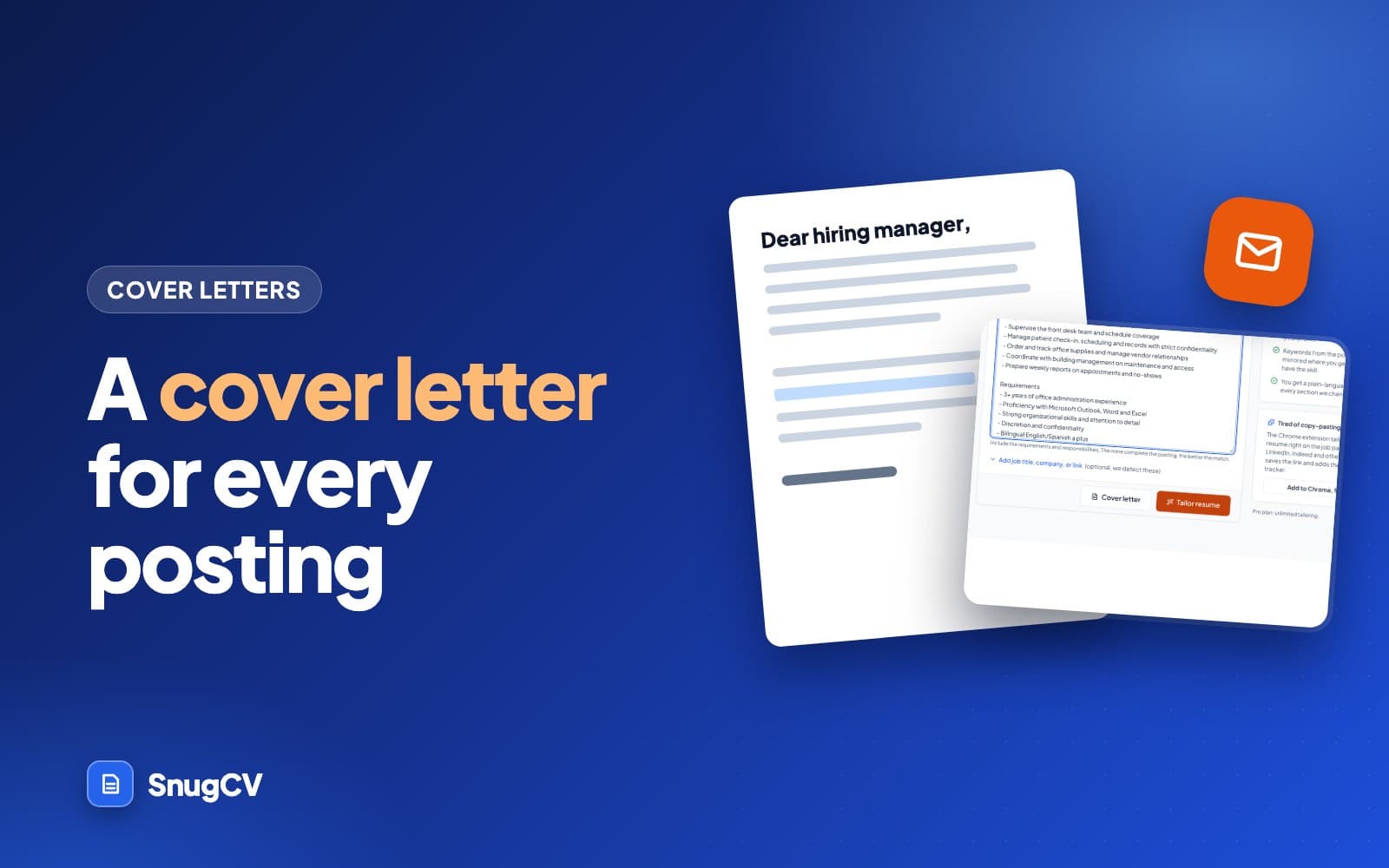
- SnugCV writes a cover letter for the same posting as your resume, from your profile.
- Generate it in the web app or from the Chrome extension panel.
- Read it for facts before you send it, the same as a resume.
- A good letter is short, names one reason for this employer and backs two or three claims with real examples.
In this guide
A cover letter is the part of an application most people put off. It has to say something about this job and this employer, and the one you wrote last month does not. With SnugCV you can generate a letter for the same posting as your resume, using the same profile, so the two documents agree with each other.
This guide covers both halves of the job: the steps to generate a letter, and what makes a letter worth sending. It includes openings from several fields, three short letters to adapt and a checklist for the read-through. If you have not tailored the resume for the same posting yet, how to tailor your resume to a job posting shows how, and it is worth doing first so the two documents agree.
What a cover letter is for
Your resume lists what you have done. The letter does a different job: it connects that list to one role and gives a reader a reason to turn the page. It can say why you want this work, tie one or two things you have done to what the posting asks for, and explain anything the resume cannot, such as a move from another field.
That gives you a simple test for every sentence. If it would sit just as well in a letter to any other employer, it is not pulling its weight. If it repeats a line from your resume in the same words, the reader has seen it already.
A letter is not always needed. If the posting says not to send one, do not. If it is optional, send one when you have something specific to say, and skip it when you would only be filling a page.
Before you start
You need a saved profile with your name and at least one job, and either a credit or a paid plan. On the free plan a letter uses one credit, the same as a resume. A cover letter is written from the profile, so a complete profile gives a better letter. If you have not built yours, see how to upload your resume and build a reusable profile.
The letter draws its examples from the work history in your profile. Vague bullets give a vague letter, and specific ones, such as what you handled, how often and what changed, give the letter something to use. Time spent on the profile pays off for every letter after it.
Write a cover letter on the web
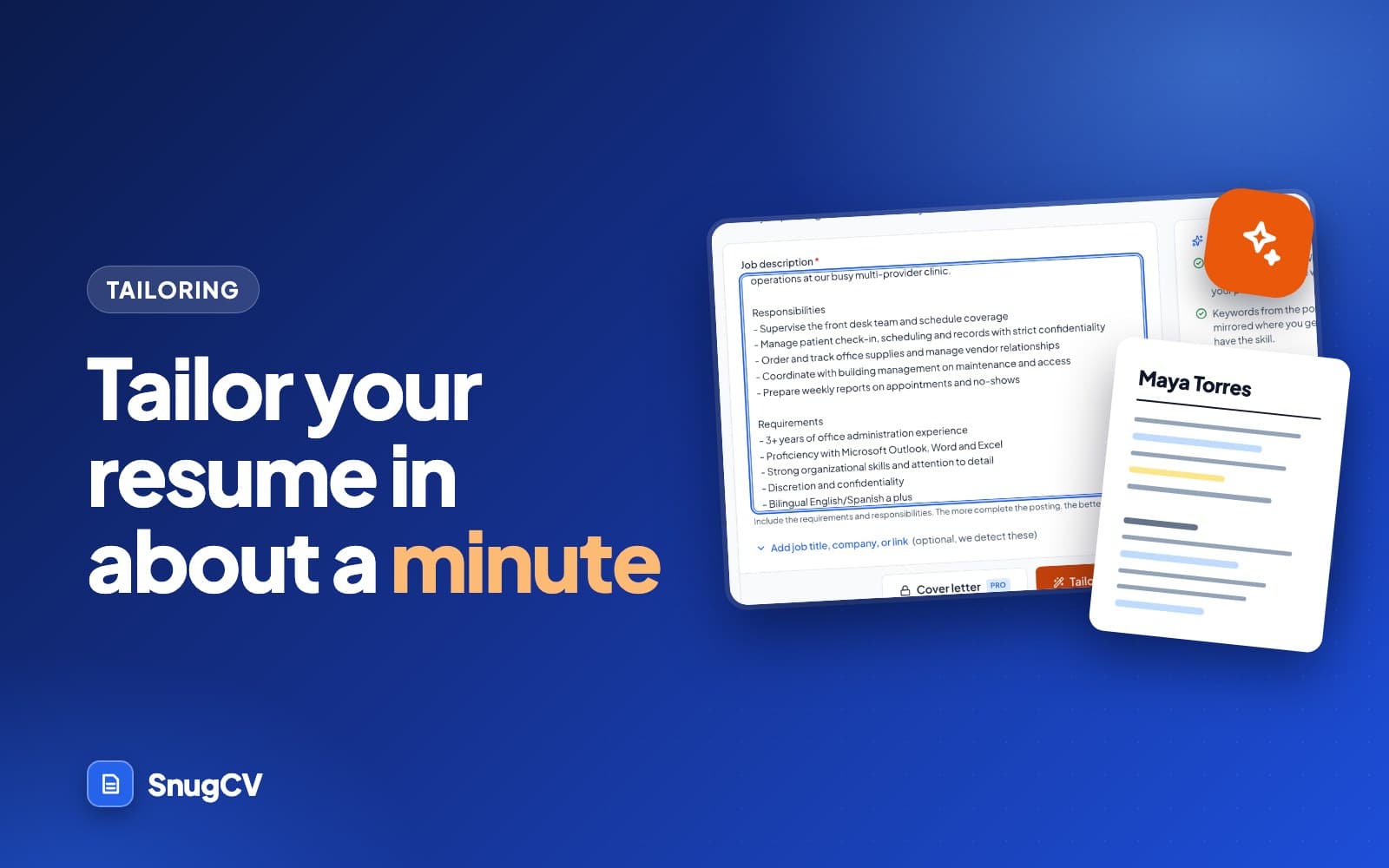
- Open Tailor resume and paste the job description.
- Choose Cover letter, next to the Tailor resume button. On the free plan it uses one credit, like a resume.
- Wait for the document to open.
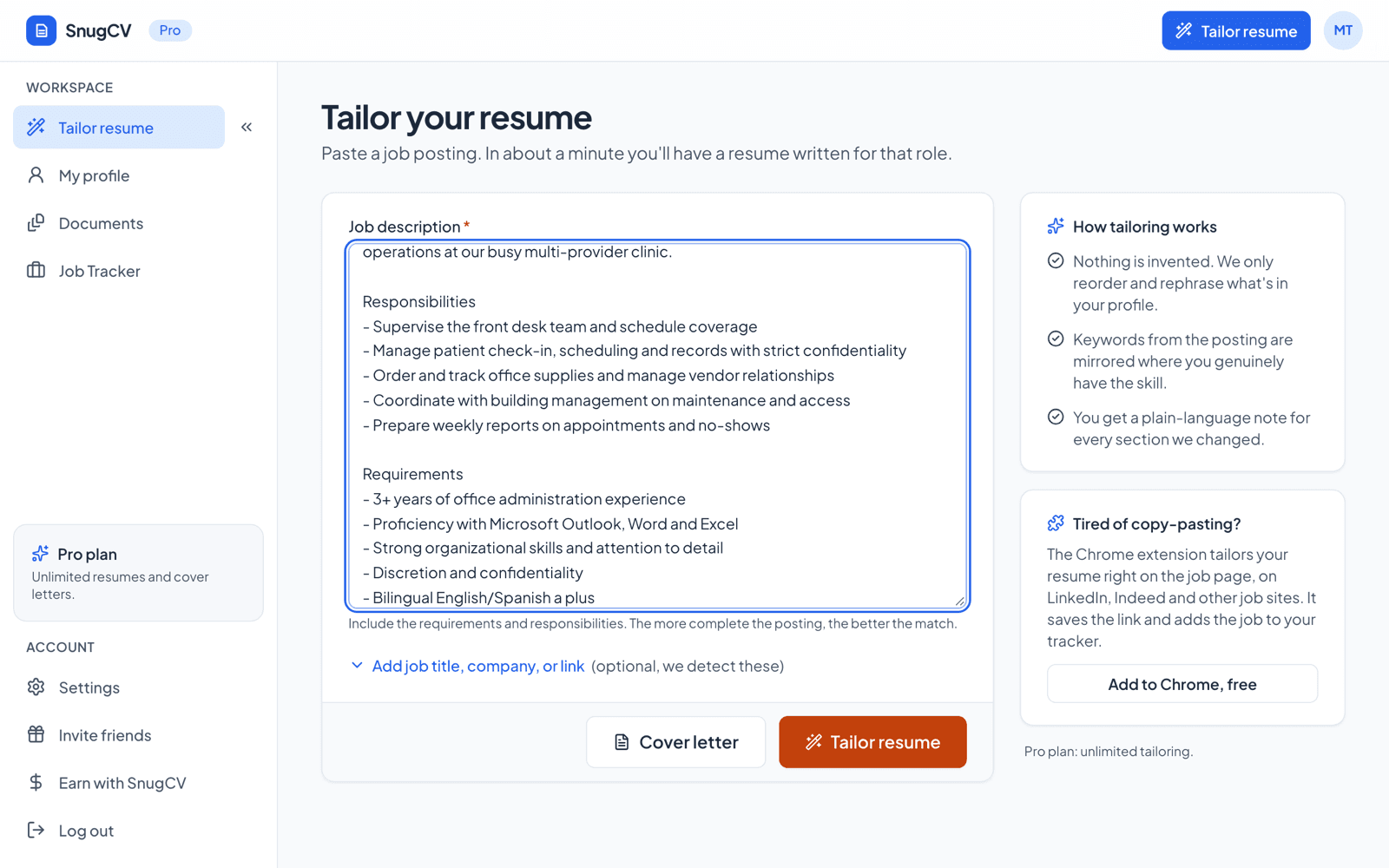
Paste the whole posting. The letter is matched to the requirements and duties in it, and a posting that is cut short gives it less to work with. The optional job title, company and link fields help when the text does not name the employer.
Write one from the job page
If you use the Chrome extension, open the posting and choose Cover letter in the panel. The PDF downloads as soon as it is ready, and the panel lists the resume and letter you have already made for that posting.
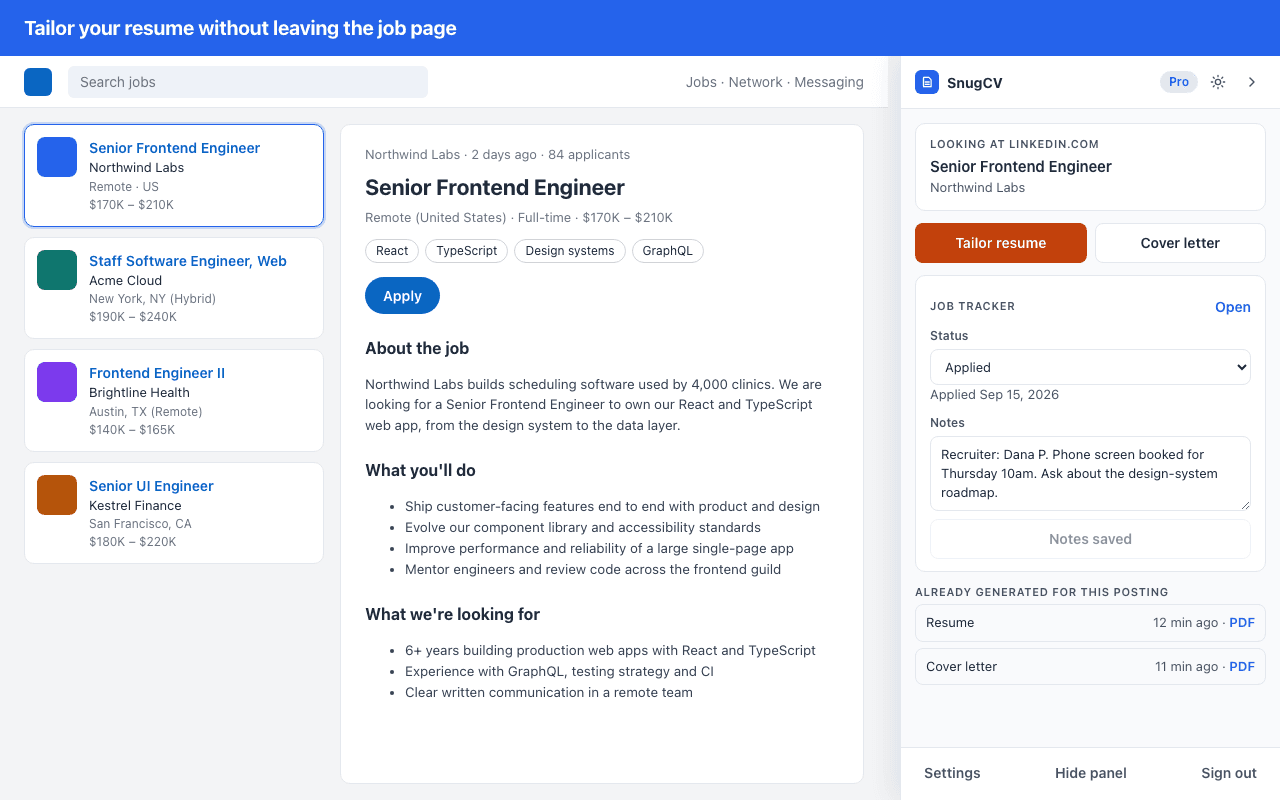
The extension reads the posting from the page, so there is nothing to copy. Tailor your resume from LinkedIn, Indeed and other job pages explains how the panel finds the posting and what to do when it does not.
What a good letter contains
Most good letters share one shape, and a letter from SnugCV follows it too: three or four short paragraphs, built from your profile and the posting. The annotated letter below is made up. Read the notes beside each part.
- 1
Dear Hiring Manager,
Greeting
Use a name if the posting gives one. If it does not, a plain team greeting is fine. Do not guess a name.
- 2
Your posting asks for someone who can keep a full schedule moving. That has been my job for four years at a dental practice.
Opening
Names what the posting wants and ties one real thing you have done to it. It does not announce that you are applying.
- 3
When Monday no-shows climbed, I began calling patients the day before and filling cancelled slots from a waitlist.
Evidence
One specific example with an action and a result. Two or three of these are plenty.
- 4
Your practice sees a lot of young children, and I enjoy making a first visit feel less frightening.
Why this employer
One real reason, specific to this employer. It is the line a template cannot write for you.
- 5
I would welcome a conversation about the front desk team. Thank you for your time.
Close
A clear, polite next step. No pressure, no repeat of the whole letter.
- 6
Sincerely, Name, email, phone
Signature block
In a SnugCV letter this comes from your profile, so check your contact details there.
3 to 4
short paragraphs, which is what SnugCV's letters aim for
Under 320
words in a SnugCV letter
1 page
a common ceiling for any cover letter, as a rule of thumb
Keep to the limit, and stop sooner when you have said what you came to say. A letter that makes one real point in 150 words beats one that makes four generic points in 300.
Openings that work
The first sentence decides whether the rest gets read closely. A weak opening announces that you are applying, which the reader already knows. A strong one names what the posting wants and connects it to something you have done. Here are four, from different fields.
Before
I am writing to apply for the position of Dental Hygienist at your practice.
After
Your posting asks for a hygienist who can keep a full schedule moving without rushing patients. After six years in a four-chair practice, that balance is what I work at every day.
It names what the practice wants and shows you know it from the inside.
Before
I am a hardworking and passionate professional looking for new opportunities.
After
For three years I have run the evening shift at a forty-seat restaurant, and I would like to bring that calm under pressure to your banquet team.
A role, a place and a reason replace two adjectives.
Before
Please accept this letter as my application for the Teaching Assistant position.
After
I have spent two years supporting a third-grade classroom, much of it with small reading groups. Your posting describes the early literacy work I most want to keep doing.
Specific enough to be checked in an interview, and tied to a line in the posting.
Before
I believe I would be a great fit for this role.
After
The posting lists scheduling, phones and no-shows. Those three words describe most of my last three years at a clinic front desk.
It uses the posting's own words for work you really did.
For a deeper look at choosing the words in a posting to echo, see how to find the keywords in a job description.
Choose the evidence
A letter can carry two or three examples before it starts to read as a list. Choosing them is the real work, and it takes a few minutes with the posting beside your resume.
- 1
Find the top needs
Mark the two or three things the posting repeats or calls required.
- 2
Match each to proof
Find a real example in your history for each one.
- 3
Add the result
Say what changed, if you know. A plain outcome is enough.
- 4
Add one reason
Write one sentence about why this employer, in your own words.
Here is the same process on a made-up posting for a dispatch coordinator at a freight company. The applicant has worked at a courier company and has never used the employer's software.
| What the posting needs | Real proof in the applicant's history | The letter sentence |
|---|---|---|
| Assign drivers and routes each morning | Planned daily routes for twelve drivers at a courier firm | "Every morning I assigned twelve drivers to routes, and I rebuilt the plan whenever a driver called out." |
| Handle late and missing loads with customers | Fielded calls about delayed parcels and kept customers updated | "When a parcel ran late I called the customer before they called me." |
| Use dispatch software | Used a different dispatch tool for three years | "I have used a dispatch system daily for three years and learn new tools quickly." |
| Say why Ridgeline Freight | The posting mentions a family-run company with regional routes | "I want to work for a regional carrier where dispatch talks to the drivers by name." |
The third row is a gap handled honestly. The letter says what the applicant has used and leaves the employer to judge the overlap. It does not name the employer's software, because the applicant has not used it.
Start here
In the posting
The duties, the tone and any line about the team or the customers. A reason you can point to in the text is a real one.
Two minutes
On the employer's own pages
An about page, a mission line or a service you would be working on. Name it plainly, without flattery.
The honest link
In your own history
The part of your work you liked most, if it is the same part this job is made of. That is a reason nobody else can write for you.
SnugCV works from your profile and the posting. It does not know why you, personally, want this job. The sentence about why this employer is the one most worth adding or sharpening yourself.
Three letters to adapt
These letters are made up. Use each as a pattern to adapt. They run about 150 words, which is plenty. The highlighted phrases echo what the made-up posting asked for.
The first is for a retail shift lead moving up to assistant store manager. The posting asked for weekend coverage, return handling and inventory accuracy.
Example: retail, assistant store manager (made up)
Dear Hiring Manager,
Your posting says the assistant manager keeps the floor running through the weekend rush. That has been my job for three years as a shift lead at Lakeview Sporting Goods, where I opened the store on Saturdays and Sundays and led a team of eight.
When we changed how returns were handled, I wrote the one-page guide the team used, and fewer cases needed a manager. I also ran the weekly stock count and tracked the differences back to receiving, which is the part of the work I enjoy most.
What drew me to Harbor & Pine Outfitters is the repair bench. I fix my own gear on weekends, and I enjoy telling customers what they need and what they can skip.
I would welcome a conversation about your weekend team. Thank you for your time.
Sincerely, Marisol Reyes
The second is for a front desk worker moving into a patient access role at a community clinic. The posting asked for phone skills, insurance checks and privacy.
Example: healthcare, patient access (made up)
Dear Hiring Team,
I have spent four years at the front desk of a busy family practice, where the phones are ringing before the doors open. The Patient Access Representative role at Northgate Community Clinic asks for the same calm on the phone and the same care with details.
At Elm Street Family Practice I schedule for four providers, verify insurance before visits and collect copays at check-in. When Monday no-shows crept up, I began calling patients the business day before and filling cancelled slots from a waitlist. I also handle patient records every day under the practice's privacy rules.
I speak Spanish and English with patients most days, and I would be glad to bring that to your clinic.
Thank you for considering my application. I would welcome the chance to talk about your front desk team.
Sincerely, Amara Okafor
The third is for a warehouse associate applying to lead a shift. The posting asked for forklift certification, accuracy targets and safety.
Example: warehouse, team lead (made up)
Dear Hiring Manager,
I have worked the floor at a regional distribution center for five years, and for the last two I have been the person the shift looks to when a pick line backs up. The Team Lead role at Ridgeline Freight is the next step I have been working toward.
I have held a forklift certification since my first year, and I train new hires on the scanner and the warehouse system in their first week. I keep the shift's pick rate and accuracy sheet and go through it with the team each morning, which is how we found a labeling problem on one aisle.
I follow safety procedures because they keep people from getting hurt, and I am the one who reports near misses. I would like to lead a team that holds the same view.
I would be glad to talk. Thank you for your time.
Sincerely, Daniel Whitaker
A blank pattern you can fill in for any field:
Template: short cover letter
Dear [Name, or Hiring Team],
[One sentence that names what the posting wants and ties it to something you have done.] [One sentence on the setting: where, for how long, for whom.]
[Your strongest example for the posting's top need: what you did, how, and what changed.] [A second example for the next need, if you have one.]
[One sentence on why this employer or this work, in your own words.]
[A clear next step and thanks.]
Sincerely, [Your name]
Check the letter before you send it
A generated letter is a draft to review, the same as a resume.
- Read it for facts. Every claim should be something you can talk about in an interview.
- Check the company and role names.
- Look at the opening line. Change anything that does not sound like you.
- Make sure it does not repeat your resume line for line. A letter works best when it says why you want this job, with the resume covering what you have done.
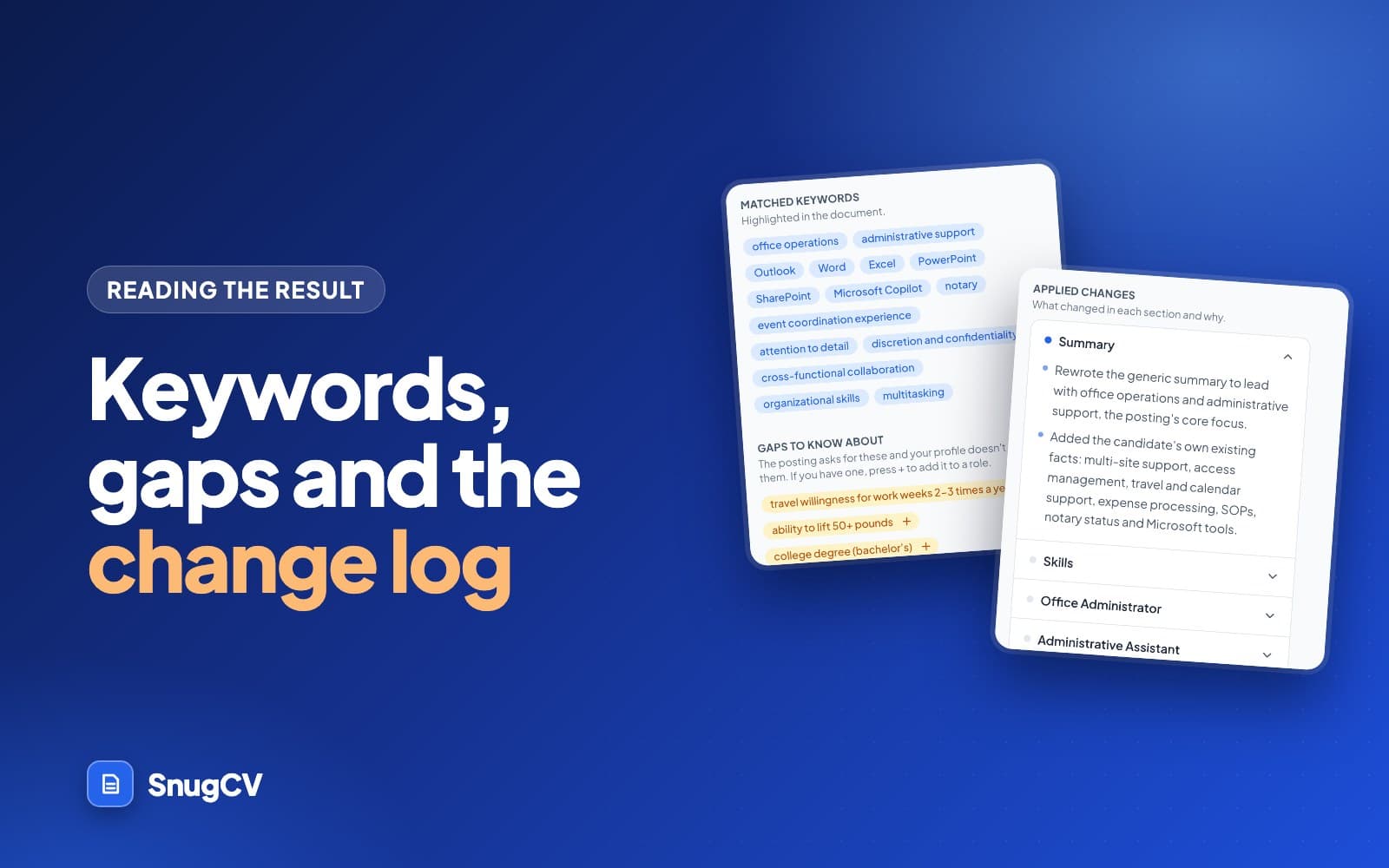
The change note on the document page for a letter explains which achievements were chosen to highlight and why. Read it. If the same achievement leads your resume summary, the letter can usually give room to a different one, and the two documents then show more of your work between them.
Read-through, before you send
0 of 9 done
Edit, download and send
The letter opens as a document with a live preview. Choose Edit to change it. The edit screen has a greeting, the body paragraphs and a closing. Each paragraph can be rewritten, moved up or down or removed, and you can add a paragraph of your own. You can pick a font, and the preview updates as you type. Save changes keeps your edits and the PDF reflects them, and Revert to AI version brings the original back. Edits apply to that letter only and leave your profile as it was.
At the bottom of the letter your name, email and phone come from your profile. The letter has no date line or address block, so if an application asks for a formal letter layout, copy the text into your own document and add them. If it asks for a PDF, download it.
| Where it goes | What to do |
|---|---|
| An upload field | Download the PDF. Name the file with your name and the company |
| A text box on the application | Copy the paragraphs from the preview and paste them in |
| An email | Use the paragraphs as the body. Keep the subject line plain, with the role and your name |
Tone and language
Pro includes a setting that adapts the voice of your documents to the company's style, from formal corporate to casual startup. It is off by default, which gives a neutral professional tone. You can turn it on in Settings. See how to choose your template, font and section order for where the setting lives.
Match the field when you read the result. A letter to a law firm or a bank can be more formal than a letter to a bakery or a community nonprofit, and a short, warm letter can suit a small team. Whatever the tone setting gives you, edit anything that does not sound like you, because a letter in a voice you do not use is hard to stand behind in an interview.
The letter follows your resume language setting. On auto-detect it is written in the language of the posting, so a Spanish posting gets a Spanish letter. How to make a resume in Spanish, German, French, Polish or Serbian covers the setting.
Mistakes to avoid
Do
- Open with what the posting wants and how your work meets it
- Back each claim with one real example
- Give one specific reason for this employer
- Keep it to three or four short paragraphs
- Check the employer's name and the role every time
Avoid
- Repeat your resume bullet by bullet
- Open with a line that could go to any employer
- Claim a skill, a tool or a result you cannot explain
- Send the letter you wrote for another job
- Apologize for gaps in a long paragraph. Say one honest sentence, or leave it out
If you are changing fields, the letter is where the move should make sense. Career change resume covers how to map the work you have done to a new posting.
Next step
When both documents are ready, fill in the application with autofill and log it in the tracker. If the application leads to an interview, how to prepare for an interview and the thank-you email after an interview pick up from here.
Questions people ask
Is the cover letter a Pro feature?
No. On the free plan a cover letter uses one credit, the same as a resume, and the Cover letter button works on every plan. Pro gives you unlimited tailoring within a fair-use limit of 125 a month, so you can write a letter for every posting you send a resume to.
Where do I find my cover letters?
On the Documents page, next to your resumes. Each is labeled Cover letter, and you can download it as a PDF. They are also listed on the job's own page in the job tracker, so the resume and the letter you made for a posting sit together and you can find what you sent.
Can I write one from the Chrome extension?
Yes. The extension panel has a Cover letter button beside Tailor resume, and the PDF downloads when it is ready. The panel also lists the resume and letter you have already made for that posting, so you can see at a glance which of the two you still need.
Does it invent things about me?
No. The letter is written from your profile and the posting, and the writer is told to use only facts from your profile. If your profile does not say something, the letter should not claim it, so read it through before you send it. You are the one who has to talk about every sentence in an interview.
Can I edit the letter?
Yes. Open the letter and choose Edit. You can change the greeting and the closing, rewrite, reorder, add or remove paragraphs and pick a font, with a live preview beside the form. Your changes apply to that letter only, and Revert to AI version brings back the original if you change your mind.
How long should a cover letter be?
A common rule of thumb is three or four short paragraphs, and no more than a page. SnugCV's letters aim for three or four short paragraphs and stay under about 320 words. Shorter is fine when you have less to say. A letter that repeats your resume is longer than it needs to be.
Should I send a cover letter when the posting does not ask for one?
If the application has a place for one and you have something specific to say about the role, a short letter can help. If the posting says not to send one, follow that. When a letter is optional, a short, specific letter is better than a generic one, and no letter is better than a careless one.
Was this guide helpful?
Get the free resume checklist and new guides
Twenty checks to run before you send a resume, as a one-page PDF. After that, a short email when new guides go up, at most once a week.