Key takeaways
- Every interviewer is working out three things: can you do the work, will you do it well here, and can they work with you. Prepare for each one.
- The job posting is a draft of the interview. Turn every duty and requirement into a likely question and attach a true example to it.
- Build a bank of six to eight real stories once, then bend them to fit the questions you are asked.
- Practice out loud, sort the logistics for the format you actually have, and write up notes within the hour afterwards.
In this guide
- What interviewers are trying to find out
- The plan at a glance
- Find out which interview you have
- Read the posting, then research the employer
- Build a story bank
- Prepare for the questions everyone gets
- Practice out loud
- Logistics for in-person, phone and video
- During the interview
- After the interview
- Common mistakes and a last-minute checklist
- Where SnugCV fits
- Keep going
An interview is a conversation with a clock running. You have somewhere between 20 and 60 minutes to show a stranger that you can do a job, and they have the same time to decide whether they believe you. Most of what goes well or badly in that conversation was settled before you walked in.
This guide gives you a plan you can follow whether you have a week or an evening. It covers research, a bank of stories, the questions every interviewer asks, practice, the logistics of in-person, phone and video interviews, what to do in the room and what to do afterwards. The examples come from retail, healthcare, teaching, trades, logistics, hospitality and office work, because the same preparation works in all of them.
If you have not read the posting closely yet, start with how to find the keywords in a job description. The posting is the best preview of the questions you will be asked, and the rest of this plan builds on it. Each of the big questions also has its own guide, linked where it comes up.
What interviewers are trying to find out
Whatever the format, every interviewer is trying to answer three questions about you. They rarely say them out loud, and nearly every question you will be asked is a version of one of them.
Ability
Can you do the work?
They look for evidence of the skills, tools and duties in the posting. A line cook is asked about a rush service. An accountant is asked about a month-end close. A teacher is asked how they would run a group working at three different levels.
Reliability and motivation
Will you do it well here?
Showing up, finishing things, learning, caring how it turns out. Questions about past mistakes, why you want this job and why you left the last one all sit here.
Working style
Can we work with you?
How you take feedback, handle a difficult customer or colleague, speak up when something goes wrong and fit with a team that already exists.
Preparation maps onto all three. Reading the posting and building stories covers the first. Research and a clear reason for wanting this job cover the second. Practicing out loud, so that you sound like yourself under pressure, covers the third.
Preparation has limits. You cannot make an interviewer like you, and you should not try to guess a personality they want. What you can do is arrive with true examples ready, so that your attention in the room goes to listening instead of searching your memory.
The plan at a glance
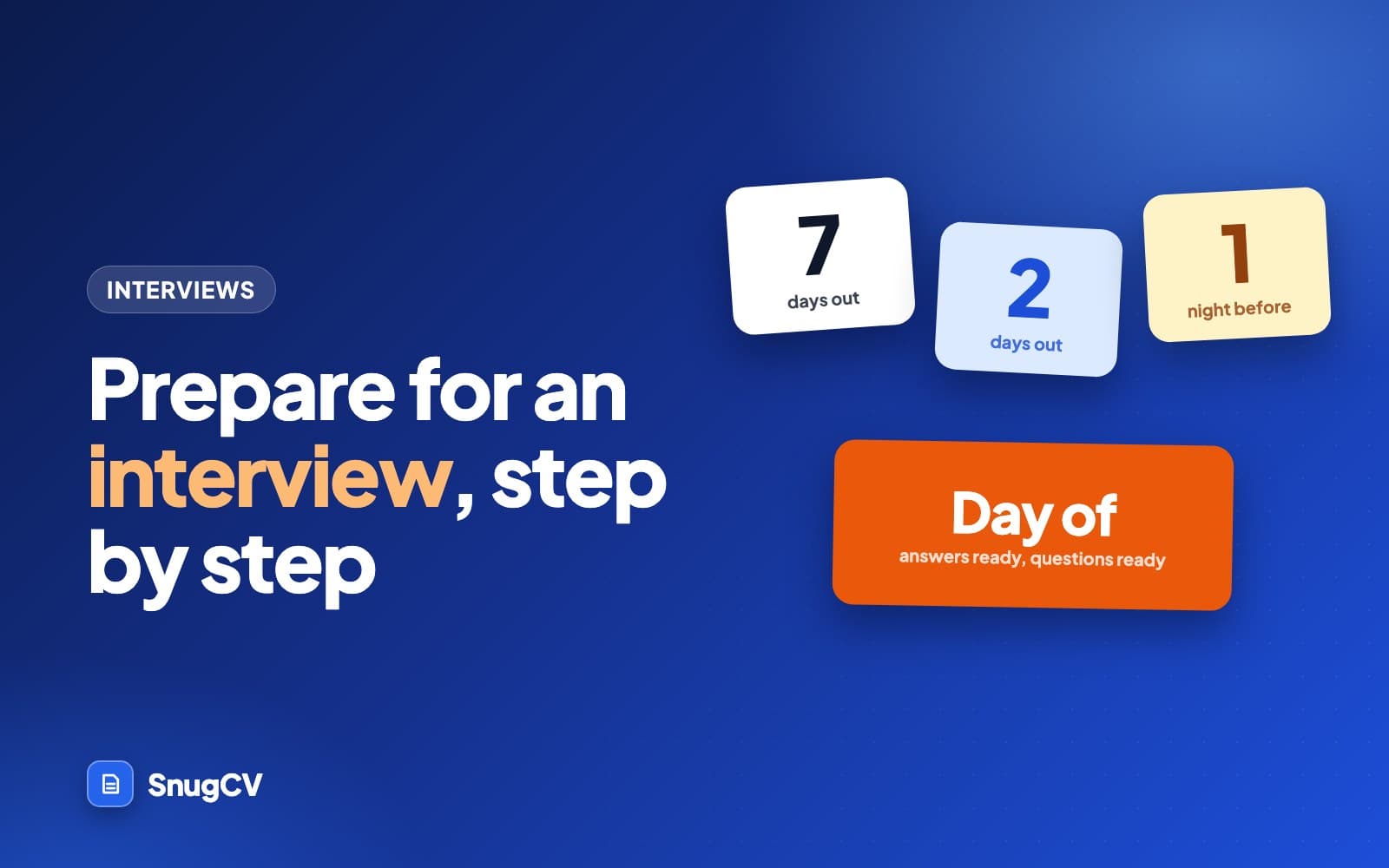
Here is the whole plan on one page. Each step has a section below.
A week out, or as soon as you get the invitation
Confirm the details. Ask who you will meet and what the format is. Read the posting twice and mark what the employer wants most. Start your story bank.
Three or four days out
Research the employer and the people. Build and sharpen six to eight stories. Draft your answers to the core questions.
Two days out
Practice out loud at least twice, once with another person or a recording. Write the questions you will ask. Sort out the route, the tech or the childcare.
The night before
Lay out clothes and documents. Read your one-page summary once and stop. Sleep.
The morning of
Eat, drink water, say your opening answer out loud once, leave early or log on early.
In the room
Listen, answer, ask your questions, close well.
Within a day after
Write up notes, send a thank-you, update your tracker, keep applying.
Find out which interview you have
"Interview" is a loose word. A 20-minute phone call with a recruiter and a half-day working trial in a kitchen are both interviews, and they need different preparation. Find out which one you have before you prepare anything else.
| Format | Who you meet | What it is for | What to prepare |
|---|---|---|---|
| Recruiter or phone screen | A recruiter or HR coordinator, often 15 to 30 minutes | Checking the basics: fit with the role, pay range, availability, whether to pass you on | A 60-second summary, your reason for applying, a pay range, your notice period or start date |
| Hiring manager interview | The person you would report to | The real conversation about the work and whether they want you on their team | Stories matched to the posting, questions about the work |
| Panel interview | Two to five people, often from different teams | The same questions asked with several people listening and comparing notes | Answers aimed at the asker and shared with the room, names written down |
| Group interview | Several candidates and one or two interviewers | Seeing how you behave around others, used in some retail, hospitality and call center hiring | Short answers, listening, including quieter people |
| Skills test, demo or working interview | A manager and the team you would work with | Seeing the work itself: a cooking trial, a typing test, a demo lesson, a ride-along | Ask what the task is, bring what you need, practice it under time |
| Recorded one-way video | Nobody live: you answer on-screen prompts | A first filter when many people have applied | A timer, a quiet room, a camera check |
| Final or senior round | A director, owner or executive | Judgment, motivation and fit at the end of a process | Your reasons for wanting the job, questions about direction, how you would approach the first 90 days |
Ask, and ask in writing, so you have the answer on paper. Recruiters can usually tell you who you will meet and what to bring, and asking is normal. Here is a short note you can adapt.
Template: confirming an interview and asking what to expect
- To
- [Recruiter name]
- Subject
- Interview on Thursday at 10:30: a few quick questions
Hello [Name],
Thank you for the invitation. I am confirming Thursday at 10:30 at your Eastgate site.
So that I can prepare properly, could you tell me:
- who I will be meeting, with their roles
- how long the interview will run, and whether there will be a task or a test
- anything I should bring, such as ID, certificates or samples of my work
- where to park and which entrance to use
Thank you,
[Your name]
If you need an adjustment, such as step-free access, a captioned video call or extra time on a written test, say so when you confirm. Many employers have a standard process for this, and the rules differ by country and region, so check yours. You do not need to explain more than you want to.
Read the posting, then research the employer
Turn the posting into a list of likely questions
A posting is a draft of the interview. Every duty and requirement is a question waiting to be asked, usually in the form "Tell me about a time you..." or "How would you...". Mark them, then write the likely question and your evidence next to each one.
Here is a made-up posting for a logistics job. The highlighted phrases are the ones an interviewer is likely to build questions around.
Job posting (made up for this guide)
Dispatch Coordinator, Harbor Line Freight
Coordinate daily routes for a fleet of local delivery drivers. Re-plan routes when orders, weather or breakdowns change the day. Be the first call for drivers who have a problem on the road. Keep customers informed of delays by phone and email. Enter and reconcile delivery records in our routing software.
Requirements: two years in dispatch, logistics or a similar coordinating role. Calm under pressure. Clear, short communication.
| The posting says | The question you can expect | Evidence you could bring |
|---|---|---|
| Re-plan routes when the day changes | "Tell me about a day when the plan fell apart. What did you do?" | The week a supplier failed and you re-sequenced the shift. Any field has one: a no-show, a double-booked room, stock that did not arrive |
| First call for drivers with problems | "How do you handle someone who is upset or in a hurry on the phone?" | A call where you stayed level and fixed the problem |
| Keep customers informed of delays | "How do you deliver bad news?" | A time you told a customer something unwelcome early, with a plan attached |
| Delivery records in routing software | "Which systems have you used, and how do you keep records accurate?" | The systems you know by name, and the habit you use to check your own entries |
| Two years in a coordinating role | "Walk me through your background." | Your 60-second summary |
| Calm under pressure | "Describe the busiest stretch you have handled." | A peak you can describe: holiday week, flu season, month-end |
Do the same for the gaps. If the posting asks for something you have not done, expect a question about it, and prepare an honest answer: what you have done that is close, and how quickly you learn. Why should we hire you covers how to answer when your experience is thinner than the posting.
Research the employer in 30 minutes
You are looking for three or four specific, true observations you can mention naturally. A good one is specific: "You opened a second site in the spring, and the posting mentions covering both." "I read your website" tells them nothing. Where to look depends on the kind of employer.
| Employer | Where to look | What to find |
|---|---|---|
| Large company | Careers page, press or news page, product pages, a public annual report | What they sell and to whom, recent launches, how they describe their values, where your team fits |
| Small local business | Website or social page, map listing and photos, menu or price list | What regulars like, what the place feels like, busy hours, what the owner is proud of |
| Hospital, clinic or care provider | The services pages, the unit or department page, patient information, recent news | Who they serve, what the unit specializes in, any programs or recognition |
| School or district | School website, newsletters, the district's published plans | Programs, priorities, how they describe their approach to learning |
| Public sector or nonprofit | Mission statement, annual report, program pages | The mission, who the programs serve, how the role supports it |
| Staffing agency | The agency's site and the client's site, if you can learn who the client is | What kinds of placements they make, what the client does, how shifts and assignments work |
If you know who you will meet, look at their role and how long they have held it. It helps you pitch answers at the right level: a peer wants to hear how you work day to day, and a director wants to hear how you think about problems. Use it to understand them, not to flatter them, and do not mention anything personal you found.
Employee reviews can give a sense of a workplace, though they tend to be written by people with strong feelings, good or bad. Look for a theme repeated across several, and raise it only as a question, never as an accusation.
Build a story bank
Most interviews are made of two kinds of question: questions about you ("Tell me about yourself", "What are your strengths?") and questions that start "Tell me about a time". The second kind is where unprepared people struggle, because a good example is hard to find while someone is watching you. A story bank solves that. You write down six to eight real episodes from your work once, then bend them to fit the question.
- 1
Situation
Where and when, in one or two sentences.
- 2
Task
What was yours to do.
- 3
Action
What you did, step by step, using the word I.
- 4
Result
What changed, and what you learned.
Aim for a spread. These eight slots cover most of what interviewers ask.
- A time you solved a problem under pressure
- A time you dealt with a difficult customer, patient, parent or colleague
- A time you made a mistake and what happened next
- A time you learned something quickly
- A time you led or organized other people, with or without the title
- A time you improved a process, saved time or reduced waste
- A time you were proud of the work
- A time you disagreed with someone and handled it
Here are made-up story seeds from six fields. Each is one or two sentences, which is all a seed needs to be.
Problem under pressure
Retail: pressure
Holiday week, two registers down and a queue to the door. I opened the self-checkout lane for small baskets, asked a floor associate to bag, and the line cleared in about twenty minutes.
Mistake and recovery
Healthcare: a mistake
I gave a family the wrong visiting hours. I noticed an hour later, found them, corrected it, and asked the charge nurse to post the hours at the station.
Improved a process
Teaching: improving
Half my third graders stalled on fractions after a unit test. I regrouped them for two weeks, used number lines with one group and counters with another, and re-tested.
Learned quickly
Trades: learning fast
The crew switched bending methods mid-project. I asked the foreman for ten minutes, practiced on scrap at lunch, and was running my own sections the next day.
Difficult person
Hospitality: a hard guest
A guest was furious about a lost reservation. I let him finish, apologized for the specific thing, found a table at the pass and sent dessert. He asked for me by name next visit.
Improved a process
Office: a process
Invoices were arriving in three places. I set up one shared inbox and a weekly checklist, and the late-payment reminders stopped within a month.
Write each story on a card, or on one page, using this template.
Template: story card
Headline: [A few words you will recognize at a glance, for example "Holiday queue"]
Situation: [Where and when, one or two sentences]
My part: [What was mine to do]
What I did: [Two or three steps, using "I"]
Result: [What changed. A number if you have one, otherwise something a person could see]
What I would do again or differently: [One sentence]
Questions it answers: [pressure, conflict, mistake, learning, leading]
Then match the stories to the posting. List your story headlines down the side and the posting's top requirements across the top, and mark where each story fits. Stories that fit three requirements are your workhorses. A requirement with no story is a gap you now know about while there is still time to think.
| Story | Calm under pressure | Working with people | Accuracy | Learning quickly |
|---|---|---|---|---|
| Holiday queue | Yes | Yes | ||
| Wrong visiting hours | Yes | Yes | ||
| New bending method | Yes | Yes | ||
| Shared invoice inbox | Yes | Yes |
The full method for structuring each story, with 25 or more common behavioral questions and worked answers, is in behavioral interview questions and the STAR method.
Prepare for the questions everyone gets
The core questions
A short list of questions turns up, in different words, in nearly every interview. Prepare each one in outline, not as a script.
| Question | What it is checking | How to prepare |
|---|---|---|
| Tell me about yourself | Whether you can summarize your work and its direction in a minute | A present, past and future summary of 60 to 90 seconds. See tell me about yourself |
| Why do you want this job? | Whether you have a real reason or sent a mass application | One specific thing about the employer and one about the work itself |
| Why should we hire you? | Whether you understand what they need | A claim, evidence and a reason for this employer. See why should we hire you |
| What are your strengths? | Self-knowledge, and whether your strengths match the job | Two strengths the posting asks for, each with a one-line example |
| What is your biggest weakness? | Honesty and how you manage yourself | A real, work-related weakness and what you do about it. A disguised strength sounds rehearsed |
| Tell me about a time when... | Evidence of how you behave | Your story bank |
| Why did you leave, or why are you leaving? | Whether you would leave us for the same reason | A short, neutral, forward-looking reason |
| Where do you see yourself in a few years? | Whether your plans fit what the role can offer | An honest direction in this field. It does not have to be a job title |
| What are your pay expectations? | Whether you fit the budget | A researched range, covered below |
| When can you start, and what is your availability? | Practical fit | Your notice period (check your contract) and your shift availability written down |
The awkward ones
Gaps, being let go, short stays and career changes are the questions people dread most, and they are also the ones where a plain answer works best. The pattern is the same each time: say the fact in one sentence, say what you did or learned, then point forward. Do not apologize at length, do not invent a reason, and do not criticize a former employer.
Before
I just took some time off. It was not really anything.
After
I stepped away for about a year to look after my mother after her surgery. While I was away I kept my food handler certificate current and covered weekend shifts at a family bakery. I am ready to work full time again, and this schedule suits me.
States the reason briefly, shows you stayed close to the work, and points forward. Use your own true facts. You do not owe details you want to keep private.
Before
My manager was terrible and the whole place was a mess.
After
The team was restructured and my role moved away from working with customers, which is the part I do best. That is why this position caught my eye.
Same underlying story, no blame. If you were let go, say so plainly in one sentence, then say what you have done since.
Before
I was laid off, but it was not my fault. They cut everyone.
After
My position was eliminated when the warehouse closed in March. Since then I have renewed my forklift certification and done temp work on two sites. I am looking for a permanent team.
A closure or layoff is a fact, not a flaw. Say it once, then show what you did next.
Pay is the other question people avoid. A researched range, and a question back, is a fair answer in most conversations.
Recruiter
What are your salary expectations for this role?
You
I would like to understand the full scope first. From what I have seen for similar roles in this area, I am looking at somewhere between [low] and [high], depending on the details. What range have you set for it?
Recruiter
We are working with [range].
You
That is in line with what I had in mind. I am interested, and I am happy to go through the details closer to an offer.
What an employer may ask about pay history, and whether it has to share a pay range, differs by country, state and sometimes city. Check your local rules before the call. The whole offer stage has its own guide: how to negotiate salary.
Your own questions
Nearly every interview ends with "Do you have any questions for us?" Saying no can read as low interest. Prepare five and ask two to four. Three starting points that work in most fields:
- What does a good first three months look like in this role?
- What does the team find hardest about this work?
- What are the next steps, and when should I expect to hear from you?
Questions to ask the interviewer has more than 40, grouped by purpose, with notes on which to ask whom and what to listen for.
Practice out loud
Reading your notes silently feels like practice and is not, because an answer that makes sense on paper comes out in different words when you speak it. Say your answers out loud, in three rounds.
- 1
Talk it through
Answer each core question into a voice memo. It will be rough. That is fine.
- 2
Listen and trim
Play it back. Cut the filler, the second example and the apology. Time it.
- 3
Add pressure
Answer to a friend who interrupts, asks 'why?' and stays silent a beat too long.
A rule of thumb for length: most answers land between 45 seconds and two minutes, "Tell me about yourself" sits near a minute, and a story takes up to two minutes. If you pass two minutes on a single answer, you have probably lost the room.
Practice also covers things that are not answers. Rehearse the first 30 seconds: walking in, greeting, small talk. Rehearse the pause, the two seconds before an answer that make you look thoughtful instead of rushed. Rehearse the close: your questions, and asking about next steps.
The first answer is rarely the end of the question, so practice the follow-up as well.
Interviewer
Tell me about a time you handled an angry customer.
You
Last December a customer came back with a coffee machine that had stopped working after four days. He was loud, and there was a queue. I took him to the side counter, let him finish, then offered an exchange or a refund and checked which he wanted. He took the exchange and thanked me.
Interviewer
What would you do differently?
You
I would have moved him away from the queue faster. I waited a minute too long, and that minute made it harder for both of us.
Here is a rule of thumb for splitting a three-hour preparation session.
- Posting and employer. Mark requirements, write likely questions, research the employer and the people.
- Stories. Pick and write six to eight stories, match them to the posting.
- Out loud. Core questions and stories, aloud, timed, with a person if you can.
- Questions and logistics. Your questions, route or tech, clothes, documents.
Logistics for in-person, phone and video
Each format fails in its own way, so each has its own checklist.
Where it goes wrong: arrival
In person
- Do a trial run of the route at the same time of day, or check transit and parking the night before
- Aim to arrive 10 to 15 minutes early and wait nearby until about five minutes before
- Be courteous to everyone you meet on the way in
- Bring two copies of your resume, a notebook, a pen and ID if the site needs it
- Phone silent and out of sight
Where it goes wrong: environment
Phone
- A quiet room with good reception and a charged phone
- Resume, posting, stories and questions open in front of you
- Sit upright or stand, since your voice carries it
- Answer with your name: "Hello, this is [Name]"
- Water within reach, notifications off
Where it goes wrong: tech
Video
- Test the link, camera and microphone a day before, on the same device
- Camera at eye level, light in front of you, a plain background
- Close other programs, and have a phone number for the interviewer as a backup
- Look at the camera at key moments, and glance at notes sparingly
- Join a few minutes early and check the time zone
Recorded one-way interviews work differently: nobody is there, so read the instructions on time limits and retakes before you start, treat each prompt as the real question, and look at the camera, not at your own face.
What to wear and bring, by field
These are common conventions, not rules, and workplaces differ. The safest move is to ask the recruiter what people wear day to day, then dress one step smarter than that. Choose clothes you have sat, stood and walked in.
| Field | What people usually wear to interview | What to bring |
|---|---|---|
| Office, finance, administration | Business casual to smart, one step above the daily dress code | Resume copies, a notebook, a list of references if asked |
| Retail and hospitality (front of house) | Clean, neat clothes in the style of the store or venue, and closed shoes you can stand in | Your availability written down, ID, a pen |
| Healthcare (clinical) | Neat, conservative clothes you could wear on a unit, and closed shoes | Resume copies, license and certification details, ID. Ask whether documents are needed |
| Trades and construction | Clean work clothes or neat casual, boots if a site visit is possible | Certificates, license, references, a list of tools you own. Ask whether there is a practical test |
| Warehouse and logistics | Clean, practical clothes and sturdy shoes, in case of a walk-through | Forklift or equipment certificates, ID, your work history with dates |
| Teaching and education | Business casual, with layers in case you tour classrooms | Sample lesson plans, license details, a portfolio on paper or a tablet |
| Customer service (phone or video) | Smart on top for video, with a tidy background | A headset, notes, a backup contact number |
The night before and the morning of
The night before
0 of 5 done
The morning of
0 of 5 done
During the interview
The first two minutes
Greet people by name and smile. Follow the other person's lead on handshakes, since customs vary by person and culture. Small talk is a way of seeing whether you are at ease, so answer honestly and ask one question back. Then settle into the conversation.
Listening and answering
Hear the whole question before you answer. A pause of two or three seconds feels long to you and normal to them. Answer the question that was asked, then stop. If you are not sure you were clear, check in once: "Does that answer what you were asking?"
If a question knocks you off balance, ask for a moment.
Interviewer
Tell me about a time you disagreed with a coworker.
You
That is a good one. Could I take a moment to think of the best example?
Interviewer
Of course.
You
Last spring, a colleague and I disagreed about how to split the weekend rota. I asked for ten minutes at the end of a shift, we each laid out what we needed, and we agreed to alternate Saturdays. It has worked since.
If you do not know something, say so and show the closest thing you do know.
Interviewer
Have you used ShiftWise for scheduling?
You
I have not used ShiftWise. At my last job I built the weekly rota first in a spreadsheet and later in a booking app, so I am used to checking cover, swaps and breaks. I usually pick up new software within a few days. What does training look like for it here?
Panels, groups and working interviews
Several interviewers
Panel
Write down names as they are introduced. Look at whoever asked, then bring the others into your answer. Do not worry if one person says nothing.
Several candidates
Group
Let others finish, give credit by name, and bring quieter people in. What is being watched is how you work with others, so a short, useful answer beats a long one.
Doing the work
Working interview or trial shift
Ask beforehand what you will be doing and what to bring. Follow safety rules, ask when unsure instead of guessing, and ask whether the trial is paid. Rules on unpaid trials vary by country and region, so check yours.
Closing well
The last few minutes are the ones people remember. Ask your questions, then close in four parts.
- 1
Thank you for walking me through how the team handles peak weeks.
Thank them, specifically
A specific thanks shows you were listening. It also gives them something to remember you by.
- 2
From what we discussed, route changes and customer calls are the heart of the job, and they are what I do best.
Restate the fit in one sentence
One sentence. You are handing them the summary they will give their colleagues.
- 3
I would be glad to take this on.
Say you want it, if you do
Interviewers cannot always tell how keen you are. Saying so removes the doubt.
- 4
What are the next steps, and when might I expect to hear?
Ask about next steps
You leave knowing what happens and when, which tells you when to follow up.
After the interview
Within the hour
Write down who you met, the questions you were asked, the answers you want to improve and anything you forgot to say.
That evening or the next morning
Send a short thank-you that mentions one real detail from the conversation. There are templates in the guide to the thank-you email.
By the date they gave you
Wait. Keep applying and keep preparing for any other interviews you have.
A few days after that date, or about a week after the interview if no date was given
Send one polite check-in. A single follow-up is reasonable. A string of them is not.
The notes matter more than people expect. They give you material for the thank-you, for a second-round interview and for the next first-round interview, where you will meet some of the same questions.
Thank-you email after an interview has more than ten templates for different situations. A check-in can be shorter still.
Template: a short check-in
- To
- [Interviewer name]
- Subject
- Following up on the dispatch coordinator interview
Hello [Name],
I am writing to check in on the dispatch coordinator role. You mentioned that you hoped to decide by the 20th, and I wanted to say that I am still very interested and can answer any further questions.
Thank you,
[Your name]
If you are not chosen, you can reply once to thank them and ask whether they have any feedback that would help you. Some will answer and many will not, and either way you have left a good impression for the next opening.
Common mistakes and a last-minute checklist
Do
- Read the whole posting and prepare for every duty it names
- Use true stories with real details: a place, a person, a number if you have one
- Practice out loud and trim your answers
- Find out the format and who you will meet
- Prepare two to four questions of your own
- Say you do not know, and say how you would find out
- Write up notes within the hour
Avoid
- Memorize scripts word for word
- Research only the home page
- Speak badly of a former employer or colleague
- Say we for everything, so they cannot tell what you did
- Give a three-minute answer to every question
- Say you have no questions
- Overstate a skill or tool you have barely used
- Check your phone in the lobby or on the video call
Last-minute checklist
0 of 8 done
Where SnugCV fits
Tailoring your resume to the posting is the first piece of interview preparation, because the interview follows the posting. SnugCV lists the keywords your profile supports and the gaps it does not, which doubles as a list of what to prepare stories for and which questions to expect. Employers, titles, dates and education are copied unchanged, so the resume you sent matches what you will say in the room.
The free job tracker keeps the posting as it was captured, with notes for interview dates, names and the questions you want to ask, so everything for one interview sits on one page.
Keep going
The big questions each have their own guide: tell me about yourself, why should we hire you and behavioral interview questions and the STAR method. When you reach the end of the interview, questions to ask the interviewer gives you a list to choose from, and the thank-you email covers what to send afterwards. If you reach the offer stage, how to negotiate salary has scripts for it.
Questions people ask
How long should I spend preparing for an interview?
A common rule of thumb is two to four hours for a first interview and more for a final round: about an hour on the posting and the employer, an hour on stories, an hour practicing out loud and the rest on logistics. Spread it over a few days if you can, because answers improve after a night's sleep.
What if my interview is tomorrow?
Do four things in this order: mark the five requirements the posting stresses, choose three true stories that show them, say your answers to 'Tell me about yourself' and 'Why this job' out loud twice, and write two questions to ask. Then sort out your route or tech and go to bed. That covers the questions that come up in most interviews.
Should I memorize my answers?
Memorize the shape of each answer, meaning the point, the example and the result, rather than the sentences. A recited answer sounds flat and falls apart when the interviewer interrupts or asks a follow-up. Saying an answer out loud several times, in slightly different words each time, makes you fluent without sounding rehearsed.
How early should I arrive?
A common rule of thumb is 10 to 15 minutes early for an in-person interview and a few minutes early for a video call. Reach the area sooner than that and wait nearby, so a late train does not become a late arrival. If something goes wrong, call as soon as you know and give a realistic new time.
Is it okay to bring notes?
Yes. A notebook with your questions and a few bullet points is normal in most interviews and shows you took the meeting seriously. Do not read your answers from it. On a phone or video interview you can keep notes in front of you, off camera. If you are unsure, it takes five seconds to ask whether the interviewer minds.
What should I do if I do not know the answer to a question?
Say so plainly, then say what you do know that is close and how you would find out the rest. 'I have not used that system, but I have run the same process in another one, and I pick up new software quickly' is a complete answer. Guessing with confidence is what costs people the job.
Was this guide helpful?
Get the free resume checklist and new guides
Twenty checks to run before you send a resume, as a one-page PDF. After that, a short email when new guides go up, at most once a week.