Key takeaways
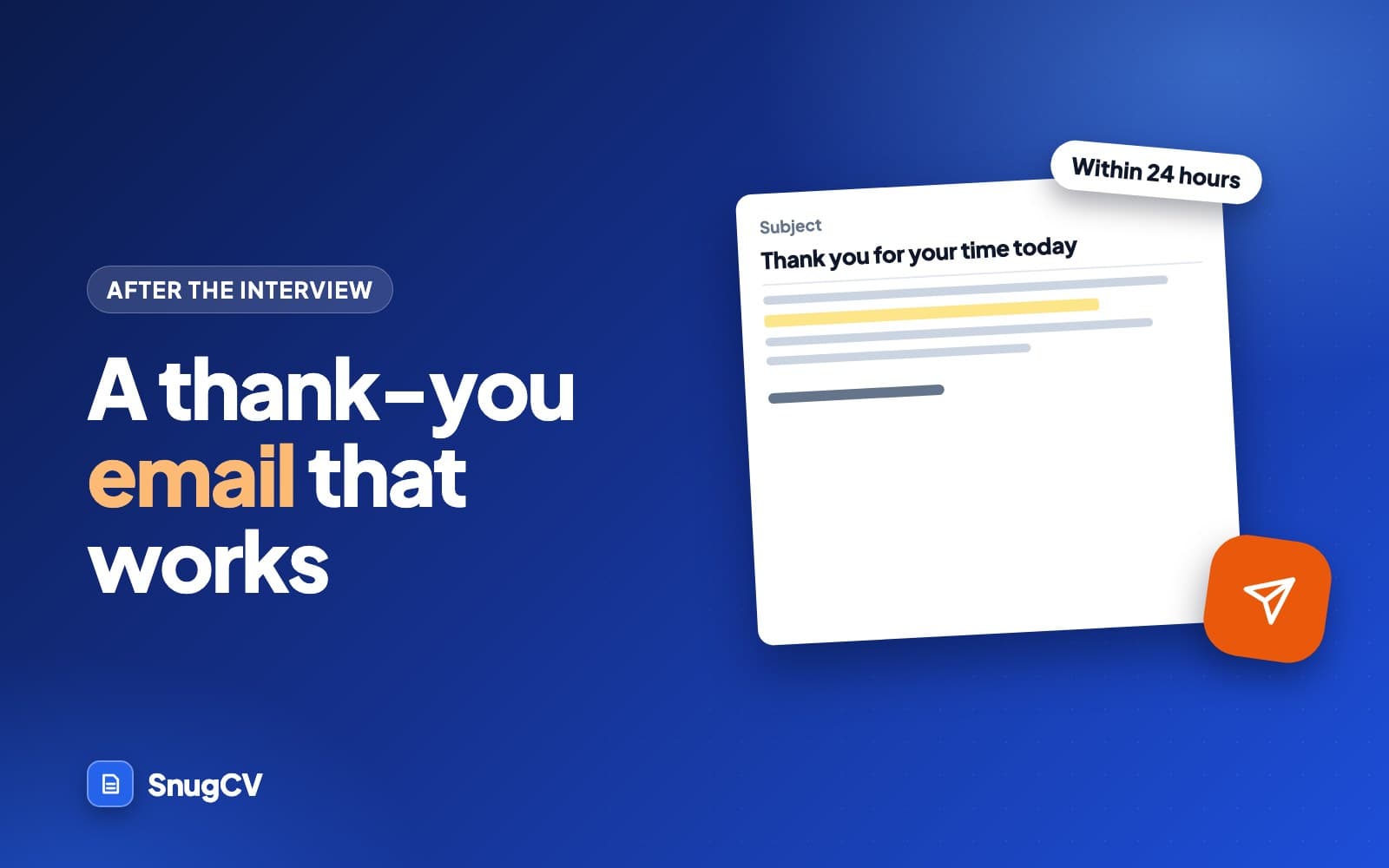
- Send it within a day, usually that evening or the next morning, and sooner if the interviewer said they decide quickly.
- Keep it to a few short paragraphs: thanks, one specific detail, one line about your fit and a clear close.
- Write to each interviewer separately and mention something that person said, not a line you could send to anyone.
- A thank-you email will not rescue a poor interview. Use it for one useful point and a courteous close.
In this guide
- Should you send one?
- When to send it
- Get names and addresses before you leave
- What a good thank-you email looks like
- Subject lines
- Make it specific
- Templates you can copy
- Email or a handwritten note?
- Several interviewers
- What to avoid
- How long it should be
- After the thank-you: following up
- Before you send
- Where SnugCV fits
- Keep going
An interview ends, you walk out, and a small question follows you home: should I write to them? The answer is yes, usually, and the email takes about ten minutes. It will not turn a poor interview into a good one. It does keep your name in front of the person making the decision, and it gives you a chance to add one useful point you did not get to say.
This guide covers when to send it, what goes in it, how to write the subject line, and 16 templates you can copy and adapt, from a recruiter phone screen to a final round to a note after you have been turned down. If you are still getting ready for the interview itself, how to prepare for an interview is the place to start, and tell me about yourself helps you with the first question you will be asked.
Should you send one?
Usually, yes. It is a courtesy, it shows how you write, and it reminds the interviewer which candidate you were among several. It is also a chance to add a detail that did not fit the conversation.
What a thank-you email can do
- Thank the people who gave you their time
- Remind them who you are, with one specific detail
- Add one fact or example you did not get to say
- Confirm you are still interested and clarify any next steps
What it cannot do
- Rescue an interview that went badly
- Change a decision that has already been made
- Guarantee that anyone reads it
- Replace a good answer you did not give
Customs differ by country, industry and employer. In some places a thank-you email is routine, in others it is rare. Where you are unsure, a short, polite note is a safe default, and the employer's own style of writing is a good guide to how formal to be.
When to send it
Within about a day is the usual advice. The reason is practical: the interviewer is still thinking about the candidates they have seen, and some hiring decisions move quickly. Send your note while you are still fresh in their mind and before the decision is made.
| Situation | Send by | Why |
|---|---|---|
| Morning or afternoon interview | That evening or the next morning | They are still comparing candidates |
| Late-day interview | First thing the next morning | The note is waiting when they open their inbox |
| Friday interview | Friday afternoon or Monday morning | Either works, and a Friday afternoon note is ready for the start of their week |
| Phone screen with a recruiter | Same day or next morning | They may be moving candidates forward within a day or two |
| The interviewer said they decide today or tomorrow | Within two hours | The window is short |
| A day of several interviews | That evening, one email per person | Each person meets several candidates |
| You forgot, and it has been a week | Now, and keep it short | A late note beats no note |
These are rules of thumb. If the interviewer told you something specific about their timeline, follow that.
A ten-minute routine
- 1
Make notes
Right after the interview, write names, topics and anything you promised.
- 2
Get addresses
From the interviewer, the coordinator or the invitation.
- 3
Pick the detail
One specific thing you discussed, plus one line connecting it to you.
- 4
Draft
Use a template below and delete anything that sounds generic.
- 5
Check
Names, titles, company, role and dates. Read it aloud once.
- 6
Send and log
Send it, and note the date and who got it.
Get names and addresses before you leave
The easiest time to ask for an email address is at the end of the interview. A simple line works: "What is the best way to follow up with you?" If you are meeting several people, ask for a business card or ask the coordinator who is there for names and emails.
If you did not ask, check the interview invitation, the signature on earlier messages or the email from whoever scheduled the meeting. Do not guess an address from a pattern, because a wrong guess can land with a stranger. If you only have the recruiter's address, write to the recruiter, thank them and ask them to pass your thanks on to the interviewers.
Check the spelling of every name and the title of every person. A misspelled name is an easy error to avoid, and in a short email it stands out.
What a good thank-you email looks like
The structure is simple and the same for almost every situation. Here is one in a made-up scenario, a front desk coordinator interview at a physical therapy clinic, broken into its parts.
- 1
Thank you, Front Desk Coordinator interview
Subject line
Names the role so the email is easy to find and file. It does not need a clever angle.
- 2
Hi Ms. Okafor,
Greeting
Match the way the interviewer addressed you. If they used first names, use hers. If you are not sure, a title and surname is safe.
- 3
Thank you for meeting with me yesterday about the front desk coordinator position.
Thanks, with the role
One sentence. It names the role in case the person is hiring for several.
- 4
I enjoyed hearing how the clinic handles same-day cancellations, and the way you described filling those slots from a waitlist stayed with me.
One specific detail
This is the sentence that proves the email was written for this person, and it gives them a reason to remember the conversation.
- 5
At my current clinic I built and maintained our waitlist, so that part of the job sounded like work I would be glad to take on.
One line of fit
A single line that ties your experience to what they said. It adds a fact, and it does not repeat your resume.
- 6
I'm happy to answer any further questions. I look forward to hearing about next steps.
Close
Calm and clear. It leaves the next move with them, without pushing for an answer.
- 7
Thank you again, Jamie Rivera, 555-0142
Sign-off
Your name and a phone number. A signature saves them a search if they want to call.
Subject lines
A good subject line is plain and easy to file. It should say who you are, or at least what it is about, without needing to be opened first.
| Situation | Subject line |
|---|---|
| First interview | Thank you, [job title] interview |
| After a specific day | Thank you for meeting on [day] |
| Panel | Thank you, [job title] interview with the [team name] team |
| Phone screen | Thank you for the call, [job title] |
| Adding a point | One more thought on [topic], [job title] interview |
| After the date has passed | Following up on the [job title] position |
| Closing the loop | Thank you, [job title] |
Leave these out of the subject line
- URGENT
- A fake Re: that makes it look like a reply
- Exclamation marks
- Emoji
- Puns and slogans
- Thanks!!! with nothing else
Make it specific
The detail is what makes a note feel written for one person. It can be small, as long as the interviewer could not have received the same sentence from any other candidate. Good raw material comes from the interview itself: a problem the team mentioned, a change they are making, a tool or a customer type, a question that made you think. The hook you planted in your answer to tell me about yourself and the stories you told for behavioral questions are good places to look for a thread to pick up again.
Before
I enjoyed learning about the company and am very interested in the opportunity.
After
I liked hearing that the store is moving to keeping customer notes for regulars this spring. I've kept a notebook of regulars at my current store for two years, and I would be glad to help set that up.
Retail. The detail shows you listened, and the second sentence is a true link to your own work.
Before
Thank you for the tour of the facility.
After
Seeing the new intake area helped me picture how patients move through the clinic. I did intake at my current office for three years, and I'd be glad to talk more about how I kept the waiting room moving.
Healthcare. It names what you saw and what you can add.
Before
I am confident I would be a great fit for the role.
After
After walking the dock yesterday, I'm confident I could step into the evening receiving team. I've worked with the same handheld scanner system at my current site.
Warehouse. A fact replaces the claim of confidence.
Before
Thank you for asking about my teaching style.
After
I kept thinking about your question on supporting students who are behind in reading. One thing I would add is the weekly small group I run during the morning block, which gives me a regular check on who needs more help.
Teaching. It continues a conversation instead of closing it.
Before
I have strong attention to detail and would love to contribute.
After
You mentioned that month-end reconciliations are the main bottleneck. In my last role I wrote the checklist our team used to close faster, and I'd be glad to share how I put it together.
Office and finance. It speaks to the problem they named.
Templates you can copy
Each template is short on purpose. Replace the brackets with true details from your own interview and delete any sentence that does not apply. Use the one that matches your situation, and do not send any of them unchanged.
After a first interview with a hiring manager
Template: first interview
- To
- [Interviewer's email address]
- Subject
- Thank you, [job title] interview
Hi [Name],
Thank you for taking the time to talk with me [today / yesterday] about the [job title] role. I enjoyed hearing about [one specific thing: a project, a challenge, how the team works].
Our conversation about [topic] made me more interested in the position. [One sentence connecting your experience: At my current job I handle X, which sounds close to what you described.]
I'm happy to send [a work sample, references or anything else that would help]. I look forward to hearing about next steps.
Thank you again,
[Your name]
[Phone number]
After a phone screen with a recruiter
Template: recruiter phone screen
- To
- [Recruiter's email address]
- Subject
- Thank you for the call, [job title]
Hi [Name],
Thanks for speaking with me [today] about the [job title] role at [company]. It was helpful to hear how the team is set up and what the hiring process looks like.
I'm interested and think my [relevant experience, such as six years in scheduling] fits what you described. I'm available for the next conversation on [days or times]. [Anything you agreed to send, such as: I have attached my updated resume.]
Thanks again,
[Your name]
[Phone number]
A phone screen is a conversation with a person who may be moving through a list of candidates. A short, clear note helps them pass you on to the next step.
After a panel interview
If you have each person's address, write to each one. A note to the individual lets you mention something that person raised.
Template: individual note after a panel
- To
- [Interviewer's email address]
- Subject
- Thank you, [job title] interview
Hi [Name],
Thank you for your time [yesterday]. Your question about [specific thing] made me think, and I'd add one point: [one or two sentences with a true detail from your experience].
I also enjoyed hearing how you [something they said about their work or the team]. I look forward to hearing from the team.
Best,
[Your name]
[Phone number]
If you only have one address, or the panel was large, one group email is fine.
Template: one group email after a panel
- To
- [Name], [Name], [Name]
- Subject
- Thank you, [job title] panel interview
Hello [Name], [Name] and [Name],
Thank you all for meeting with me [today]. It was useful to hear the team's different views on [topic].
[Name], your question about [topic] stayed with me, and [one added thought]. [Name], I appreciated hearing about [topic]. [Name], thank you for explaining [topic].
The conversation made me more confident that this role is a good fit for [what you offer]. I look forward to hearing about next steps.
Best regards,
[Your name]
[Phone number]
After a video interview
Template: video interview
- To
- [Interviewer's email address]
- Subject
- Thank you for the video interview, [job title]
Hi [Name],
Thank you for meeting with me by video [today]. I appreciated [one specific thing about the conversation], and it gave me a clearer picture of how the role works day to day.
[If something went wrong technically: Thank you for your patience when my connection dropped. I'm glad we were able to finish the conversation.]
I'm very interested in the position, and I'm happy to share anything else that would be helpful.
Best,
[Your name]
[Phone number]
After a group interview or hiring event
For retail, hospitality and high-volume hiring, the person who ran the session may have met dozens of people. Name the day, the place and the activity so they can place you.
Template: group interview or hiring event
- To
- [Organizer's email address]
- Subject
- Thank you, [company] hiring event on [day]
Hi [Name],
Thank you for running the group interview at [location] on [day]. I enjoyed [the activity, such as the team exercise or the role play] and meeting the other candidates.
I'm very interested in the [position] at [location]. I'm available to start [date] and can work [shifts or hours].
Thanks again for your time,
[Your name]
[Phone number]
After a second or final round
By the final round, the interviewer has your resume and has heard your stories. The note can be warmer and a little more direct about your interest.
Template: second or final round
- To
- [Interviewer's email address]
- Subject
- Thank you, [job title] final interview
Hi [Name],
Thank you for the time you and [Name] spent with me [today], and for introducing me to [team members]. Meeting [names] helped me picture how the work fits together, especially [specific topic].
After today's conversation, I'm even more interested in the role. [One line on something concrete you would be glad to take on in the first months, if you have a true example.]
If there is anything else you need from me, I'm happy to provide it. Thank you again.
Best,
[Your name]
[Phone number]
After a site visit or skills test
Trades, kitchens, workshops and warehouses often include a walk-through or a hands-on test. Mention the part you saw or did.
Template: site visit or skills test
- To
- [Interviewer's email address]
- Subject
- Thank you for the site visit, [job title]
Hi [Name],
Thank you for having me on site [day] and for walking me through [the shop, the kitchen, the job site]. It was useful to see [the equipment, layout or process], and I appreciated the chance to [do the test or demonstration].
[One thing you learned or noticed, and one line on how you would apply your experience.] I'm keen on the position and happy to answer any questions about [the test or your experience].
Thanks again,
[Your name]
[Phone number]
When you forgot something
Template: adding a point you forgot
- To
- [Interviewer's email address]
- Subject
- One more thought on [topic], [job title] interview
Hi [Name],
Thank you again for the conversation [yesterday]. After we spoke, I realized I did not mention [a relevant thing, such as that I have also handled X].
[One or two sentences with the true detail.] I wanted to share it because it connects to what you said about [topic].
Thank you for considering my application.
Best,
[Your name]
When you need to correct an answer
Template: clarifying an earlier answer
- To
- [Interviewer's email address]
- Subject
- A quick clarification, [job title] interview
Hi [Name],
Thank you for the conversation [yesterday]. I wanted to clarify one answer. When you asked about [topic], I said [what you said]. To be more accurate, [the correct fact].
I wanted to make sure you had the right picture. Thank you again for your time.
Best,
[Your name]
Keep a correction to the facts. A long apology draws more attention than a small slip deserves.
To the person who arranged the interview
The person who scheduled your interview did real work on your behalf, and a short note acknowledges it.
Template: thanking the recruiter or coordinator
- To
- [Coordinator's email address]
- Subject
- Thank you for arranging my interview
Hi [Name],
Thank you for arranging my interview on [day] and for the clear instructions about [parking, the building or the video link]. I enjoyed meeting [Name] and [Name].
Please pass on my thanks to the team. I'd welcome any update on next steps when you have one.
Best,
[Your name]
[Phone number]
When the date they gave has passed
This one is a follow-up, and it comes after you have already sent a thank-you. The section on cadence below says when to use it.
Template: following up after the decision date
- To
- [Interviewer's email address]
- Subject
- Following up on the [job title] position
Hi [Name],
I hope your week is going well. I'm following up on the [job title] role we discussed on [date]. You mentioned a decision by [date], so I wanted to check on the timeline.
I remain very interested in the position and happy to provide anything else that would help. Thank you for your time.
Best,
[Your name]
[Phone number]
When you have another offer with a deadline
Use this only if it is true. It gives the employer a reason to update you, and it should not be used as pressure.
Template: another offer with a deadline
- To
- [Interviewer's email address]
- Subject
- [Job title] position, timing
Hi [Name],
Thank you again for the interview on [date]. I'm writing because I have received an offer from another company, and I need to respond by [date].
The [job title] role is one I am genuinely interested in, and I wanted to let you know in case it affects your timeline. Is there an update you can share, or anything I can provide?
Thank you for your consideration.
Best,
[Your name]
[Phone number]
After a rejection
A rejection can be the start of a longer relationship. Companies hire again, and interviewers move between employers.
Template: after a rejection
- To
- [Interviewer's email address]
- Subject
- Thank you, [job title]
Hi [Name],
Thank you for letting me know, and for the time you spent with me during the process. I enjoyed learning about [topic] and meeting [Name or the team].
If another role opens that fits my background in [your field or skill], I would be glad to be considered. I wish you and the team well with [project or goal].
Best,
[Your name]
When you decide the job is not right
Withdrawing early is kinder to everyone than disappearing, and it keeps the door open.
Template: withdrawing politely
- To
- [Interviewer's email address]
- Subject
- Withdrawing my application, [job title]
Hi [Name],
Thank you for the time you and the team have spent with me. After careful thought, I have decided to withdraw from consideration for the [job title] role, because [a short, honest reason, or: the role is not the right fit for me right now].
I appreciated [something specific about the conversation or the team]. I wish you well and would be glad to stay in touch.
Best regards,
[Your name]
A handwritten note
For a small employer, a school, a nonprofit or a trade where cards are common, a short handwritten note after your email can leave a good impression. It should be brief enough to fit on a card and legible.
Template: handwritten card
Dear [Name],
Thank you for meeting with me on [day]. I enjoyed hearing about [specific topic] and meeting [Name or the team]. I'm very interested in the [job title] role and would be glad to hear about next steps.
With thanks,
[Your name]
Email or a handwritten note?
The default
Arrives within hours, which matters when a decision is days away. Easy to forward to the rest of the hiring team. Works for every situation and every kind of employer.
An extra
Handwritten card
Memorable, and a good fit for small organizations and for roles where personal contact is part of the job. It is slow, so it may arrive after a decision. Send the email first, then the card.
Several interviewers
A thank-you after a panel or a day of interviews is easiest when you have made notes about who said what.
Best when you can
Separate emails
One short note per person, each with a detail only that person raised. Keep the messages similar in length, so nobody is left out.
When you have to
One group email
Fine for a large panel or when you only have a shared address. Name each person once and mention one point for each of them.
Common
Only one address
Write to your main contact, thank them, and ask them to pass on your thanks. Name the interviewers so they know who to pass it to.
What to avoid
Do
- Send each person their own message, with their own detail
- Check the spelling of names, titles, the company and the role
- Keep it short enough to read on a phone
- Use plain text and a simple signature with a phone number
- Say thank you clearly, then add one useful point
Avoid
- Copying one identical email to everyone you met
- Asking about salary, benefits or vacation before there is an offer
- Repeating your resume or pasting a second cover letter
- Attaching documents nobody asked for
- Using emoji, slang or exclamation marks in every line
- Pushing for an answer or sending a follow-up every day
Salary questions come later, once you have an offer. How to negotiate salary covers that stage.
How long it should be
Under 150
Words, as a rule of thumb
3 to 4
Short paragraphs at most
1
Specific detail from the conversation
Write it so a person can read it on a phone in under a minute. If you cannot fit the point into that, it probably belongs in a separate conversation. Plain text is enough, and so is a short signature with your name and phone number. Leave the resume out unless the interviewer asked for it, because they already have it.
After the thank-you: following up
The thank-you is the first message. If the decision date passes without a word, a follow-up is reasonable, and the timeline below is a rule of thumb. If the employer told you something different, follow that.
Within a day
Send the thank-you email.
Until the date they gave
Wait. If you have no date, a week or so is a fair first window.
One or two business days after
Send one short follow-up, using the template above.
About a week later
If you still have no answer, one more brief check is acceptable.
After that
Keep applying. Silence is common, and some employers come back late.
The best way to avoid guessing is to ask during the interview what the timeline is. Questions to ask the interviewer includes questions about next steps, and an answer like we will decide by the end of next week tells you exactly when a follow-up is fair.
Before you send
A last look
0 of 7 done
Where SnugCV fits
The thank-you is easier to write if the details are in one place. The SnugCV job tracker is free, and each job has a status, a history and a notes field. Set the status to Interviewing, then add the interviewers' names, the date and what you discussed. When you sit down to write, the facts are there, along with the posting and the resume you sent. A free job application tracker shows how it works.
Keep going
A thank-you email is one of several letters in a job search. How to write a tailored cover letter covers the one you send before the interview, and how to negotiate salary covers what comes after an offer. If you are preparing for the next interview, behavioral interview questions and the STAR method helps you build a set of stories you can rely on.
Questions people ask
Do I need to send a thank-you email after an interview?
You do not have to, and it is a small courtesy that costs about ten minutes. It lets you thank the interviewer, remind them who you are and add one useful point. It will not change a decision that has already been made, and some interviewers never read it. Where norms are unclear, a short, polite note is a safe default.
How soon should I send it?
Within about 24 hours is the usual guidance: the same evening or the next morning. If the interviewer said they would decide that day or the next, send it within a couple of hours. After a Friday interview, Friday afternoon or first thing Monday both work. A late note is still better than none.
How long should a thank-you email be?
Short. A rule of thumb is under 150 words, in three or four brief paragraphs that can be read on a phone. One specific detail from the conversation and one sentence connecting it to your experience will do more than a paragraph of general enthusiasm. Anything longer risks reading as a second cover letter.
What if I do not have the interviewer's email address?
Ask at the end of the interview, or ask the person who scheduled it. Check the invitation or the signature of earlier messages. If you only have the recruiter's address, write to the recruiter and ask them to pass on your thanks. Avoid guessing an address, because a wrong guess can reach a stranger.
Should I send a thank-you after a phone screen or group interview?
Yes, a short one works well for a phone screen with a recruiter, and for a group interview or hiring event you can write to the person who ran it. Keep the message proportionate: a few lines that confirm your interest and any next steps you agreed on, not a full letter.
Is a handwritten note better than an email?
It can be memorable, but it is slow, and a decision may be made before the card arrives. Email is the safer first choice. If you want to send a card, send the email first and the card afterward, particularly where the employer is a small business and handwritten notes are common.
What if I made a mistake in the interview?
If you gave a wrong fact or missed something important, a brief and calm correction in the thank-you is fine. State what you want to clarify in one or two sentences and move on. Do not apologize at length for how you came across, because that draws more attention than the slip deserves.
Was this guide helpful?
Get the free resume checklist and new guides
Twenty checks to run before you send a resume, as a one-page PDF. After that, a short email when new guides go up, at most once a week.