Key takeaways
- Your questions are part of the interview. They give you what you need to decide, and they show the interviewer how you think about the work.
- Prepare eight to ten, ask two to four, and choose them from what you still need to know after the conversation, not from the top of a list.
- Match the question to the person. Recruiters know process, hiring managers know the work, and teammates know what a normal week feels like.
- Skip anything the website already answers, and raise pay and time off at the right moment, in the right words.
In this guide
- Why they ask, and how many to ask
- Questions about the role and the day-to-day work
- Questions about success, expectations and growth
- Questions about the team and your manager
- Questions about culture and how work really happens
- Questions about the process and closing questions
- Which questions to ask which interviewer
- Question sets by field
- Questions to skip, and what to ask instead
- Reading the answers
- Choosing your questions and asking them well
- Where SnugCV fits
- Keep going
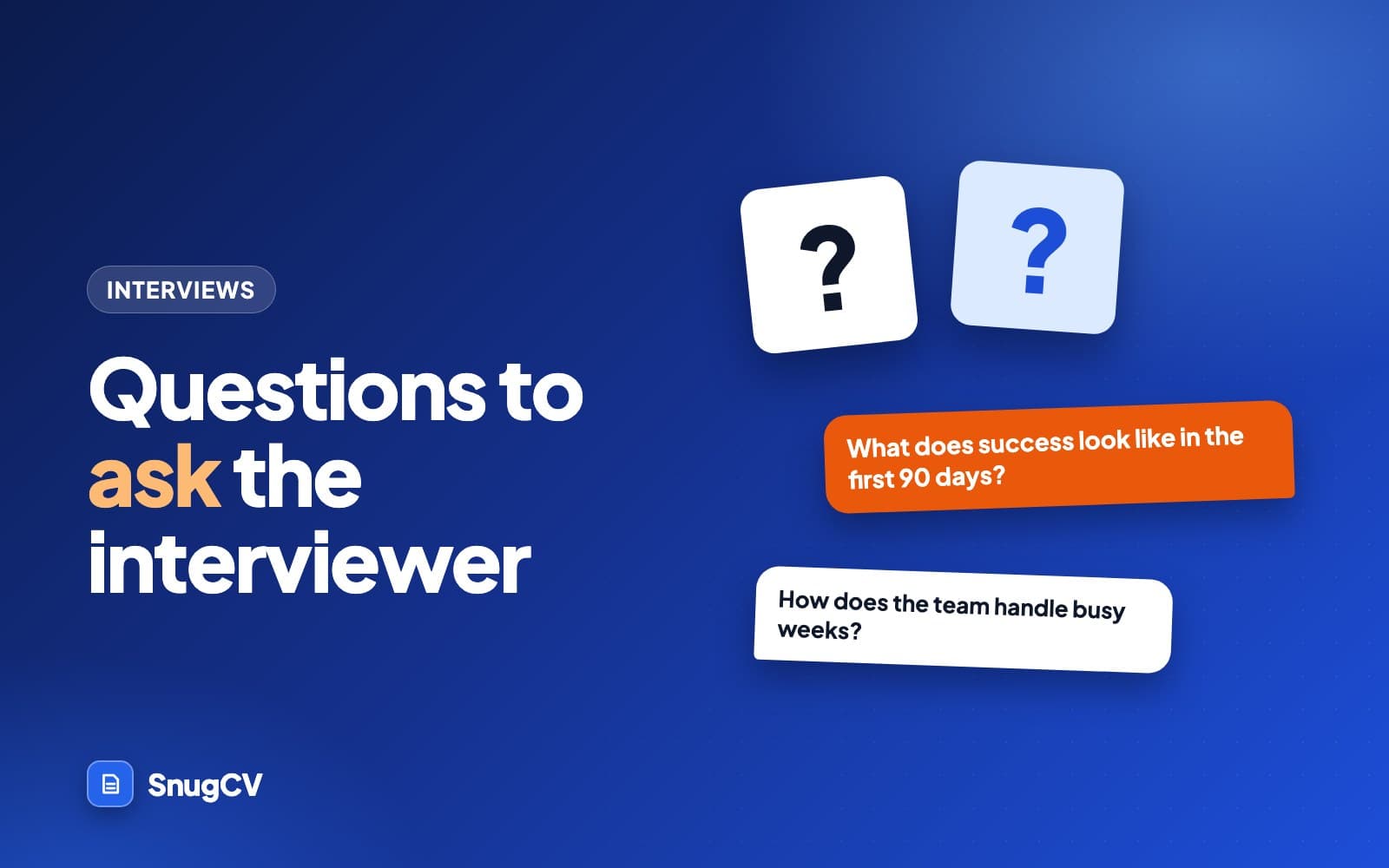
Near the end of nearly every interview, someone says, "Do you have any questions for us?" The interviewer is watching what you do with the chance. It is the one part of the interview you control completely, and it shows how you think about the work.
It is also your best chance to find out what you would be signing up for. Postings are written to attract people. The real job lives in the things a posting does not cover: who covers when someone is out, how success is judged, what the schedule looks like in practice.
This guide gives you more than 40 questions grouped by purpose, a note on what to listen for in the answers, which to ask which interviewer, sets for particular fields and a list to skip. Choose a few rather than reading them all out. If you are still building the rest of your preparation, start with how to prepare for an interview.
Why they ask, and how many to ask
The question does two jobs at once, one for each side of the table.
From your side
What the interviewer learns
Whether you prepared, what you care about, how you think about the work, and whether you listened to the last 40 minutes. A question that builds on something they said lands better than a generic one.
From their side
What you learn
Whether the job is the one in the posting, how the team works, what is hard about it and whether you want it. You are choosing too, and an offer is only useful if you would accept it.
A workable rule of thumb is to prepare eight to ten questions and ask two to four. Some will be answered before you get to them, and some will stop mattering. In a 30-minute phone screen you may have time for one or two. In a final round with a hiring manager you may have a quarter of an hour.
- Warm-up. Introductions, small talk, a short description of the role.
- Questions for you. Your background, stories, motivation, practical details.
- Questions from you. The part this guide is about. Some interviewers invite them throughout.
- Closing. Next steps, timelines, anything either side wants to add.
Never ask something the posting or the website answers. If you ask what the company does, you have shown the interviewer you did not look. Instead, refer to what you found: "I saw you opened a second site this spring. How is that changing the work for this team?"
Questions about the role and the day-to-day work
These are the questions most likely to change your decision, because they describe the job you would actually do. Ask at least one. A hiring manager or a teammate is best placed to answer.
| Question | What to listen for |
|---|---|
| What does a typical day or week look like in this role? | Specific tasks, tools and times. A vague answer ("a bit of everything") can mean the role is not well defined. |
| What would I spend most of my time on in the first month? | Whether there is a plan for new starters or whether you will be left to find your own way. |
| Which parts of this job take people longest to get good at? | A candid answer about difficulty, and whether there is training or a person who helps. |
| How much of the work is routine, and how much changes from day to day? | Fit with how you like to work. Neither answer is wrong. |
| Why is this position open? | A new role usually means growth and some uncertainty about what the work is. A replacement is worth a follow-up: how long did the last person stay, and where did they go? |
| What tools or systems will I use every day? | Whether they are current and whether training is offered. Listen for names, not "the usual stuff". |
| How is work assigned and prioritized when several things arrive at once? | Who decides, and whether there is a system or just whoever shouts loudest. |
| What does the busiest time of the week or year look like here? | Overtime, extra shifts and how the team copes. |
| How much of the role is independent, and how much is working with others? | The shape of your week, and how much support you would have. |
You
What does a typical week look like for someone in this role?
Hiring manager
Mondays are mostly planning, then it is heads down on the schedule until Thursday, and Fridays are for catching up with clients.
You
How much of the planning is yours to decide, and how much comes from above?
Hiring manager
Most of it is yours. We set the targets, and you sequence the work.
Questions about success, expectations and growth
If you do not know what good looks like, you cannot do the job well, and you cannot tell whether it suits you. These questions get at how the employer thinks about performance, and what happens to people who do well.
| Question | What to listen for |
|---|---|
| What would success look like in this role after three months, and after a year? | Concrete outcomes. If nobody can say, expectations may change under you. |
| How is performance measured, and how often is it reviewed? | Clear measures and a rhythm of feedback, rather than "we will see". |
| What would you most like the person in this role to accomplish first? | The employer's real priority, which may differ from the posting. |
| What does the strongest person on the team do that others do not? | What the manager actually values. Listen for behaviors, not adjectives. |
| What are the biggest challenges the team faces right now? | Honesty. A manager who names a real challenge is easier to work with than one who has none. |
| How do people usually learn new systems or procedures here? | Whether there is onboarding, a buddy or a manual. |
| How have people in this role grown or moved on? | Real examples of progression, such as a lead role, a specialization or a transfer. |
| Does the team support certifications, courses or licenses? | Whether development is paid for, scheduled and encouraged, or left to you. |
| How and how often do you give feedback? | A regular rhythm beats a yearly review. |
Questions about the team and your manager
You work with people before you work for a company. If you meet your future manager or teammates in the process, use that time.
| Question | Best asked of | What to listen for |
|---|---|---|
| How is the team structured, and who would I work with most? | Hiring manager | Names, roles and how work passes between people. |
| How would you describe your management style? | Hiring manager | A concrete description: how often you meet, how much freedom you get, how problems are raised. |
| How does the team handle it when something goes wrong? | Anyone | Whether the answer is about fixing the problem or finding someone to blame. |
| How long has the team been together, and what has changed recently? | Hiring manager or peer | Stability. A very new team can be a good place to work, and it also means the processes may still be forming. |
| How do you handle disagreement about priorities? | Hiring manager | Whether there is a way to raise concerns and have them heard. |
| What do you enjoy most about working with this team? | Peer | Warmth, and whether the answer comes easily. |
| How do new people usually get help in the first weeks? | Peer or hiring manager | A named person or a process, instead of "just ask anyone". |
| Who would be my main contact in the first month? | Recruiter or hiring manager | Someone specific, which shows onboarding is planned. |
If you ask a teammate how long they have been there and what has kept them, you will often learn more from the pause than from the answer. Do not press. A candid peer will say what they like and, often, what they would change.
Questions about culture and how work really happens
Culture is a vague word that hides concrete things: how schedules are set, what happens when someone is sick, how decisions are communicated, whether overtime is expected. Ask about behavior and you get answers you can use.
| Question | What to listen for |
|---|---|
| How are shifts or schedules set, and how far ahead are they shared? | Predictability. For shift work, this is often the answer that matters most to your life. |
| What happens when someone calls in sick or needs time off at short notice? | Whether the team has cover or whether the pressure lands on whoever is left. |
| How does the team handle a busy period or a deadline crunch? | Whether it is planned and shared or an expected, unpaid habit. |
| How much notice is usual for overtime or weekend work? | Whether you can plan, and whether it is paid or taken back as time. |
| How do decisions get made, and how do people hear about them? | Whether you would be informed or left to find out. |
| What do people who do well here have in common? | The real values, in the form of behaviors. |
| What surprised you when you joined? | A candid, specific answer. Good and bad surprises are both useful. |
| Is the role on-site, remote or hybrid, and how is that decided? | Whether arrangements are fixed or negotiable, and who decides. |
| How does the team communicate day to day, and how often does it meet? | The rhythm of your week: how many meetings, which tools, how much is in person. |
Phrases such as "we work hard and play hard" or "we are like a family" tell you little by themselves. Follow up with "Can you give me an example?" A team that lives by a value can usually name one.
Questions about the process and closing questions
Always end by finding out what happens next. It is the question that keeps you from spending a week guessing.
| Question | What to listen for |
|---|---|
| What are the next steps, and what is the timeline? | Specific dates, or at least a window. "We will be in touch" without a date is worth noting. |
| Who else will I meet, and what will they want to know? | The shape of the rest of the process, and a chance to prepare. |
| Is there anything else I can provide, such as examples of my work or references? | Whether they want more, and which skills they are weighing. |
| What is the best way to follow up, and when? | Permission to follow up, and how they prefer it. |
| Is there a start date you have in mind? | How urgent the hire is. |
| From what we have discussed, is there anything about my background that gives you pause? | A concern you can still address. See below. |
The last one is the boldest, and it can be the most useful. Use it with the person who decides, once, near the end.
You
Before we finish, from what we have talked about, is there anything about my background that gives you pause? I would rather address it now than leave it.
Hiring manager
Honestly, you have not managed a team of this size. Most of your experience is with groups of three or four.
You
That is fair. In the last year I covered the whole shift of eleven when my supervisor was out for a month, and I handled the rota and the handovers. I would be glad to go through how I did it.
Which questions to ask which interviewer
Different people know different things. The right question to a recruiter is a waste of the hiring manager's time, and the other way round.
| Who | What they know best | Ask about | Leave for someone else |
|---|---|---|---|
| Recruiter or HR coordinator | The process, the timeline, the pay range, the outline of benefits, why the role is open | Next steps, range, location and schedule rules, how many rounds | A detailed day in the role, or what the manager is like |
| Hiring manager | The work, the priorities, how the team runs, what success means | Success measures, challenges, management style, growth, what you would do first | Benefits detail, payroll mechanics |
| Peer or future teammate | What a normal week feels like, how new people are helped, what they would change | A typical day, what surprised them, how the team supports each other | Pay, promotions, or asking them to judge their boss |
| Senior leader or owner | Direction, priorities, what the next year looks like | Where the department is heading, the biggest challenge, how this role supports it | Day-to-day logistics |
| Someone from another team | How the teams work together | How the groups hand work over, where friction shows up | Questions about the role's own tasks |
Question sets by field
The questions that matter most vary by kind of work. Here are starting points from eight fields. Use them as a stock to adapt.
Store and floor work
Retail
- How far ahead are schedules posted, and how do shift swaps work?
- What are the staffing levels like on a typical weekend?
- How is training handled for new starters in a busy season?
- How are targets or commission measured, and how often?
Clinical and support roles
Healthcare and care
- What is a typical patient or resident load on this unit?
- Who supports a new person in the first weeks, and for how long?
- How are shifts and weekend rotations set?
- What happens on a short-staffed shift?
Schools and education
Teaching
- What does mentoring look like for a new teacher here?
- How much planning time is built into the week?
- Which curriculum and assessment tools does the school use?
- How does the school involve families?
On-site work
Trades and construction
- What is the usual mix of jobs, and how much travel is involved?
- Who provides tools and protective equipment?
- Are hours counted toward a license or apprenticeship, and who signs them off?
- How is overtime scheduled and communicated?
Shift work
Warehouse and logistics
- What are the shift patterns and start times, and how is peak season handled?
- What equipment training and certification is provided?
- How are rates or targets set, and how are they measured?
- How is safety reviewed, and who can stop a task?
Front and back of house
Hospitality and food service
- How is the rota built around opening, closing and the busiest services?
- If the role receives tips, how are they shared?
- What training do new starters get before their first full shift?
- How does the team handle a short-staffed service?
Phone and chat
Customer service and call centers
- Which measures are used, and how are they coached?
- What is the usual mix of contacts, and what can agents escalate?
- How are breaks and schedules arranged?
- What does quality review look like, and who sees it?
Desk-based work
Office, admin and finance
- Which systems and software will I use most?
- Where does the busiest period fall, such as month-end or year-end?
- How are work and approvals handed between teams?
- How many days are expected in the office, and who decides?
Questions to skip, and what to ask instead
Very few questions are off limits. Most of the bad ones are bad because of when they are asked or how they are worded. Here are the usual offenders, with a better version of each.
Before
So, what does your company do?
After
I read that you opened a second site this spring. How is that changing the work for this team?
Anything the website answers tells the interviewer you did not look. Refer to something you found, and ask about its effect on the job.
Before
Did I get the job?
After
What are the next steps, and when should I expect to hear from you?
Asking for a verdict puts the interviewer on the spot. Asking for the timeline gets you the date you actually need.
Before
How soon can I take a vacation?
After
How does time off work for new starters? I would like to plan around the first few months.
Best saved for the offer stage, when you are choosing. If you have a trip already booked, mention it once you have an offer, as a fact with dates.
Before
Why does everybody quit?
After
How long have most people on the team been here, and what keeps them?
The same question without an accusation. If turnover is high, you will hear it in the answer.
Before
Can I work from home?
After
How is the work split between on-site and remote, and how is that decided?
The first version reads as a condition. The second asks for the facts, and you decide what to do with them.
Before
What are the benefits?
After
Is there a summary of the benefits I could look at before a decision?
Reasonable to ask the recruiter. A hiring manager may not know the details, and benefits are usually shared in writing with the offer.
Before
No, I think you have covered everything.
After
You covered most of what I wrote down. You mentioned the team is changing its scheduling system. How will that affect the first few months?
Saying you have no questions reads as low interest. A follow-up on something they said reads as attention.
Some questions are better left out entirely in a first interview:
- Questions about the interviewer's personal life, or about other people in the company
- Questions about what happens if you break a rule, or how closely you are monitored
- Questions about how well you did in the interview, as opposed to what happens next
- Anything that sounds like you are already looking for the exit
Pay, benefits and time off
Pay is a fair thing to ask about. The trouble comes from asking first, asking only that, and asking the wrong person. A recruiter screen is the natural place: a recruiter can usually say what the range is, and both sides need to know whether it works.
Recruiter
Do you have any questions for me?
You
A couple. Could you tell me the pay range for the role, so we know whether we are in the same area?
Recruiter
It is [range], depending on experience.
You
Thank you. That works for me to continue. What does the rest of the process look like?
Whether an employer has to share a range, and what it may ask you about your pay history, differs by country, state and sometimes city. Check your local rules. If you are asked for your own number first, or you are comparing an offer, how to negotiate salary has scripts for each stage. Questions about benefits detail and time off belong with the offer or with HR, in writing.
Reading the answers
The answers are the point of asking. One answer is a data point, not a verdict, since people have off days and some topics are simply someone else's department. What you are looking for is a pattern across questions and across people.
Answers that reassure
- Specific examples with names, tools and timelines
- A candid answer that includes the hard part of the job
- Two people give the same account
- A clear description of how new people are trained
- They can say how success is measured
- They offer to introduce you to the team
Answers worth a second look
- The role is described in generalities, or as 'a bit of everything'
- Different people describe the job differently
- Nobody can say how success is judged
- The previous person is described with contempt
- A question about schedules or time off gets deflected
- You are pushed to decide fast without being given the details
If an answer worries you, ask one follow-up, calmly: "Can you give me an example?" If the example is good, you have your answer. If there is none, that is information too, and you can weigh it against what the job offers you.
Choosing your questions and asking them well
You need four. Before the interview, pick one from each of these groups, then add one you could only ask this employer.
Choose your four
0 of 5 done
Template: a set of questions to take with you
The work: You mentioned [something they said]. What does that look like in a normal week?
Success: What would you want someone in this role to have achieved by the end of the first three months?
The team: How does the team handle it when something goes wrong or a deadline moves?
The process: What are the next steps, and when should I expect to hear?
An opening line: I wrote down a few questions. May I ask them?
The craft is in how you ask. The simplest method is to listen for a detail in what the interviewer has said, and turn it into a question.
- 1
Listen
Catch a detail: a tool, a change, a challenge.
- 2
Pick
Choose the one that touches what you care about.
- 3
Ask
Refer to it by name: 'You mentioned...'
- 4
Follow up
Ask for an example, or for how it works in practice.
When the interviewer has already covered your list, you do not need to stop.
Interviewer
Do you have any questions for us?
You
You have answered most of what I wrote down, which was helpful. One thing I would like to understand better: you said the team moves to the new booking system in the spring. How will the first few months look for someone who joins now?
Interviewer
Good question. We pair each new starter with a senior colleague for the changeover, so you would learn the new system with someone beside you.
Take notes while you listen, and write down what you heard in the hour afterwards. Your notes feed your thank-you note and help you compare roles if you have more than one, and the guide to the thank-you email after an interview shows how to use one detail from the conversation.
Where SnugCV fits
The posting is where good questions start. SnugCV lists the keywords your profile supports and the gaps it does not for each posting you tailor for. A gap is a good place to look for a question: if the posting names a tool you have not used, "How do new starters learn the system?" is a natural one. In the free job tracker, a job's notes can hold the questions you plan to ask, interview dates and names, next to the posting as it was captured, so you can reread them before you go in. How to read your tailored resume explains the matched keywords and gaps panels, and the job application tracker guide shows how notes and statuses work.
Keep going
The questions you ask come after the ones you answer. Tell me about yourself and why should we hire you cover the two openers most interviews begin with, and behavioral interview questions and the STAR method covers the "tell me about a time" questions in the middle. After the interview, the thank-you email is your next step.
Questions people ask
How many questions should I ask at the end of an interview?
Two to four is a good range for a full interview, and one or two for a short phone screen. Prepare more than that, because some will be answered during the conversation. Quality counts for more than quantity: three questions that follow from what you heard will land better than eight read from a list.
What if the interviewer already answered all my questions?
Say so, then ask about something they mentioned. 'You have covered most of what I wrote down. You mentioned the team is changing its scheduling system. How will that affect the first few months?' That shows you were listening, and it is far better than saying you have no questions.
Can I ask about salary in the first interview?
Yes, and a recruiter screen is the natural place. Ask for the pay range for the role, plainly. It is fair, because you both need to know whether you are in the same area. What counts against you is leading with pay and showing no interest in the work. With a hiring manager, save it until the conversation turns to it.
Is it okay to ask whether there is anything that gives them pause about me?
It can work well near the end of a conversation with the person who decides. It gives you a chance to answer a concern while you are still in the room. Be ready to hear a real answer and respond calmly with a fact or an example. Skip it if you are talking to someone who cannot influence the decision.
Should I bring my questions on paper?
Yes. A notebook with your questions is normal, and it shows you took the meeting seriously. You can say 'I wrote down a few things' and glance at it. Use the page to remember, and keep the conversation natural, following up on what the interviewer says rather than reading down the list.
Should I ask the same questions in every round?
Asking the same question of two different people is a useful way to check an answer, such as how the schedule works or how success is measured. Different interviewers see the job differently, so make sure the question suits the person. Do not repeat a question a previous interviewer has already answered for you.
Was this guide helpful?
Get the free resume checklist and new guides
Twenty checks to run before you send a resume, as a one-page PDF. After that, a short email when new guides go up, at most once a week.