Key takeaways
- Answer in three beats: what you do now, the earlier steps that explain how you got good at it, and why this job is the next one.
- Aim for roughly 60 to 90 seconds. Keep one detail the interviewer can ask about next.
- Choose your details from the posting. The same person gives a different answer for a different job.
- Say the answer out loud with a timer. Know the beats and the first and last sentences, and do not memorize every word.
In this guide
- What the interviewer is really asking
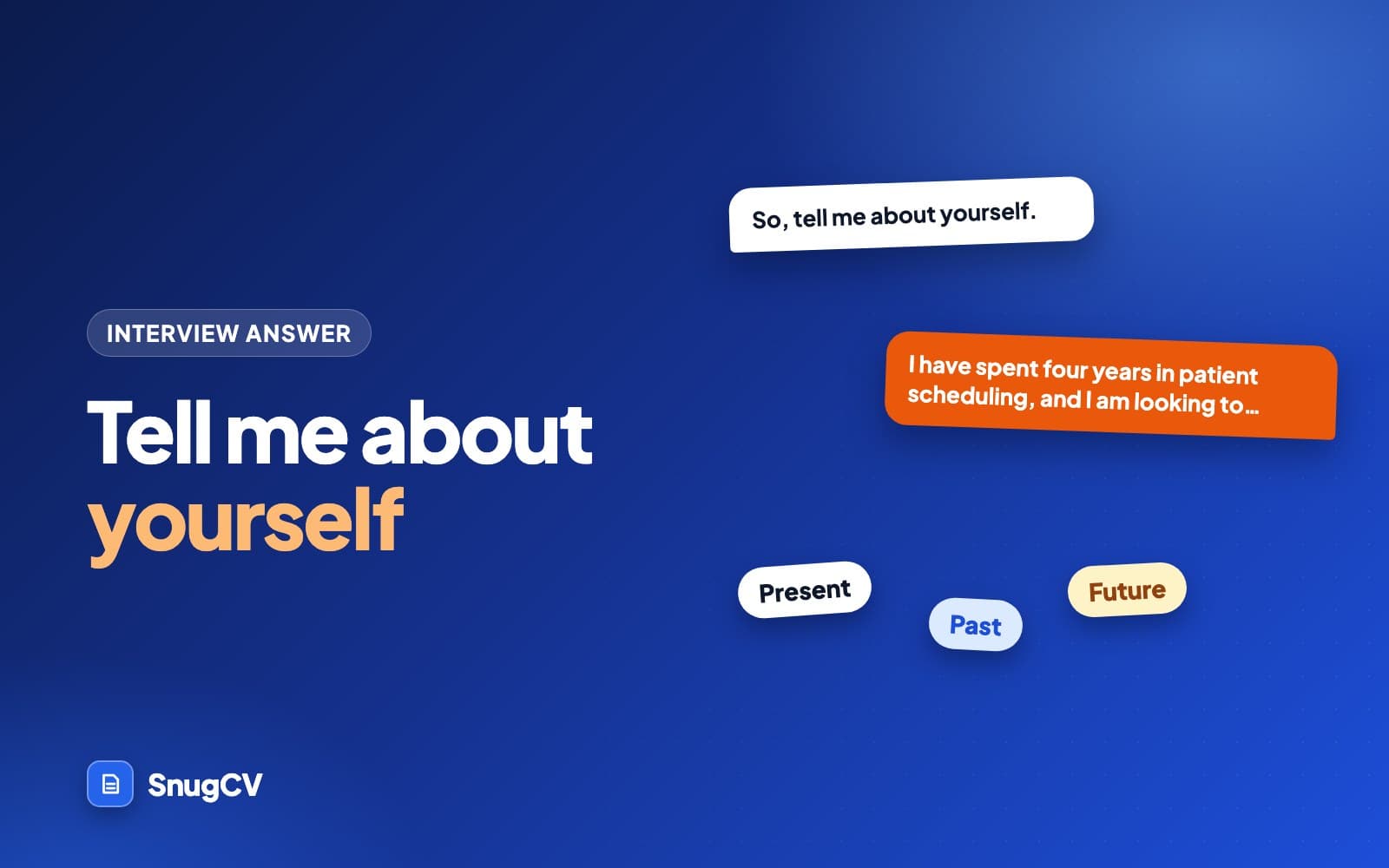
- The present, past, future formula
- How long it should run
- Gather the raw material first
- Sixteen example answers
- Weak answers, rewritten
- Plant one hook
- Change the answer for each posting
- Gaps, layoffs and other awkward parts
- What to leave out
- Common mistakes
- How to practice
- A fill-in template
- Where SnugCV fits
- Keep going
Almost every interview opens with some version of the same sentence: tell me about yourself. It sounds like a warm-up, and it is one, but the answer shapes the rest of the conversation. The interviewer chooses follow-up questions from whatever you say here, and they form a first impression of how clearly you think.
This guide gives you a three-part formula, 16 made-up example answers from retail to nursing to the trades, a rewrite of the most common weak answers, and a practice routine that takes about twenty minutes. Every example is a model. Swap in your own facts and say only what is true. If you are still building your overall plan for the interview, how to prepare for an interview covers the rest of the process.
What the interviewer is really asking
The interviewer already has your resume, so reading it back adds nothing. The question is an open door, and what you carry through it tells them three things.
- Which parts of your background you think matter for this job.
- How well you organize a thought and say it out loud.
- Where to dig next, because the detail you mention is the detail they will ask about.
Seen that way, a good answer is a short, selected, relevant account of your working life that ends at the job in front of you. It is a work question, even when it sounds friendly.
Ways this question gets asked. Answer them all the same way.
- Tell me about yourself
- Walk me through your resume
- Introduce yourself
- Tell us a bit about your background
- What brings you here today?
- How did you get into this field?
- Tell me about your journey
- Give us the highlights of your career
The present, past, future formula
The formula has three beats and one rule: finish on the job in front of you.
Beat 1
Present
What you do now, in a sentence or two, with one piece of proof that gives it scale: a team size, a volume, a type of customer, something you built or fixed.
Beat 2
Past
The one or two earlier steps that explain how you got good at it. Pick what this job cares about and leave the rest of the chronology out.
Beat 3
Future
What you want to do next and why this role is it, using something specific from the posting or the employer.
The three beats do not take equal time. Here is a rough split for a 75-second answer.
- Present. Who you are now, with one proof point
- Past. How you got here, only the relevant steps
- Future. Why this role, why now
The formula in one worked example
Here is a made-up answer from a hotel front desk agent applying to be a guest services supervisor, split into its parts so you can see what each one does.
- 1
I'm a front desk agent at the Lakeshore Inn, a 120-room hotel, where I run check-in, group arrivals and most of the complaint calls on the evening shift.
Present
One sentence in the present tense: the role, the place and the scope. The room count gives the listener a sense of size without a speech about it.
- 2
I started in housekeeping four years ago, so I can tell a real room problem from a front desk request, and I moved to the desk after eighteen months. Last summer my manager had me train the six new hires.
Past
Two steps, both useful for a supervisor. The housekeeping start is a strength here, so it stays in. The training detail is the hook: it is exactly what a supervisor does.
- 3
I'd like to supervise the evening team, which is why your posting caught my eye. It's the same shift on a bigger property, and a team I'd be coaching.
Future
It names what you want and ties it to the duties in this posting. A vague line about growth would waste the best sentence in the answer.
How long it should run
60 to 90 sec
A common rule of thumb for the whole answer
150 to 200
Words, at a normal speaking pace
1 hook
A detail the interviewer can ask about next
First drafts often run two to three minutes, which is long for an opening. The ranges below are rules of thumb. Watch the interviewer: if they lean in and nod, you have a little room, and if they glance at the clock, wrap up.
| Setting | Aim for | Why |
|---|---|---|
| Recruiter phone screen | 30 to 60 seconds | They are working down a list and want the short version |
| First round with a hiring manager | 60 to 90 seconds | Room for one proof point and one hook |
| Panel | 60 to 90 seconds | Everyone hears it once, so keep it even and on topic |
| Walk me through your resume | 2 to 3 minutes | They asked for the whole path, so give each job one line |
| Senior or executive role | 90 seconds to 2 minutes | More history to cover, but still a headline and not the book |
To time yours, write it out and read it aloud with a stopwatch. If it runs long, delete the earliest job on the list, then delete adjectives. Both cuts are usually painless.
Gather the raw material first
You can write the answer in ten minutes if you collect the parts before you start.
Before you write the first sentence
0 of 6 done
The first item matters more than it looks. The method in how to find the keywords in a job description takes ten minutes and tells you which parts of your history to put first. Your resume summary is a written cousin of this answer, so if you have already written one, start there. Resume summary examples shows how.
Sixteen example answers
These are made-up people, employers and numbers. They are models to adapt. Replace every detail with a true one, and cut any line you could not support with a follow-up question. Each answer is written to be spoken, so it uses short sentences and plain words.
Starting out
Example: new graduate, junior field technician at a water utility
I just finished a degree in environmental science, and I'm looking for work where I'm outside testing water and soil, which is why this field technician role caught my eye. In my final year I ran a sampling project on a creek near campus, collecting monthly samples and logging the readings in a spreadsheet that a local watershed group still uses. Before that I spent two summers on a grounds crew, so early starts and equipment don't bother me. I'd like to start in the field, learn the lab side from the senior techs, and work toward a compliance role. You do both, and that's the main reason I applied.
A graduate has no long work history, so the project does the work of the past beat. Notice that the answer also names a real next step instead of promising to be "a quick learner."
Example: first job, grocery store cashier at 17
I'm in my junior year of high school and looking for my first job. For two football seasons I've helped run the concession stand at home games, which means counting the cash box, managing a line, and training the freshmen who join. I haven't missed a shift or a practice this year, and I can work weekends and after school. I'd like to start at the registers and learn the store, and your store is the one my family shops at, so I know how busy it gets.
With no paid experience, you can still show reliability, handling money and working with people. If this is you, resume with no experience shows how to describe those things on paper too.
Changing direction
Example: teacher moving into corporate training
For nine years I taught middle school science, most recently as department lead. The part I liked best was taking people with different starting points and getting them to the same place, and I did that every week with the new teachers I mentored. Last year I built and ran onboarding for the eleven new staff members at my school, from the handbook to the first-week schedule. I'd like to do that full time, and a training role at a company that hires in volume is the version I've been looking for. I also finished an instructional design certificate this spring.
A career changer's answer gets the old job into the new job's vocabulary. The word "onboarding" carries the whole answer. For the same translation on paper, see career change resume.
Example: military logistics to civilian supply chain
I spent seven years in the Army as a supply sergeant, responsible for ordering, storing and issuing equipment for a company of about 140 soldiers. In civilian terms, that's inventory control, purchasing and warehouse operations. Last year I led a full inventory of our supply room that came out with no unexplained differences, and I've since finished a forklift certification and an online course in warehouse management software. I'm looking for an inventory control role where accuracy matters as much as it did there, and your distribution center is a good fit for that.
Translate rank and jargon into what a civilian employer would call the work. If the interviewer would need a glossary, rewrite the sentence.
Example: freelance bookkeeper moving to an in-house job
For five years I've run my own bookkeeping practice with about twenty small-business clients, mostly restaurants and contractors. I handle monthly closes, payroll and sales tax filings, and I took two clients from shoebox receipts to clean books in a quarter. Working alone has taught me to be self-checking and to explain numbers to people who don't like numbers. What I miss is a team and a single set of books to get really good at, which is why I'm applying to your finance team.
Coming back or moving on
Example: returning after four years of full-time caregiving
Most recently I've been home caring for a family member, and that's wrapped up now, so I'm glad to be back. Before that I spent seven years as an office administrator at a three-dentist practice, where I ran scheduling, insurance claims and the front desk. During the break I kept my skills current with a spreadsheet course and I've kept the books for a community garden group. What I want next is a steady front-office job in a clinic like yours where I can own the schedule. Your posting mentions claims follow-up, which was the part of the old job I did best.
The gap gets one sentence and no apology. Then the answer goes straight back to work. If a gap is on your resume, the interviewer will hear a short, calm explanation as a normal fact.
Example: laid off when a distribution center closed
I was a shift supervisor at a distribution center for six years. The site closed in August when the company consolidated, so I'm looking for a new floor to lead. On the day shift I managed fourteen people across receiving and outbound, and in my last year we cut mis-ships roughly in half by changing how we staged orders at the dock. I want to keep doing that kind of work, in a place where safety is something a supervisor can really influence. From what I've read about your facility, that's the case here.
State the reason for leaving in one factual line. Complaints about the old employer do not belong here, even if they are fair.
Example: internal move, from press operator toward shift lead
I've been at Delta Print for four years. I started on the press floor, and for the last eighteen months I've been the shift lead's backup, which means I run the line when they're out and train new operators. In that time I've learned every press on the floor, and I wrote the changeover checklist that our second shift still uses. I'd like to formally take on the lead role, because I'm already doing a good part of it and I'd like to do it with the title and the responsibility.
Experienced candidates
Example: finance director with sixteen years of experience
I'm a finance leader with sixteen years in manufacturing and distribution businesses. For the last six I've been finance director at a regional food distributor, where I lead a team of nine, own the monthly close, and report to the owners and the bank. The work I'm proudest of is moving us from a ten-day close to a five-day close and building the cash forecast that got us through a very tight winter. Earlier in my career I was in audit, which is where I learned to read a business from its numbers. This role interests me because you're about to open a second site, and I like the stage where finance has to grow with the business.
Senior candidates tend to list scope and forget to say what they changed. Give the interviewer one change you made and one that came out of it.
Example: commercial electrician with eight years in the trade
I'm a licensed journeyman electrician with eight years in commercial work. I started as an apprentice with a small contractor doing tenant fit-outs, and for the last four years I've run a crew of three on office and retail jobs, from rough-in through inspection. My work generally passes inspection on the first visit, and I'm comfortable reading plans and coordinating with the general contractor. I'd like to move to larger commercial projects and, in a few years, into project lead work, which is why a company that does your size of build interests me.
Frontline and service work
Example: registered nurse moving from a hospital floor to an outpatient clinic
I'm an RN with six years on a busy med-surg floor, the last two as charge nurse. I'm comfortable with heavy patient loads, with frightened families, and with explaining a plan of care at the bedside. The part I've come to like most is teaching: discharge education, medication reviews and helping people manage a condition at home. That's why I'm applying to your outpatient clinic. I'd like to build longer relationships with patients, and your diabetes education program is the part of the posting that stood out.
Example: retail associate moving up to assistant store manager
I've worked at Harbor Home Goods for three years, starting as a part-time cashier and moving to department lead for kitchenware last spring. Day to day I run the floor on weekends, train new hires on the register, and handle returns and complaints. Over the holiday season I took over the displays for my department and we finished the season ahead of our target. I'm ready for a bigger part of the store team, and the assistant manager role is the next step: scheduling, the cash office and coaching associates, which are the parts of my job I already volunteer for.
Example: customer service representative moving to a team lead role
I've spent four years on the phones for an internet provider, the last two on the escalation desk taking customers who have already called two or three times. I'm good at staying level with someone who is angry and at finding the problem underneath the one they opened with. Last quarter I started writing short summaries of the repeat issues I was seeing, and my supervisor now sends them to the training team. I'd like to coach other reps through the same situations, and a team lead role is where that happens.
Example: CDL driver applying to a regional carrier
I've held a Class A CDL for seven years, five of them on regional dry van routes, mostly home weekly. I've kept a clean record with no preventable accidents in the last five years, and my deliveries run on time unless weather says otherwise. I like regional work because I'm good at planning a day around hours of service and dock times. Your posting mentions home time every weekend and a newer fleet, which is what I'm looking for in my next carrier.
Short versions
Two situations call for a shorter answer: the recruiter phone screen and the room where you will be asked several more questions straight away.
Recruiter
Phone screen, 40 seconds
I'm a dental hygienist with ten years in family practices, the last four at a three-hygienist office. I'm moving to the area next month and I'm looking for a long-term place with a steady patient base, which is what your posting describes. I can start any time after the fifteenth. Happy to go into more detail on anything.
Several interviewers
Panel, 60 seconds
I'm a third grade teacher in my sixth year, in a school where about half my students are learning English. I use a lot of small-group work, and last year our class's reading growth was the strongest in our grade. I'd like to bring that to a team that's building its language support, which is the part of your school's description I connected with most.
On a phone screen the interviewer cannot see you, so say your name and current role clearly in the first sentence and stop when you're done.
Weak answers, rewritten
Most weak answers fail in one of six ways. Here is each one, with a rewrite built from the same background.
Before
Well, I graduated in 2016, then I took a year off, then I worked at a pharmacy for two years, then a grocery store, then a different pharmacy, and now I'm at a clinic.
After
I'm a pharmacy technician with six years of experience, the last two at a clinic pharmacy where I fill prescriptions and handle insurance rejections. Before that I worked at a retail pharmacy, which is where I learned to keep a busy counter moving. I'd like to move into a hospital setting, and your sterile compounding work is the draw.
A chronology makes the listener do the sorting. A selection tells them what matters.
Before
I'm married with two kids, we just moved here from Ohio, and I love hiking and baking.
After
I'm a dental hygienist with ten years in family practices. I recently moved to the area, so I'm looking for a long-term practice with a steady patient base.
A move is worth one clause when it explains why you are applying. The rest belongs to you.
Before
I'm looking to leave because my manager micromanages and the pay is bad.
After
I've learned a lot on the floor at my current store, and I'd like to move into scheduling and training, which a store this size doesn't offer.
The reason for leaving is the same. It now points at what you want, which is easier for the interviewer to agree with.
Before
I'm a hard-working, detail-oriented team player who's passionate about customer service.
After
I'm a front desk coordinator at a physical therapy clinic, where I check in about sixty patients a day and keep the schedule full by calling people the day before to confirm.
Adjectives are claims. A scale and a habit are evidence, and the listener can picture them.
Before
I'm a nurse. I've been one for five years.
After
I'm a nurse with five years on a cardiac step-down unit, where I look after patients who are recovering from procedures and teach them what to watch for at home. I'm interested in your telemetry unit because it's the same kind of patient with more complexity.
Too short is as unhelpful as too long. Give the interviewer something to follow up on.
Before
I'm sorry, my resume has a gap, I've been out of work for a while and it's been hard.
After
I took two years out to care for my father, and I'm ready to return. Before that I spent six years in accounts payable, and I've kept my spreadsheet skills current with a course this year.
One plain sentence, then straight back to what you offer. An apology invites worry that the facts do not support.
Plant one hook
The best answers leave a loose thread on purpose. A single concrete detail, a change you made or a thing you built, gives the interviewer an easy follow-up, and you get to continue on a story you have already prepared.
Interviewer
To start, tell me a bit about yourself.
You
I'm a dispatcher for a regional plumbing company, three years now. I schedule eleven technicians across two counties, and last winter I rebuilt how we handle emergency calls so the nearest tech goes first. Before that I worked in a call center, where I learned to keep my voice level when someone's basement is flooding. I'd like to move into a dispatch lead role, which is why this posting stood out.
Interviewer
Tell me more about the emergency call change. What did you actually do?
You
The old system was first come, first served, so a tech could drive across the county past a closer job. I put the techs on a shared map, tried nearest-first for two weeks on the evening shift, and tracked the arrival times. Average arrival came down, and the owner made it the rule for every shift.
Change the answer for each posting
The same person gives a different answer to different postings, because the interviewer cares about different parts of their history. Here is Priya, a made-up pharmacy technician with six years of experience: four on a retail counter, then two in a hospital outpatient pharmacy. She opens three interviews, and only the first sentence and the hook change.
Posting stresses volume
Busy retail counter
I'm a pharmacy technician with six years of experience, four of them on a high-volume retail counter, where I filled, labeled and handled insurance rejections for about a hundred patients a day.
Posting stresses accuracy
Hospital pharmacy
I'm a pharmacy technician with six years of experience, the last two in a hospital outpatient pharmacy where I help prepare IV medications under a pharmacist's supervision, so double-checks and documentation are second nature.
Posting stresses ordering
Inventory role
I'm a pharmacy technician who, for the last two years, has handled ordering and the controlled-substance counts at a hospital outpatient pharmacy, and I keep our stock records accurate.
Every line is drawn from the same six years. Each one picks the true fact the posting cares about and says it first. That is the same logic as tailoring a resume to each job, applied to speech.
Gaps, layoffs and other awkward parts
Some histories need one more sentence than others. The goal in every case is a short, factual line that you can say calmly, followed by a move back to what you offer.
| Situation | A sentence you could say, if it is true |
|---|---|
| A gap for caregiving or health | I took eighteen months out to care for a family member, and I'm ready to return. |
| A layoff or closure | My position was eliminated when the company closed the site. |
| A short stay at one job | The role turned out to be mostly sales, and I'm a service person, so I left to find service work. |
| A change of field | I've spent six years in retail management, and the part I enjoyed most was training, so I'm moving into corporate learning. |
| Stepping back from management | I'd like more hands-on work and fewer people-management duties, and this role is that. |
| Being let go | The role ended, and what I took from it was [one true lesson]. Since then I have [what you did with it]. |
The last row needs your own true lesson in the brackets. Keep it to two sentences and do not criticize the old employer.
What to leave out
Leave these out of the answer
- Your age, marital status or children
- Health or medical history
- Religion or politics
- Salary expectations
- Complaints about a past employer
- Every job you have ever had
- Hobbies with no link to the role
- Apologies
In many places employers are limited in what they are allowed to ask about, and the rules vary by location. What you volunteer is up to you, and a safe default is to keep the answer about work. A hobby or volunteer role can go in when it supports the job, such as coaching a youth team for a supervisor role.
Common mistakes
Do
- Open with your current role, or with the one fact that matters most for this job
- Use concrete nouns: the size of the team, the type of customer, the kind of equipment
- End on this job and this employer
- Stop talking when you are finished and let them take over
- Say the answer aloud before the interview, more than once
Avoid
- Reciting a script word for word, which sounds recited
- Starting with a long wind-up like So basically, I guess I'll start from the beginning
- Stacking adjectives with no proof behind them
- Trailing off with Yeah, so that's me
- Answering for a different job than the one you applied for
How to practice
You do not need a coach. You need ten minutes, a phone and a timer.
- 1
Write it
Three beats, 150 to 200 words, in the words you would really use.
- 2
Cut to cues
Reduce it to the three beats and your hook on a card.
- 3
Say it aloud
Use a timer. Check it lands in the range for your setting.
- 4
Record it
Listen once. Mark filler words, detours and anything you could not support.
- 5
Try it on a person
Ask what they would ask you next. That is your hook working.
- 6
Rewrite the opener
Change the first and last sentence for each posting.
If you will be asked it several times in one day by different people, keep the answer the same and say it fresh each time. Every interviewer is hearing it for the first time.
A fill-in template
Copy this, replace the brackets with true facts, and cut anything that does not fit.
Template: tell me about yourself
Right now I'm a [your role] at [your employer], where I [main responsibility] for [the scale: who or how much]. [One piece of proof: something you built, fixed, handled or learned.]
Before that, I [the earlier step that explains how you got good at this]. [One sentence about a skill or habit it gave you that this job needs.]
What I'd like to do next is [what this role offers]. That's why [something specific from the posting or the employer] caught my eye, and I'd be glad to talk about it.
Where SnugCV fits
A tailored resume and a good answer to this question come from the same work: finding what a posting wants and matching it to what you have done. SnugCV lists the keywords from a posting that your profile supports and the ones it does not, with a plain-language note on every change to your resume. Read that list before an interview and use it to pick the present and past details your answer leads with. Everything on it comes from the history you uploaded, so it doubles as a reminder of what you have really done.
How to read your tailored resume explains the matched keywords and gaps panels.
Keep going
This answer opens the interview, and the questions after it test the claims you made. Behavioral interview questions and the STAR method shows how to prepare stories for the follow-ups, why should we hire you covers the question that often comes next, and questions to ask the interviewer helps you close well. After the interview, a thank-you email is the last step.
Questions people ask
How long should my answer to tell me about yourself be?
A common rule of thumb is 60 to 90 seconds, which is around 150 to 200 words at a normal speaking pace. A recruiter phone screen can be shorter, and a request to walk through your resume can run two or three minutes. Time yourself out loud, because most first drafts are longer than they feel.
Should I mention my family or hobbies?
You decide what to share, and a safe default is to keep the answer about work. Mention a hobby or volunteer role only when it supports the job, such as coaching a youth team for a supervisor role. Details like age, family status, health or religion are not needed, and in many places employers are limited in what they may ask.
Can I use the same answer for every interview?
Keep the same skeleton and change the details. The first sentence and the last sentence should come from the posting in front of you. A hospital and a retail pharmacy both want a pharmacy technician, but they care about different parts of your history, and your answer should reflect that.
What if I have no work experience?
Use school, volunteering, family responsibilities, sports or projects as the past beat, and be specific about what you did. A first-job answer works well with one concrete example of reliability, such as running a stand at school events, and a clear reason you want this particular job. Never invent a job or stretch a title.
Is walk me through your resume the same question?
It is close. Both ask for the story of your working life, but walk me through your resume usually invites a longer, more chronological answer of two to three minutes. Use the same three beats, give each past job one line instead of one story, and still finish on why this role.
Should I memorize the answer?
Memorize the beats, the first sentence and the last sentence, and leave the middle loose. A word-for-word script tends to sound recited and falls apart if you lose your place. Practice out loud several times so the structure is automatic and the words come out a little differently each time.
Was this guide helpful?
Get the free resume checklist and new guides
Twenty checks to run before you send a resume, as a one-page PDF. After that, a short email when new guides go up, at most once a week.