Key takeaways
- Tailoring changes what you emphasize and the words you use. Your history stays as it is.
- The top of your resume decides whether a hiring manager keeps reading, so the most relevant lines belong there.
- Employers, titles, dates and degrees stay exactly as they are, and you only claim what you can support.
- Give full effort to the roles you most want, a lighter pass to solid fits, and know when one resume is enough.
In this guide
- What it means to tailor a resume
- Why one resume for every job falls short
- Read the posting for what it cares about
- What tailoring changes, and what it leaves alone
- How much to change
- Worked examples from different fields
- A routine you can repeat
- When one resume is enough
- Before and after you send it
- The honest limits
- Mistakes to avoid
- Where SnugCV fits
- Keep going
Most people keep one resume and send it everywhere. When you are tired and the list of open roles is long, that is a sensible way to get applications out. The cost is that a resume written for nobody in particular leaves the reader to work out why you fit. Tailoring does that work for them, using the same facts about your career.
This guide covers what tailoring is, what to change and what to leave alone, how much effort each application deserves and when one resume is enough. The examples come from retail, nursing, teaching, logistics, hospitality and office work, because the idea is the same in every field. When you want the steps, how to tailor your resume to a job posting is the product walkthrough and how to find the keywords in a job description is the method by hand.
What it means to tailor a resume
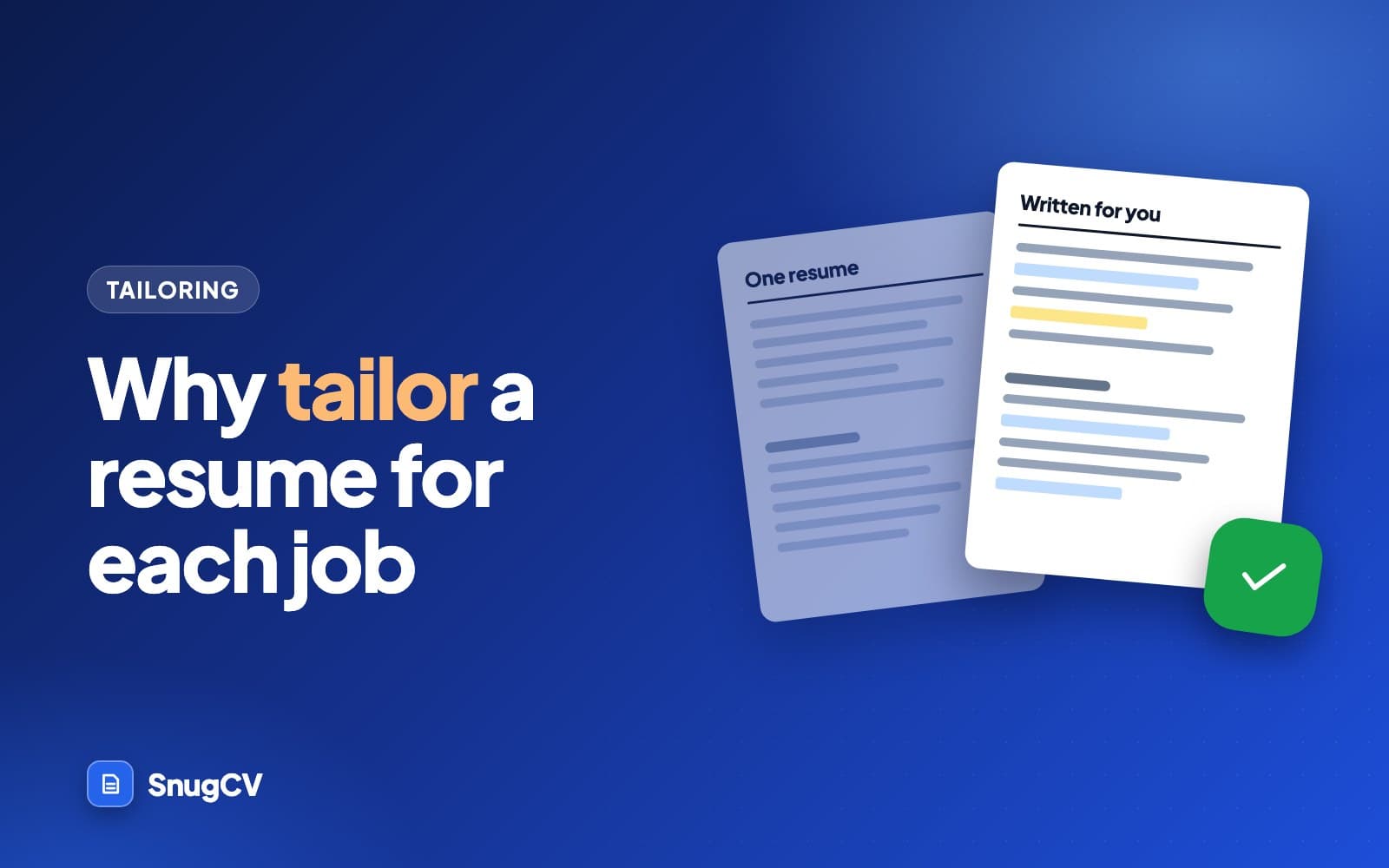
Tailoring a resume means adjusting what you emphasize and the words you use so the document answers the job posting in front of you. Your history stays as it is. You change the order, the emphasis and the wording.
Take two people with the same four years at the same company. One is applying for a customer support role and the other for a team lead role. The first leads with how they handled difficult customers. The second leads with training new hires and covering shifts. Each did all of it, and each puts first what their reader is looking for.
You have more true things to say than a resume has room for. Tailoring is the choice of which ones go on the page for this reader, and in which words.
Why one resume for every job falls short
A hiring manager working through a stack of applications spends little time on each one. The top of your resume is what decides whether they keep reading, so the things most relevant to that job need to be there, not on the second page.
The posting also tells you what the employer wants, often in specific words. Employers describe the same work differently. One calls it customer success and another calls it account management. If your resume never uses the posting's terms, you leave the reader to translate.
Many employers collect applications in an applicant tracking system, and recruiters can often search it by keyword. If your resume says "client onboarding" and the posting says "customer implementation", a search for the posting's phrase may not turn you up, even though you did the work. How a particular system ranks or filters applications is not public. Treat matching the posting's wording as a way to be easier to find, and not as a way to guarantee anything. What is an ATS explains what these systems do in plain terms.
Finally, a resume has limited room. Each line spent on something irrelevant to this job is a line not spent on something that is.
Three different readers may handle your resume, and each wants something a little different.
Hiring manager
The skimmer
Has a stack of applications and little time for each. Looks at the top of the first page for the few titles and terms that say you have done this work.
Recruiter
The searcher
Types the posting's own words into the applicant tracking system and sees which resumes use them. A different word for the same thing may not show.
Whoever meets you
The interviewer
Reads the resume as an agenda and picks bullets to ask about. Everything you list is open to a question, so everything has to be true.
Read the posting for what it cares about
Before you change a word, decide what this posting cares about most. Three signals are worth a minute.
- Repetition. A duty or a term that appears in the title, the opening paragraph and the list is the core of the job.
- Position. Postings often list the most important duty first, though not always. The opening paragraph is the employer's own summary.
- Strength of language. "Required", "must" and a number of years are gates. "Preferred" and "a plus" are bonuses.
Write down the three or four things that come out on top and keep them beside you while you edit. How to find the keywords in a job description shows the full method with a worked posting.
What tailoring changes, and what it leaves alone
Four parts of a resume are worth adjusting for each job. After them comes what stays put.
The summary at the top
The summary is the first thing a skimmer reads. A generic one names qualities. A tailored one names the field, the span of experience and two or three things this posting cares about. Rewrite it so its first sentence speaks to this role. Resume summary examples has more by field.
Before
Dependable administrative professional with strong communication skills, looking for a new opportunity.
After
Administrative assistant with five years in medical offices, handling patient scheduling, insurance verification and front desk coverage for a four-provider practice.
Every part was already in the profile. The second version names the field, the span and the three duties a scheduling posting asks for.
The order of your skills
A reader's eye lands on the first few skills and may stop there. Move the ones the posting asks for to the front, and use the posting's term where it is accurate: if it says Microsoft Excel and you use Excel, write Microsoft Excel. Skills to put on a resume lists examples by field.
A skills line, ordered for a medical scheduling posting
- Appointment scheduling
- Insurance verification
- Practice management software
- Microsoft Outlook and Excel
- Patient intake
- HIPAA
The same person's other skills, lower down for this posting
- Social media posting
- Basic photo editing
- Event setup
- Cash handling
The wording of your bullet points
Describe the same work in the posting's terms, where those terms are accurate. The change is usually a noun or a verb, and the facts stay put. Resume bullet points goes deeper on the formulas.
Before
Worked with customers by phone and email to set up their accounts and answer questions.
After
Onboarded new customers by phone and email: set up their accounts and answered setup questions.
Onboarded is the posting's word for what the first line described. Nothing was added.
Which bullets you keep
If a role has more bullets than fit, keep the ones that matter to this job and let the rest go for this version. A common rule of thumb is more bullets for recent roles and fewer for older ones, and how long a resume should be looks at the page limit. The bullets you cut are still true. This reader just does not need them first.
Header
Maya Torres
Summary
Skills
Experience
Education
- 1Summary: the first sentence speaks to this role.
- 2Skills: the posting's requirements come first, in its own wording where it is accurate.
- 3Bullets: the same work described in the posting's terms, and the most relevant bullets kept.
What stays exactly as it is
Employers, job titles, dates, degrees and certifications stay exactly as they are. These can be checked, and they are what people get caught on. If your title was Coordinator, it is Coordinator on every version, even when the job you want is titled Manager. If you did manager-like work, say so in a bullet, as long as it is true.
Numbers stay as they are too. If you supervised about 40 people, 40 is the number, and not 50 because the posting says 50 or more.
Do not add a skill, tool or result you cannot support. A good test is whether you could talk about it for two minutes in an interview. If you could not, leave it out.
How much to change
The right amount depends on how close the posting is to what you already do. A useful test: cover your name and read only the first third of the page. Could a stranger guess which role it was written for? If yes, stop.
| How close the role is | Level | What usually changes |
|---|---|---|
| The same role you do now, in a similar setting | Light | The summary and the order of your skills, and a bullet or two where the posting's words differ from yours |
| The same field with a different emphasis, or a step up | Medium | The summary, the skills, the wording of the bullets in your last two roles, and which bullets you keep |
| A different field or a different level of the work | Heavy | All of the above, plus a decision about which jobs and bullets lead. See career change resume |
If you find yourself rewriting most of the resume, step back. Either the role is a stretch from the experience you have, or your profile does not yet say what you have done. Both are worth knowing before you send anything.
Worked examples from different fields
One history, two postings
This one is made up to show the idea. An operations assistant at a regional distributor did several things in that job. They scheduled inbound vendor deliveries, kept the shared delivery calendar current, built a weekly delivery report from the order system, and flagged late shipments to the team lead. Here is how the same job reads for two different postings.
| Logistics coordinator posting | Operations analyst posting | |
|---|---|---|
| Summary | Operations assistant with four years of scheduling vendor deliveries and keeping a distribution team on time. | Operations assistant with four years of tracking delivery performance and reporting on it each week. |
| First bullet | Scheduled inbound vendor deliveries and kept the shared delivery calendar current for a six-person team. | Built the weekly delivery report from the order system and flagged late shipments to the team lead. |
| Skills lead with | Scheduling, vendor coordination, calendar management | Reporting, order system, data entry accuracy |
Both versions come from the same list of things this person did. Neither adds anything and neither removes anything from the record. They differ in what comes first.
Three more people
These people are made up. Each has one master history, and each shows how the front of the page changes for one posting. The facts in the second version were already in the first person's records.
Before
Motivated retail professional with six years of experience seeking a new challenge.
After
Retail associate with six years in specialty stores, two as assistant lead, opening and closing the store, running the till and reconciling the cash drawer.
A keyholder posting repeats opening, closing and cash handling. Those facts were in a bullet and now lead the summary.
Before
Compassionate nurse with five years of experience in a hospital.
After
Registered nurse with five years on a medical-surgical unit, including shifts covered on other units when short-staffed.
A float pool posting values range. The cross-coverage was in a bullet and now opens the summary.
Before
Experienced middle school science teacher.
After
Middle school science teacher with eight years in the classroom, who also mentored two new teachers and led the department's lab safety refresh.
An instructional coach posting asks about mentoring and leading. The teacher did both and had left them low on the page.
Four more postings
Here is what moves to the top for each.
Logistics
Warehouse associate
The posting requires a forklift certification and names pick rate and accuracy. The certification moves to the top of the skills, and the bullet about accuracy leads the most recent role. A bullet about organizing the break room can go.
Hospitality
Server to shift lead
The posting asks for opening checklists and training new staff. Those two bullets lead. The long list of menu items you know can shrink to a line.
Office
Executive assistant or office manager
An assistant posting stresses calendars and travel. An office manager posting stresses vendors, supplies and budgets. The same person leads with different halves of the same history.
First or second job
Early career
When the posting asks for skills you built in a course, a volunteer role or a part-time job, those lead the page, with the actual dates and places. A short history has less to choose from, so the choice matters more.
A routine you can repeat
- 1
Read it twice
Mark what the requirements ask for, and anything the posting repeats.
- 2
Match
For each marked item, note whether you have done it and one example in your own words.
- 3
Summary
Rewrite it so the first sentence speaks to this role.
- 4
Skills and bullets
Move the requested skills first, then edit the bullets that match.
- 5
Trim
Shorten or drop what is not relevant to this job.
- 6
Read it as the interviewer
Check that you could explain every line.
- 7
Save and record
Name the version after the company and role, so you know what you sent.
Done by hand, this takes real time for every application, and that is the reason most people stop doing it. The keyword pass alone, which steps 1 and 2 amount to, takes 10 to 15 minutes per posting once you are practiced.
Budgeting time across many applications
You do not need to give every application the same effort. A search with thirty postings and a search with five need different plans. A simple way is three tiers.
| Tier | What it is | What to do |
|---|---|---|
| Top choices | Roles you would be glad to get, where you meet most of the requirements | Full tailoring of summary, skills and bullets. Have an example ready for each keyword. Consider a cover letter, and look for a person at the company to write to |
| Solid fits | A fair match and a good job | The summary and skills order, plus the top bullets of your most recent role |
| Light pass | Many postings for the same title with near-identical duties | One tailored version for the group, with a small edit to the first line of the summary |
- Top choices. About three of ten postings
- Solid fits. About four of ten
- Light pass. About three of ten
Two habits make this work. First, keep one complete master version with every job and every bullet you have, so each tailored resume is a trimmed and reordered copy and never something you rebuild from memory. Your SnugCV profile plays that role if you use it. Second, record what you sent. A tracker or a spreadsheet with the company, the role, the date and the version saves you from guessing in an interview. The job application tracker keeps that beside the resume.
1
Master record of everything you have done, kept complete
4
Parts worth adjusting: summary, skills, bullet wording, bullets kept
2 min
The test for any line: could you talk about it for that long with an example?
When one resume is enough
Tailoring has a cost, so use it where it pays. If one version already answers a posting, you can stop. Four questions settle most cases, in this order.
- 1
Same duties?
Do the postings ask for the same core work?
- 2
Same words?
Do they describe it in the same terms you use?
- 3
Does the top answer it?
Would the first screen of your resume answer this posting?
- 4
Any hard gate?
Does it require a license or credential you hold or lack?
| Situation | Verdict |
|---|---|
| Several postings for the same title with near-identical duties | One version, tailored once for the group |
| The same title in a different industry, with different vocabulary | Tailor at least the summary and the skills |
| A step up, a sideways move or a new field | Tailor, including the bullets |
| A referral to someone who already knows your work | A light pass is usually enough, because the reader knows the story |
| A site that applies in one click with the resume you have on file | Make that file a good general version, because it is what gets sent |
| A posting with a hard requirement you do not meet | Do not spend tailoring effort on it |
Before and after you send it
Prepare for the questions it invites
Every line you tailor becomes a possible question. A summary that opens with scheduling invites "tell me about your scheduling", and a bullet about reducing no-shows invites "how did you do that?" Before an interview, go through the resume line by line and prepare a short true example for each one that matches the posting. A resume you can speak to line by line is a stronger resume than one with better words and no stories behind them. If you also send a cover letter, how to write a tailored cover letter shows how to keep it to facts from your history too.
Keep the versions straight
Once you send ten different resumes, the details blur. Name each file so you can tell them apart in a month: your name, the role and the company, for example Priya-Nair-Float-Pool-RN-Mercy-General.pdf. Keep a one-line note of what you changed. When a recruiter calls and says "I saw your resume", you want to know which one they saw.
The honest limits
Tailoring helps, and it helps within limits. It is better to know them.
- It cannot turn a missing requirement into one you hold. A posting that needs a license, a certification or a number of years is asking for a fact that no wording changes.
- It cannot guarantee a screen, a call or an offer. How a given employer's system ranks applications is not public, and hiring depends on many things beyond the resume, such as who else applied and the timing.
- It cannot replace the other routes in. A message to a person at the company or a referral sits beside the resume and does work it cannot.
- It cannot fix a thin history. If your bullets say little, reordering them says little in a different order.
- It can be wrong. A tailored version, by you or by software, can reword something so it no longer says what you did. Reading the result is part of the job.
Mistakes to avoid
Copied from the posting
Collaborate cross-functionally with stakeholders to drive results.
In your own words
Coordinated weekly delivery schedules with the warehouse and purchasing teams.
The first is a sentence from a posting. The second is something you did, written in terms the posting would recognize.
- Copying whole sentences from the posting into your resume. It reads as borrowed, and it often describes work you did not do.
- Adding keywords you cannot back up. If it comes up in the interview, you will have to explain it.
- Hiding keywords in white text or tiny type. It can be spotted, and it tells the reader you were willing to game them.
- Changing a title or a date to match the posting.
- Letting your resume and your LinkedIn profile disagree on titles and dates.
- Losing track of which version went where, so you cannot remember what you told them.
- Tailoring the summary and leaving the bullets in a different vocabulary, so the top says one thing and the body says another.
Where SnugCV fits
SnugCV does these steps from a profile built once from your resume. For each posting it rewrites your summary, reorders your skills and rewords your bullets in the posting's language. Employers, titles, dates and education are copied from your profile unchanged, and each change comes with a note so you can see what it did and reject any edit. Your first 5 tailored resumes are free, with no card needed.
Keep going
Once you know why to tailor, the next questions are how to check the result and how to word it. How to read your tailored resume shows what to check, and resume keywords lists terms by field. For the wording itself, resume action verbs has verbs by type of work, and how to check your resume for ATS problems covers the formatting side.
Questions people ask
Do I need a different resume for every application?
Not always. If two postings ask for the same things in the same words, one version can serve both. Change the version when a posting asks for something different, and spend the effort on the roles you most want. A short pass on the summary and skills often covers the similar ones.
How much should I change?
Enough that the first screen of the resume answers the posting. For most roles that means the summary, the order of your skills and a handful of bullets. If you find yourself rewriting most of it, step back and check that the role fits the experience you actually have.
Is tailoring a resume dishonest?
No, as long as every statement is true. Choosing what to put first is what every resume does, because no resume holds everything. Adding something that did not happen, or changing a title or a date, is where it stops being honest. Emphasis is a choice. A false claim is a lie.
Does tailoring get a resume past applicant tracking systems?
It can make your resume easier to find when a recruiter searches by the posting's terms. How a given employer's system ranks or filters applications is not public, so no amount of tailoring guarantees a result. Treat matching words as a way to be easy to find and easy to read.
How long does tailoring take by hand?
The keyword pass alone takes 10 to 15 minutes once you are practiced, and rewriting the summary, skills order and bullets takes more on top. That cost is why many people tailor only for the roles they most want. SnugCV tailors from your saved profile in about a minute.
What if I do not have what the posting asks for?
Note it as a gap and look at the rest of the posting. Postings are wish lists, and employers rarely find someone who meets every line. If the missing item is a hard requirement such as a license, be honest with yourself about whether to apply. Never add a skill you do not have to cover it.
Should my LinkedIn profile change for each job too?
No. LinkedIn is one public page for everyone, so it should be accurate and complete rather than shaped for a single posting. What matters is that your resume and LinkedIn agree on employers, titles and dates, because a reader who checks both will notice a mismatch.
Was this guide helpful?
Get the free resume checklist and new guides
Twenty checks to run before you send a resume, as a one-page PDF. After that, a short email when new guides go up, at most once a week.