Key takeaways
- A summary is two to four lines under your name that say who you are, what you do best and one piece of proof, in the words of the job you want.
- Write a summary when you have relevant experience, an objective when you have little, and treat a profile as another name for a summary.
- Write it last and rewrite it for each posting: the title, the top strengths and the proof point should match the job in front of you.
- Every claim has to survive an interview question. Cut any adjective you could not back with a story.
In this guide
The summary is the one section of a resume that you write fresh for each job. Your employers, titles and dates stay fixed. The summary is where you choose which parts of that history go first, and where you say them in the words of the posting in front of you.
This guide gives you a formula you can fill in, more than 30 made-up examples sorted by situation (student, career changer, returning to work, experienced) and by field (healthcare, teaching, retail, hospitality, trades, logistics, office, finance, tech), and a method for tailoring the summary to any posting. If you have not yet pulled the keywords out of the posting you are applying to, start with how to find the keywords in a job description, because the summary is built from them.
What a resume summary does
A resume summary is a short block of text at the top of your resume, under your name and contact details and above your work history. It answers one question for a reader who is moving quickly: is this person worth reading further?
It can answer that because it is the only part of the resume that you can reshape for a job without changing a single fact about your past. A reader who finds the posting's title and two of its core skills in the first three lines has a reason to keep going. A reader who finds "motivated professional seeking a challenging role" has none.
Header
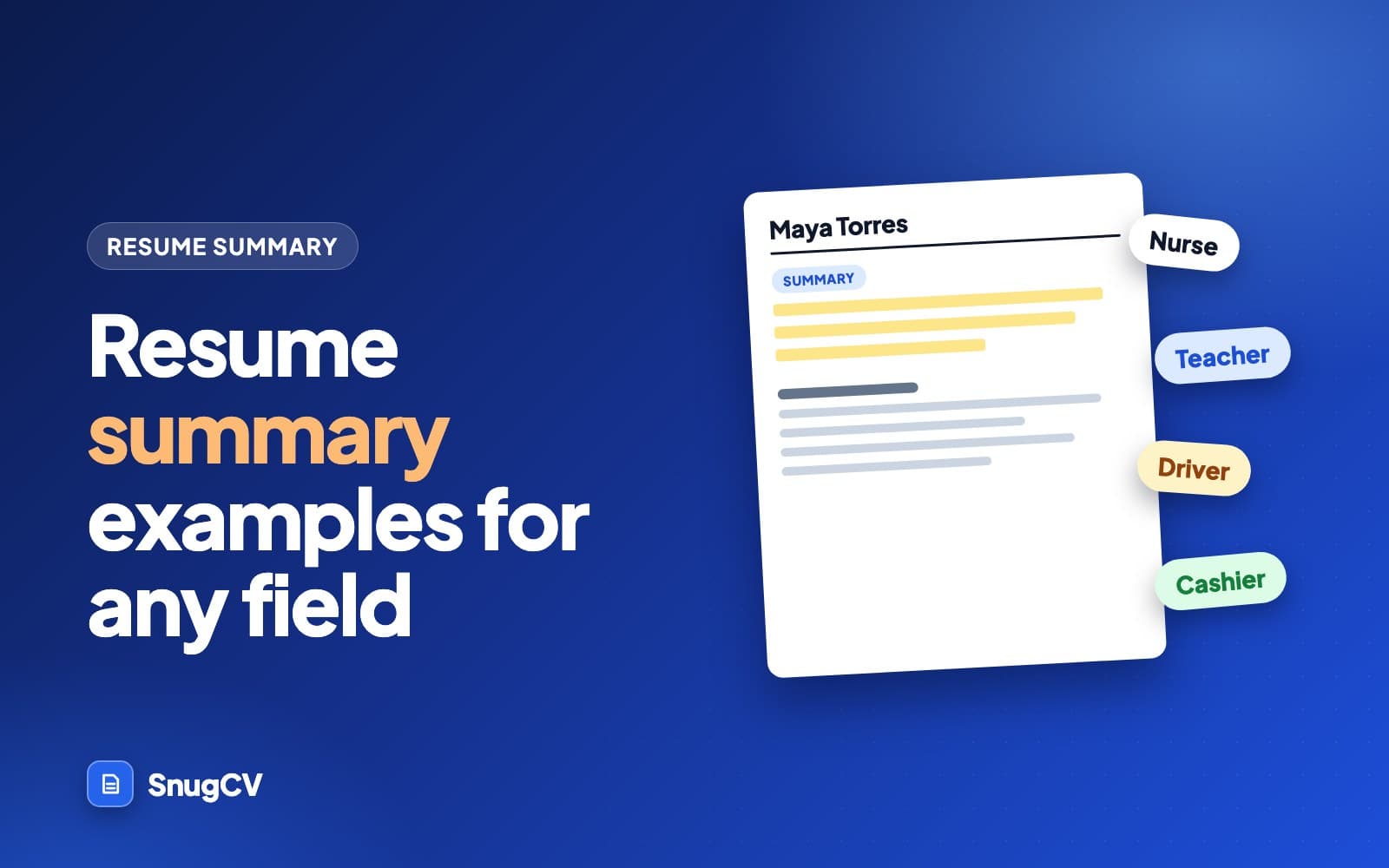
Maya Torres
Summary
Skills
Experience
Education
- 1It sits directly under your name and contact details, before any job.
- 2Two to four lines is a common length: enough for a claim and its proof.
- 3It is written for this posting. The jobs below it stay the same for every application.
2 to 4 lines
A common length. Long enough for a claim and its proof.
40 to 80 words
A rule of thumb. Past about 100 it starts to read like a cover letter.
1 proof point
A number, a size or a trusted responsibility. Two if the rest is short.
Because the summary is short, every word has to be something you could defend.
Paste a draft summary into the counter below to check it against the 40 to 80 word range.
Resume word counter
- 0
- Words
- 0
- Characters
- 0
- Lines
- 0
- Bullets
Paste some text to see how long it is.
Five hundred words a page is a rule of thumb. Type size, margins and spacing change how much fits. A resume summary usually runs 40 to 80 words.
Everything you enter stays in your browser. Nothing is sent to a server.
Summary, objective or profile: which one to write
These three words get used loosely, and they overlap. The table separates what each is meant to do.
| Name | What it says | Best for | Watch out for |
|---|---|---|---|
| Summary | What you offer: your role, strengths and one proof point | Anyone with relevant experience, including career changers who can show transferable work | A list of adjectives with no facts |
| Objective | The job you want and what you bring to it | Students, first jobs, large career changes, and fields or employers that still expect one | "Seeking a challenging position" lines that say nothing about you |
| Profile | The same job as a summary. Some templates and many UK CVs use this word | Anyone who wants to follow a template's labels | Treating it as a different thing and writing both |
| Headline | One line under your name: a title and a specialty | A short add-on above any of the three | Titles you have not held |
The practical rule is short. If you can name a result, a scope or a responsibility from relevant work, write a summary. If you cannot yet, write one or two sentences that name the role you want and the real things you bring to it: coursework, volunteering, a certification, a skill learned somewhere else. That is an objective, and a specific one is a perfectly good opening.
Career changers often do best with a blend: one sentence of summary about what you have done and one sentence about where you are heading. Some fields still expect a stated objective, and education is one that comes up often, so check a few postings and resumes in your own field. In the UK and a few other places, the same block is called a personal profile, and the advice here applies to it unchanged.
A summary earns its space when
- You have a clear target job and can name it in the first line
- Your job titles do not tell the whole story: a change of field, a specialty or a promotion path
- You have one result or responsibility that is worth putting before the jobs
- You want a place to use the posting's own words in full sentences
Skip it or shrink it when
- The page is full and your titles already say everything the summary would
- The summary would only repeat your most recent job title and employer
- You have nothing specific yet, in which case a one-line objective is better than filler
- It reads the same as the summary on every other resume in the pile
A formula that works for most people
Almost every good summary answers the same four questions in order. You can drop the last one, and you can reorder the middle two, but the first should always say what job or field you are in.
- 1
Who you are
Job title or field, plus years or setting. Use the posting's title if it truthfully describes you.
- 2
What you do best
Two or three strengths the posting asks for, in its words.
- 3
One proof
A number, a size, a record or a responsibility someone trusted you with.
- 4
What you bring next
Optional. The kind of role, team or setting you are aiming for.
Here is the formula as a fill-in template. Copy it, replace the brackets with your own facts, then cut anything that does not apply.
Template: resume summary
[Job title] with [number] years of experience in [setting or specialty]. Skilled in [strength 1], [strength 2] and [strength 3]. [One proof point: what you handled, how much, or what improved.] [Optional: the kind of role you want next.]
The same formula taken apart on a made-up pharmacy technician summary:
- 1
Certified pharmacy technician with 5 years in a busy community pharmacy.
Who you are
Title and setting in one line. The years tell the reader your level without a separate sentence.
- 2
Processes insurance claims, keeps inventory and controlled-substance logs, and explains pickup instructions in plain language.
What you do best
Three duties, each one a likely keyword in a pharmacy posting.
- 3
Trained four new technicians and opens the pharmacy alone.
One proof
A responsibility that someone trusted you with is proof even when it has no percentage attached.
- 4
Looking for a hospital pharmacy role with sterile compounding training.
What you bring next
One short sentence about direction, and only when it helps the fit.
Three shapes for the same facts
The formula does not fix the layout. A summary can be a short paragraph, a headline with one line under it, or three short bullets. The facts below belong to one made-up front desk coordinator.
The usual choice
Paragraph
Front desk coordinator with 5 years in a dental office, scheduling about 40 patients a day across two dentists. Verifies insurance, collects copays and keeps the daily calendar full from a cancellation list.
Short and scannable
Headline and one line
Dental front desk coordinator
5 years of scheduling, insurance verification and patient check-in for a two-dentist practice.
Good for lists of facts
Three bullets
- 5 years at a two-dentist office
- Schedules about 40 patients a day
- Verifies insurance and collects copays
Use a paragraph when your strengths connect into a story. Use bullets when you have a handful of crisp facts and the reader will skim, which can suit entry-level and hourly roles. Whichever shape you choose, keep it within the same two to four lines.
Examples by situation
Your situation changes what goes first. A student leads with training and hands-on hours, a career changer leads with the work that transfers, and someone with 15 years leads with scope and results.
Students and new graduates
With little paid experience, the strongest material is hands-on hours, internships, volunteering and the specific skills you have used. Say what you can already do, then name the job.
Recent graduate
Business administration graduate
Business administration graduate with a retail operations internship and two years of weekend work on a store sales floor. Comfortable with inventory counts, cash handling and spreadsheets. Looking for an operations or merchandising assistant role where accurate counting and quick learning matter.
Final-year student
Nursing student
Final-year nursing student with 600 clinical hours across medical-surgical, pediatric and long-term care placements. CPR certified and practiced in electronic charting and shift handover. Seeking a new graduate nurse position on an acute care unit.
First job
High school senior
Dependable high school senior who has volunteered at a community food pantry for two years, sorting donations and helping serve up to 80 households each Saturday. Friendly with the public, punctual and free on weekends. Looking for a part-time job in a grocery store or cafe.
Trade school
Welding program graduate
Recent graduate of a 9-month welding program with MIG and TIG certificates and 300 hours of shop practice. Reads drawings, follows safety procedures and keeps weld logs. Seeking an entry-level fabrication position with on-the-job training.
There is more on this stage, including what to put in the rest of the page, in resume with no experience.
Changing careers
A career changer's summary has one job: make the move read as a natural next step. Name the new target in the first line, then list the old work in the new field's vocabulary.
Career change
Teacher to corporate trainer
Elementary teacher with 8 years of experience planning lessons, assessing progress and explaining new ideas to groups with very different starting points. Wrote and delivered a staff workshop on classroom software to 40 colleagues. Moving into corporate training and learning design.
Career change
Retail manager to logistics coordinator
Retail store manager with 6 years of scheduling teams of up to 25, receiving weekly stock deliveries and holding labor cost to budget. Applying that experience to a logistics coordinator role, with working knowledge of inventory systems, vendor follow-up and shift planning.
Career change
Hotel front desk to customer support
Hotel front desk supervisor with 7 years of guest service, including complaint resolution and group check-ins of up to 120 guests. Clear on the phone, trained on a reservations system and used to staying calm with upset customers. Moving into a customer support role.
Career change
Military to civilian supply chain
Former Army supply sergeant who kept equipment records for a 90-person unit and led a team of 6 specialists. Experienced in inventory control, requisitions and audit preparation. Seeking a warehouse supervisor or supply chain coordinator role.
Each one names the target role, translates the old setting into plain terms and keeps one number. For a longer walk through mapping old work to new postings, see career change resume.
Returning to work
A break is easier to handle than it feels. The dates already show it, so the summary does not need to explain it. It needs to show that you can do the work, and that your tools and knowledge are current.
Returning
Administrative assistant after caregiving
Administrative assistant with 9 years in a dental group and a school district office, returning to work after three years as a family caregiver. Recently completed a course in current spreadsheet and calendar tools. Looking for a full-time office role where accurate records and a calm phone manner matter.
Between roles
Project coordinator after a contract ended
Project coordinator with 5 years scheduling crews, tracking permits and keeping owners updated on residential renovations. Strong record of handing projects over on the agreed date. Looking for a coordinator role in construction or property maintenance.
Notice that the second example says nothing about the contract ending. A contract that finished is ordinary, and the dates under the job tell the story. Use the space for evidence.
Experienced and self-employed
With a long history, the summary has to select. Pick the scope and results most relevant to the posting and leave the rest for the jobs below.
15 years
Operations manager
Operations manager with 15 years in food distribution, most recently running a 60-person warehouse and delivery operation across two sites. Cut late deliveries from 1 in 9 orders to 1 in 25 with a new loading schedule. Experienced in budgets, safety audits and hiring.
14 years
Charge nurse
Charge nurse with 14 years in emergency and intensive care, leading shifts of up to 12 nurses and coordinating transfers with surgical and imaging teams. Preceptor to 20 new graduates. BLS, ACLS and PALS current.
Moving to an employer
Self-employed bookkeeper
Self-employed bookkeeper for 8 years, keeping monthly accounts for 20 small businesses including restaurants and tradespeople. Experienced in payroll, sales tax filings and year-end packages. Applying for an in-house accounting role with one team and one set of books.
For the self-employed, describe the work in the employer's terms: clients become accounts, projects become deliverables, and the number of people you served becomes scope.
Examples by field
Fields have habits. Healthcare postings ask about licenses and systems, trades postings ask about hours and cards, retail postings ask about volume and cash handling. The examples below follow those habits, and each group is followed by what to notice.
Healthcare and human services
Put licenses and certifications in the summary only when the posting asks for them or when they are the main qualification. They also have their own section further down.
Healthcare
Medical assistant
Medical assistant with 4 years in a family practice that sees about 30 patients a day. Takes vitals, draws blood, prepares exam rooms and updates charts in the EHR. CPR certified. Speaks English and Spanish with patients.
Healthcare
Pharmacy technician
Certified pharmacy technician with 5 years in a busy community pharmacy. Processes insurance claims, keeps inventory and controlled-substance logs, and explains pickup instructions in plain language. Trained four new technicians.
Healthcare
Certified nursing assistant
Certified nursing assistant with 3 years in long-term care, supporting up to 12 residents per shift with mobility, hygiene and meals. Trained in dementia care and thorough with documentation. Patient and steady with residents and their families.
Human services
Case manager
Case manager with 6 years supporting adults in a housing program, carrying a caseload of 35. Writes service plans, coordinates with landlords and clinics, and documents to funder standards. Helped place 60 clients in stable housing over two years.
Education
Teaching postings tend to repeat the same method words: differentiated instruction, formative assessment, classroom management. Use the ones that describe what you do, and add the grade or subject so the reader can place you.
Education
High school math teacher
High school math teacher with 6 years teaching algebra and geometry to classes of 28 to 32. Uses short daily checks to find who is stuck and regroups students for reteaching. The class pass rate on the end-of-year exam rose from 71 to 80 percent over two years.
Education
Special education paraprofessional
Special education paraprofessional with 4 years supporting students with learning and behavior plans in grades 3 to 5. Works from IEP goals, tracks progress daily and sends parents a short weekly note. Trained in de-escalation techniques.
Education
Preschool teacher
Preschool teacher with 5 years leading a room of 16 four-year-olds. Plans play-based lessons around early literacy and math goals, keeps daily records for each child and holds parent conferences twice a year. Current in pediatric CPR and first aid.
Teachers writing for a specific district or school type can adapt these further with teacher resume examples.
Retail and customer service
These postings count things: calls, transactions, deposits, team size. A summary that names the volume you handled is already more specific than most.
Retail
Sales associate
Sales associate with 3 years in a home improvement store, helping customers choose paint, tools and fixtures. Accurate product knowledge, quick checkout and a clean department. Top seller in paint for 4 of 6 quarters.
Customer service
Customer support representative
Customer support representative with 4 years handling 60 to 70 calls a day for a telecom provider. Resolves most issues on the first call and keeps handle time near team targets. Calm with upset callers and thorough in the CRM notes.
Retail
Retail shift supervisor
Retail shift supervisor with 5 years leading teams of 8 to 12 on opening and closing shifts. Runs cash-office deposits and till reconciliation, coaches associates on service standards and resolves complaints on the floor. Keyholder.
More examples in this field are in customer service resume examples.
Hospitality and food service
Speed, volume and safety training are what these postings look for. A kitchen or restaurant posting wants to know how busy your last place was.
Hospitality
Restaurant server
Restaurant server with 5 years in a 120-seat casual dining restaurant, handling up to six tables at a time on dinner service. Food safety certified, quick on the POS and careful with allergy orders. Often asked to train new servers.
Food service
Line cook
Line cook with 6 years on grill and saute stations in high-volume kitchens, plating up to 300 covers on weekend nights. Food handler certified, consistent on prep lists and labeling, and comfortable working to ticket times.
Skilled trades and construction
Trades summaries lean on hours, cards, licenses and the type of site. Include what a hiring foreman would ask first.
Trades
Electrical apprentice
Third-year electrical apprentice with 4,500 logged hours in residential and light commercial work. Reads blueprints, bends conduit, installs panels and troubleshoots circuits under journeyman supervision. OSHA 10 card. Preparing for the journeyman exam.
Trades
HVAC technician
HVAC technician with 7 years in residential service, completing 6 to 8 calls a day. EPA 608 certified. Diagnoses faults on furnaces and heat pumps, quotes repairs clearly and leaves a clean work area. Mentors new helpers.
Trades
Finish carpenter
Finish carpenter with 10 years in kitchen and bath remodels. Builds and installs cabinets, trim and built-ins to tight tolerances, reads plans and works cleanly in occupied homes. Leads a crew of three on larger jobs.
Warehouse, logistics and driving
Certifications and safety records matter most. Name the equipment, the endorsements and the volume.
Driving
CDL driver
Class A CDL driver with 8 years and about 600,000 miles over the road. Clean driving record, hazmat and tanker endorsements, and no preventable accidents. Skilled at trip planning, log compliance and dock paperwork.
Warehouse
Warehouse associate
Warehouse associate with 4 years in a distribution center, certified on sit-down and stand-up forklifts. Picks and stages orders to accuracy targets, runs cycle counts and follows safety procedures. Met daily pick-rate goals in every quarter last year.
Logistics
Dispatcher
Dispatcher with 6 years coordinating 25 drivers and daily routes for a regional delivery company. Solves breakdowns and schedule changes in real time, keeps customers updated and logs every change in the routing system.
Office and administration
Office postings usually name specific software and a level of responsibility. State who you support and how many.
Administrative
Executive assistant
Executive assistant with 8 years supporting a regional director and two vice presidents. Manages calendars across time zones, books travel, prepares monthly reports and handles confidential documents. Proficient in Outlook, Excel and expense systems.
Administrative
Front office coordinator
Front office coordinator with 5 years running reception, mail, supplies and visitor scheduling for a 60-person law firm. First voice for clients on the phone, accurate with records and quick to see what the attorneys need before they ask.
Administrative
Office manager
Office manager with 7 years running a 25-person accounting practice. Handles vendor contracts, supply budgets, onboarding and the weekly schedule. Moved the firm's paper filing to a shared drive in one quarter.
Finance and accounting
Finance readers look for accuracy and volume. Name the systems, the transaction counts and the standards you work to.
Finance
Accounts payable clerk
Accounts payable clerk with 5 years processing about 400 invoices a month, matching purchase orders and resolving vendor questions. Tightened the approval calendar to cut late-payment fees. Skilled in QuickBooks and Excel.
Banking
Bank teller
Bank teller with 3 years serving about 100 customers a day at a branch counter. Handles deposits, withdrawals and cashier's checks accurately, spots and reports unusual transactions, and refers customers to services that fit their needs.
Sales, marketing and tech
Sales and marketing postings look for results, and many tech postings look for a stack. Put the number or the stack where the reader will see it first.
Sales
Inside sales representative
Inside sales representative with 4 years selling office equipment to small businesses. Closes about 15 deals a month, manages a book of 120 accounts in the CRM and renews 9 out of 10 contracts.
Marketing
Marketing coordinator
Marketing coordinator with 3 years running email and social calendars for a regional gym chain. Grew the email list from 4,000 to 9,500 in 18 months with sign-up offers at the front desk. Works in Mailchimp, Canva and simple reporting.
Tech
IT help desk technician
IT help desk technician with 3 years resolving about 25 tickets a day for a 400-person company. Supports Windows, Microsoft 365 and VPN access, writes clear knowledge base articles and escalates with full notes. CompTIA A+ certified.
Tech
Backend developer
Backend developer with 5 years building and maintaining payment APIs in Python and PostgreSQL. Cut median response time on checkout calls from 800 to 300 milliseconds with caching and query fixes. Works easily with product and support teams.
Weak summaries and how to fix them
Most weak summaries share one problem: they could belong to anyone. The rewrites below keep the same person and swap in facts that a reader can check.
Before
Hard-working professional with a proven track record of success seeking a challenging position in a dynamic company where I can grow.
After
Medical receptionist with 5 years in a three-doctor clinic, scheduling about 60 patients a day and verifying insurance at check-in. Looking for a front desk role in a larger practice.
The first has no job, no number and a first-person pronoun. The second can be checked and matches what a clinic posting asks for.
Before
Experienced teacher who loves working with children and is passionate about education.
After
Third grade teacher with 7 years of experience in reading and math instruction. Uses weekly formative checks to plan small-group lessons. Holds a state license with an ESL endorsement.
Passion cannot be checked. A grade level, a method and a license can.
Before
Results-driven sales professional skilled in communication, leadership and teamwork.
After
Sales representative for a building supply distributor, managing 85 contractor accounts across two counties. Grew sales to the ten largest accounts by 15 percent in one year through monthly site visits.
Three skill labels become one concrete job with a size and a result.
Before
Responsible for a wide variety of duties in a fast-paced warehouse environment.
After
Warehouse associate with 4 years in a distribution center. Picks, packs and stages orders on a handheld scanner and runs weekly cycle counts. Forklift certified.
Fast-paced environment appears on thousands of resumes. A scanner, a count routine and a certification are specific.
Before
Recent graduate seeking an entry-level position to utilize my skills and gain experience.
After
Accounting graduate with a tax-season internship at a small preparer, handling 150 client folders and data entry in tax software. Looking for a staff or junior bookkeeping role.
An objective is fine. This one names the role and the real things behind it.
Phrases that take up room and say nothing
Each of these phrases costs you words and gives the reader nothing to check. If you keep one, attach a fact to it in the same sentence.
Cut, or back with a fact in the same sentence
- hard-working
- team player
- results-driven
- self-starter
- go-getter
- detail-oriented
- motivated
- passionate
- proven track record
- dynamic
- excellent communication skills
- fast-paced environment
- people person
- think outside the box
- seeking a challenging position
The usual fix is to replace the label with the thing that earned it. "Detail-oriented" becomes "reconciled 400 invoices a month". "Excellent communication skills" becomes "explains billing and next steps to patients by phone". The label disappears and the evidence stays. Skills to put on a resume covers this move for soft skills in more depth.
How to tailor your summary to a posting
Tailoring the summary takes about ten minutes once you have a master version, and it is one of the most useful edits on the page. Here is a made-up posting and a made-up applicant, Sam, who has four years in a clinic billing office.
Job posting (made up for this guide)
Claims Support Representative, Northgate Mutual
Answer inbound calls and emails from policyholders about open claims, explain next steps in plain language, document each contact in the claims system and escalate complex cases to adjusters. 2+ years of customer service, ideally in insurance or healthcare billing. Calm, clear communicator. Salesforce experience a plus.
Sam's master summary is the kind most people have: true, but written for nobody in particular. Here is the same person after tailoring.
Before
Hard-working customer service professional with experience in a fast-paced environment. Team player with strong communication skills and a positive attitude.
After
Customer support specialist with 4 years answering patient and insurer calls in a clinic billing office. Explains statements and next steps in plain language, documents every contact in the billing system and escalates unresolved cases with full notes. Familiar with insurance terms such as copays, deductibles and denials, and with a CRM for tracking cases.
Every new phrase came from Sam's real work and sits close to a phrase in the posting.
The posting's phrases and Sam's summary line up like this.
| The posting says | The summary says | Why |
|---|---|---|
| Answer calls and emails from policyholders | Answering patient and insurer calls | Same task, named from Sam's own work |
| Explain next steps in plain language | Explains statements and next steps in plain language | The posting's words, used because Sam really does this |
| Document each contact | Documents every contact in the billing system | Direct match |
| Insurance or healthcare billing | Clinic billing office | The setting appears in the first line |
| Salesforce a plus | A CRM for tracking cases | The category is true. The product is not claimed |
The method behind that table has five steps.
- Read the posting and write its job in one sentence, using its words. For this posting: answer policyholders about claims, explain next steps and document every contact.
- Pick the title that truthfully matches what you do. Use the posting's title when it fits, and a close, honest label when it does not.
- Choose the two or three must-have skills from the posting that you can prove, and put them in the second sentence in the posting's order.
- Choose the one proof point from your history that sits closest to what the job is about. A different posting may call for a different proof.
- Read the result against the posting and against your resume. Every claim in the summary should have a bullet under a job that supports it.
Tailoring the summary is quicker when the rest of the resume is already in good shape, so write it last. It is also worth reading why tailor a resume for each job if you are deciding how much effort each application deserves.
Common mistakes
Do
- Name the job or field in the first six words
- Use numbers you can explain: counts, sizes, frequencies, times
- Use the posting's title and its top two or three skills where they are true
- Write in implied first person with nouns and verbs, no I or my
- Rewrite the first line and the proof point for each posting
- Read it aloud and cut anything you would not say to the interviewer
Avoid
- Open with adjectives that anyone can claim about themselves
- Repeat your last job title and nothing else
- Write a paragraph of six or more sentences
- List skills the posting never asks for
- Claim a certification, tool or result you cannot support
- Describe what you want from the employer instead of what you offer
A checklist before you send
Summary check
0 of 8 done
Where SnugCV fits
SnugCV writes the summary for each posting from the profile you build once from your uploaded PDF resume. Paste a posting and tailoring takes about a minute: the summary is reworked in the posting's language, skills are reordered and bullets are reworded. Employers, titles, dates and education are copied unchanged. Every change has a plain-language note, so you can check the new summary against your own history before you download the PDF. Your first few tailored resumes are free with no card.
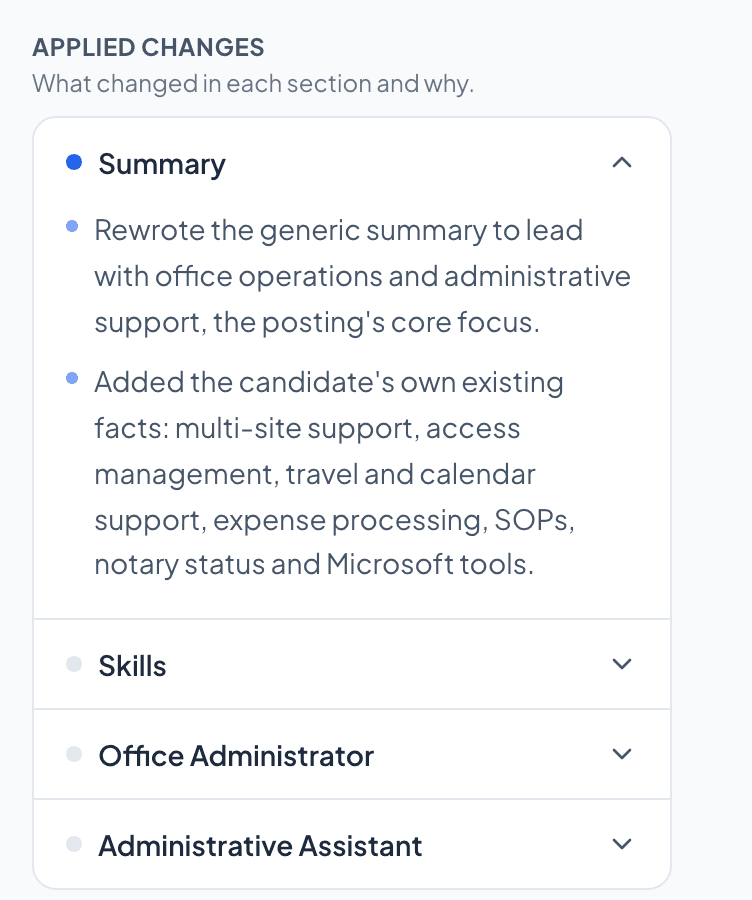
How to tailor your resume to a job posting in about a minute shows the steps, and how to read your tailored resume explains the matched keywords, gaps and change log.
Keep going
The summary opens the page, and the sections under it carry the proof. Skills to put on a resume covers what goes in the skills list and how to show soft skills, and resume bullet points covers the formulas for the lines under each job. If the same two sentences will also be your answer in the room, see tell me about yourself, and for the order and layout of the page, see how to choose your resume template, font and section order.
Questions people ask
How long should a resume summary be?
A common rule of thumb is two to four lines, or roughly 40 to 80 words. That is enough for who you are, two or three strengths and one piece of proof. Past five sentences you are retelling your work history, which the next section already does. A short summary is also easier to tailor for each posting.
Do I need a resume summary at all?
No. Plenty of strong resumes go straight from contact details to experience. A summary earns its place when it tells the reader something your job titles do not: a change of direction, a specialty, a scope or a result. If it would only repeat your most recent title, use the space for another bullet.
Should I write the summary in the first person?
Leave out I, me and my. Write fragments that start with a noun or a verb, such as 'Pharmacy technician with 5 years in a community pharmacy' or 'Manages calendars for three executives'. The reader knows the resume is about you, and the shorter form saves words. Keep full first-person sentences for your cover letter.
What do I write if I have no work experience?
Write a short objective-style summary: the role you want, then the real things you bring to it, such as coursework, a certification, volunteering, a school project or a skill from a part-time job. Two sentences is plenty. Be specific about the job, because a vague objective could fit any applicant.
Can I use the same summary for every application?
You can keep a master version, but change the first line and the proof point for each posting. The title should match the job, the strengths should be the ones the posting lists, and the proof should be the example most relevant to that employer. The edit takes a few minutes and is the main reason the summary exists.
Is it fine to use AI to write my summary?
A tool can produce a draft, but you are the one who answers questions about it in the interview. Check every claim against your history, delete adjectives you cannot back up and make sure each number is real. SnugCV drafts the summary only from facts in your own profile and shows a note on each change so you can check it.
What is a personal profile or personal statement?
On many CVs in the UK and some other countries, the opening block is called a personal profile or personal statement. It does the same job as a resume summary: a few lines on who you are and what you offer. Some university applications use personal statement for a much longer essay, so check the context before you copy a format.
Was this guide helpful?
Get the free resume checklist and new guides
Twenty checks to run before you send a resume, as a one-page PDF. After that, a short email when new guides go up, at most once a week.