Key takeaways
- Auto-detect writes the resume in the language of the posting, or you can choose one.
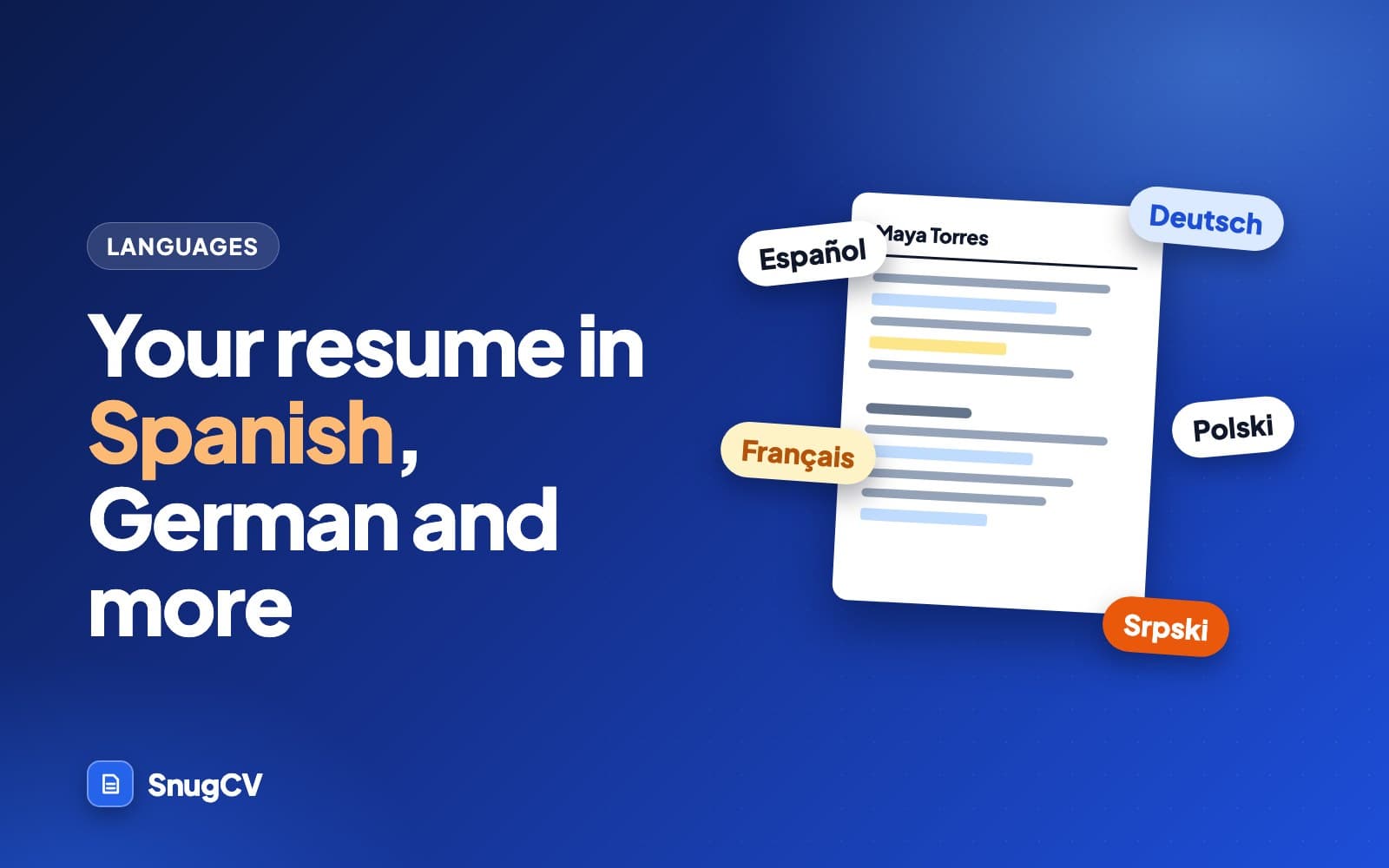
- Seven options: English, British English, Polish, German, French, Spanish and Serbian.
- Employers, job titles and dates are copied from your profile unchanged, so read every line and edit what you want in the local language.
- Photos, dates of birth and consent lines are not part of the layout. Check what the employer expects and supply it in the application.
In this guide
- The languages available
- Option one: let it follow the posting
- Option two: choose a language
- How to make a resume in Spanish, step by step
- What changes and what stays the same
- One bullet, five languages
- How CVs differ from country to country
- Check the result
- Mixing languages
- Troubleshooting
- Mistakes that cost interviews
- About the interface
- Keep going
Applying for a job in another language means more than translating the page. The resume has to read as if it was written in that language, and it has to match what that posting asks for. SnugCV can write your tailored resume in the language of the posting, or in one you pick.
This guide covers the setting, what it changes and what it leaves alone, how one plain bullet reads in each language, how CV habits differ from one country to the next, and how to check a resume in a language you may not read fluently. If you are new to tailoring, how to tailor your resume to a job posting in about a minute shows the whole flow first.
The languages available
In Settings, under Resume preferences, the Resume language option offers:
- Auto-detect
- English
- British English
- Polish
- German
- French
- Spanish
- Serbian
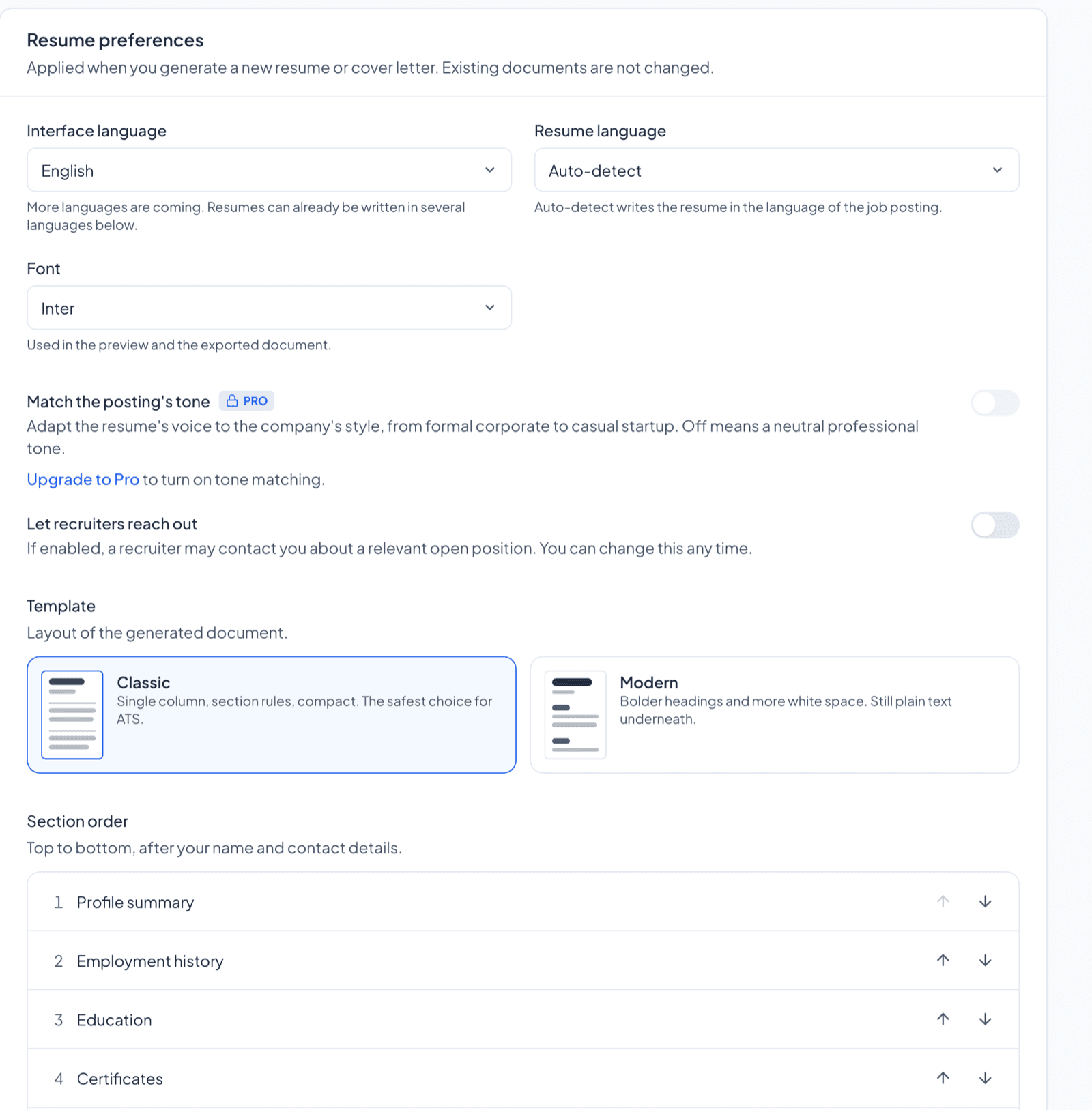
British English is its own option, so British spelling such as organisation and programme is a choice you can make without writing in a different language. The list has no regional variants of Spanish, French, German or Serbian, so check regional vocabulary yourself, such as words that differ between Spain and Latin America or between Germany, Austria and Switzerland.
Option one: let it follow the posting
Leave the setting on Auto-detect. SnugCV writes the resume in the language of the job posting. Paste a posting written in Spanish and you get a Spanish resume. Paste one in German and you get a German one, whatever language your profile is in.
This is the easiest way to apply across several countries, because you do not need to change anything between applications. A posting from a company in Madrid, one from a firm in Berlin and one from a London employer come back in three languages with no visit to Settings in between.
One case needs care. A posting may be written in English by a company that hires locally, for a team that works in another language. Auto-detect follows the posting, so you get an English resume. If you know the team works in German, choose German yourself.
- 1
You paste a posting
In any language, from the web app or the Chrome extension.
- 2
SnugCV reads its language
With Auto-detect on, the posting's language is used. With a language chosen, your choice wins.
- 3
The resume is written
The summary and the reworded bullets come back in that language.
- 4
Facts are copied across
Employers, titles, dates and education are taken from your profile as written.
Option two: choose a language
If you want a Spanish resume for a posting written in English, for example because the company works in Spanish, choose Spanish in the setting before you tailor. Every new resume and cover letter will follow it until you change it back.
Remember that the setting applies to new documents only. Documents you have already made are not changed.
Auto-detect suits you when
- You apply in several countries in the same week
- Each posting is written in the language the employer wants the resume in
- You would rather not think about the setting between applications
Choose a language yourself when
- The posting is in English but the team or the country works in another language
- You want the same posting in two languages
- The posting is in a language that is not on the list
- You want British spelling for an employer in the UK or Ireland
How to make a resume in Spanish, step by step
- Build your profile from your current resume. See how to upload your resume and build a reusable profile.
- Open Settings, set Resume language to Spanish and choose Save preferences.
- Open Tailor resume, paste the posting and generate the resume. See how to tailor your resume to a job posting.
- Read the result closely and edit anything that does not sound right.
- Download the PDF.
The same steps work for German, French, Polish or Serbian. Only the language in step 2 changes. If you tailor from the Chrome extension, it uses the same setting, so a language chosen in Settings applies there too. See tailor your resume from LinkedIn and Indeed.
What changes and what stays the same
Your facts do not change with the language. Employers, job titles, dates and education are copied from your profile as they are written. That means a job title you wrote in English in your profile stays in English in a Spanish resume. If you would rather have a local-language title, change it in your profile before you tailor, or in the document afterwards.
Here is the whole picture, part by part.
| Part of the resume | Written in the language you chose? | Where it comes from |
|---|---|---|
| Summary | Yes | Rewritten for the posting |
| Bullets under each job | Yes, for the jobs that were reworded | Your own bullets, reworded |
| Skills | Wording stays as in your profile | Your profile, possibly reordered |
| Job titles, employers, dates | No, copied as written | Your profile |
| Education, certificates, languages | No, copied as written | Your profile |
| Name, location, email, phone, links | No, copied as written | Your profile |
| Section headings | English in the preview and the PDF today | Fixed in the layout |
| Cover letter | Yes: greeting, body and closing | Facts from your profile |
Three of those rows deserve a second look before you send anything.
A job whose bullets were not reworded keeps its profile text exactly. If your profile is in English, that job can show English lines inside a Spanish resume. Read every job, including the older ones.
Dates are copied as you wrote them. A range such as Mar 2021 - Present keeps the English word Present in a German resume. Replace it in your profile with a word from the language of the resume.
Present, in each language (edit the date range in your profile)
- Spanish: actualidad
- German: heute
- French: aujourd'hui
- Polish: obecnie
- Serbian: danas
Skills keep your profile's wording. SnugCV may reorder them for the posting and may leave out clearly irrelevant ones, but it does not rename them. If you want a skill named in the local language, rename it in your profile. Tool and product names such as Excel or SAP are usually left in English in every language, and that reads as natural.
- 1
Marta Ruiz | Valencia | marta.ruiz@example.com | +34 600 555 010
Header
Name, location, email and phone are copied from your profile.
- 2
Summary
Section heading
Headings come from the layout and are in English, whatever the resume language.
- 3
Agente de atención al cliente con experiencia en soporte por teléfono y correo electrónico para una operadora de telecomunicaciones. Resuelve reclamaciones, gestiona la cola de incidencias y forma a nuevos compañeros.
Summary text
Written in the language you chose, for the posting.
- 4
Customer Support Agent, Lumen Telecom, Mar 2021 - Present
Job line
Title, employer and dates are copied as written. Edit them in your profile if you want local wording.
- 5
Resolví reclamaciones de clientes por teléfono y correo electrónico y mantuve bajo control la cola diaria de incidencias.
Bullet
Your own bullet, reworded into the chosen language.
- 6
Zendesk · Customer onboarding · Conflict resolution
Skills line
Skill names keep your profile's wording. They may be reordered for the posting.
One bullet, five languages
Here is one made-up bullet for each language, shown beside the English bullet it grew from. They show how a plain bullet reads in each language. They are illustrations, not output copied from the product, and your own result will use your own facts.
Customer service
Spanish
Profile (English): Resolved customer complaints by phone and email and kept the daily ticket queue under control.
Resume (Spanish): Resolví reclamaciones de clientes por teléfono y correo electrónico y mantuve bajo control la cola diaria de incidencias.
Warehouse
German
Profile (English): Picked and packed orders every shift with a handheld scanner and checked each order against the delivery note.
Resume (German): Aufträge in jeder Schicht mit dem Handscanner kommissioniert und verpackt, jede Bestellung mit dem Lieferschein abgeglichen.
Restaurant
French
Profile (English): Led a team of six servers during evening service and trained new staff on the till system.
Resume (French): Encadrement d'une équipe de six serveurs pendant le service du soir et formation des nouveaux employés au système de caisse.
Accounting
Polish
Profile (English): Processed supplier invoices and reconciled supplier account balances at month end.
Resume (Polish, written by a man): Księgowałem faktury dostawców i uzgadniałem salda rozrachunków z dostawcami na koniec miesiąca.
Resume (Polish, written by a woman): Księgowałam faktury dostawców i uzgadniałam salda rozrachunków z dostawcami na koniec miesiąca.
Teaching
Serbian
Profile (English): Taught mathematics to three seventh-grade classes and prepared weekly lesson plans.
Resume (Serbian, Latin script): Predavala sam matematiku u tri odeljenja sedmog razreda i pripremala nedeljne planove časova.
Resume (Serbian, Cyrillic script): Предавала сам математику у три одељења седмог разреда и припремала недељне планове часова.
Four things to notice.
- Past-tense verbs carry gender in Polish and Serbian, and titles carry it in French, German and Spanish. Check that every form matches you.
- The German and French lines drop the subject pronoun and use participles or noun phrases. That is a common way to write a CV line in both, and it keeps the line short.
- German postings often add (m/w/d) after a job title to show the role is open to everyone. It belongs to the posting, so leave it off your own titles.
- Product names, certifications and tool names stay as they are. A resume that is in one language apart from those terms reads naturally.
How CVs differ from country to country
A resume in another language is also a resume for another country, and the habits differ. What follows are general conventions. They vary by employer, industry and region, so treat them as a starting point and then look at how the employer's own site and postings write.
One thing is shared. The Europass CV tool, which many European applicants know, advises listing experience in reverse chronological order, most recent first. That matches how the upload step orders your profile, newest first.
Lebenslauf
Germany
Often laid out as a table with dates on the left and details on the right, newest first, with no unexplained gaps. A photo is common and optional. A cover letter (Anschreiben) and copies of certificates (Zeugnisse) usually travel with it.
CV
France
One page is common early in a career, and two later. A photo is optional, and age or marital status are often left off. A cover letter (lettre de motivation) is usually expected.
Currículum
Spain
A CV with a cover letter (carta de presentación) is the usual pair. The Europass format is familiar. Whether to add a photo or personal details depends on the employer, so follow the posting.
CV
Poland
One to two pages. A photo and a date of birth are common and optional. Many postings ask for a short consent to process your personal data. If the posting gives the wording, use it as written.
CV or biografija
Serbia
The Europass format is widely used, and its CV editor and cover letter builder are available in Serbian. Latin and Cyrillic are both in use, so follow the script of the posting.
Always
Your own field
Look at three postings from the same country and field. The way a company writes its own postings tells you what it expects from an applicant.
Some of those conventions have a place in a layout and some do not. This table shows what SnugCV's resume layout holds.
| Element you may see on a CV | Where it is common | In SnugCV's resume layout |
|---|---|---|
| Photo | Customary in some countries, left off in others | Not included |
| Date of birth, nationality, marital status | On some CVs, increasingly left off | Not included |
| Signature and date | Often seen on German CVs | Not included |
| Data-processing consent line | Often seen on Polish CVs | Not included |
| Reverse chronological order | The usual order across Europe | Jobs follow your profile, and you can reorder roles in the edit screen |
| Language levels such as B2 or C1 | Widely used on European CVs | A free-text line in the Languages section |
| Cover letter | Expected in many countries | Written from the same posting, in the same language |
The layout holds your name, location, email, phone, links and the sections listed in Settings. If an employer expects a photo, a date of birth, a signature or a consent line, find out how the application wants it supplied, for example in an upload field or in the form itself.
For language levels, the Europass tool uses the six levels of the Common European Framework (A1 to C2) and asks you to rate listening, reading, spoken interaction, spoken production and writing separately. The Languages section in your SnugCV profile takes any text, so you can write a line such as Deutsch (B2) and it is copied as typed. Rate yourself honestly. A language line is something an interviewer may test in the room.
If you are unsure whether a document should be called a resume or a CV where you are applying, CV vs resume explains the difference.
Check the result
A resume in a second language deserves a closer read. Look for phrasing that is correct but not what a native writer would choose. If you can, ask someone fluent to read it. You can edit every line in the document before you download it. See how to edit your tailored resume.
Before you send a resume in another language
0 of 8 done
If you ask a friend or a colleague to read it, make the request easy to answer.
A message to a fluent reader
Hi [name], I am applying for a [role] position at a company in [country], and the posting is in [language]. Could you read the attached resume as if you were hiring for this job? Please mark anything that sounds unnatural, too formal, too casual or like a literal translation, and tell me if something a local employer would expect is missing. Thank you.
Mixing languages
These are the common cases and what to do in each.
| Starting point | What to set | What to check |
|---|---|---|
| Profile in English, applying in German | Resume language: German, or Auto-detect if the posting is in German | Dates, titles you want glossed, skills wording, headings |
| Profile already written in Spanish, posting in English | Resume language: English, or Auto-detect | Employers, titles and skills stay in Spanish. Rename the ones you want in English in your profile |
| One employer, two possible languages | Make two documents, one per language | That each document reads as one language from top to bottom |
| Postings from several countries in one week | Auto-detect | The language of each result before you download |
Keep your profile in the language you can check best. The resume is built from it, so a profile you can verify line by line gives you a resume you can verify line by line.
Troubleshooting
| What you see | Why | What to do |
|---|---|---|
| The resume came back in English for a Spanish posting | Resume language is set to English or British English | Set it to Auto-detect or Spanish and tailor again |
| The resume is in the wrong language | The setting was left on a language from an earlier application | Check the Resume language line in Settings and tailor again |
| Job titles and employers are in English | They are copied from your profile as written | Edit them in your profile or in the document |
| Skills are in English | Skill names keep your profile's wording | Rename them in your profile before you tailor |
| One job still has English bullets | That job's bullets were not reworded, so the profile text was kept | Edit the bullets in the document |
| Section headings are in English | The headings are fixed in the layout today | Expect English headings above text in your language |
| The posting is in a language that is not listed | The setting offers the languages above | Choose a listed language yourself and check the result closely |
| The interface is not in my language | The interface is in English for now | Resumes and cover letters can already be written in the languages above |
Mistakes that cost interviews
Do
- Choose the language the employer will read the resume in, even if another is easier for you
- Read every job and every line of the result before you download
- Keep titles and degrees faithful, and add a short gloss only when a local reader needs one
- Ask a fluent reader to look at the summary at least
- Return the setting to Auto-detect when the application is done
Avoid
- Run the whole resume through a translator and send it unchecked
- Claim a language level you could not hold in a conversation
- Change a title to a local one that sounds more senior
- Assume a photo, a date of birth or a consent line is wanted, or not wanted, without looking at the posting
- Leave English dates and headings sitting beside a German or Polish text without noticing them
About the interface
The SnugCV interface itself is in English for now. More interface languages are planned. Resumes can already be written in the languages above.
Keep going
Once the language is right, the next question is the shape of the page. Resume formats explains chronological, functional and combination orders, and how to choose your resume template, font and section order covers the layout settings. If the application also wants a letter, how to write a tailored cover letter shows how it is written from the same posting.
Questions people ask
Which languages can SnugCV write a resume in?
English, British English, Polish, German, French, Spanish and Serbian. You can also leave the setting on auto-detect, which uses the language of each job posting. The setting is under Resume preferences in Settings and applies to every new resume and cover letter until you change it.
Will my job titles be translated?
No. Employers, job titles, dates, education, certificates, languages and contact details are copied from your profile unchanged. If you want a title in another language, edit it in your profile before you tailor, or in the document afterwards, and keep the meaning of the original title.
Is the SnugCV interface available in other languages?
Not yet. The menus and buttons are in English today, and more languages are planned. Resumes and cover letters can already be written in the languages above, so you do not need to wait for the interface. Settings already has an Interface language option, ready for more choices when they are added.
Do accented letters and Serbian characters show correctly in the PDF?
Yes. The PDF export embeds fonts that cover Polish and Serbian characters, along with other accented and non-Latin text. Open the downloaded file once and look at your name and the first few lines, because that is the quickest way to confirm every character is right.
Can I keep one resume in two languages for the same posting?
Yes. Set the language, tailor and download, then change the language and tailor the same posting again. Each run makes a separate document and uses one credit on the free plan. The setting applies to new documents only, so the first document stays as it was.
Does SnugCV add a photo or a date of birth for European CVs?
No. The layout has your name, contact line, links and the sections listed in Settings. It has no field for a photo, a date of birth or a signature. If a posting asks for one of those, check how to supply it in the application itself.
Is the cover letter written in the same language?
Yes. Cover letters follow the same Resume language setting as resumes. With auto-detect on, the letter follows the language of the posting. With a language chosen, the greeting, the body and the closing are all written in it.
Was this guide helpful?
Get the free resume checklist and new guides
Twenty checks to run before you send a resume, as a one-page PDF. After that, a short email when new guides go up, at most once a week.