Key takeaways
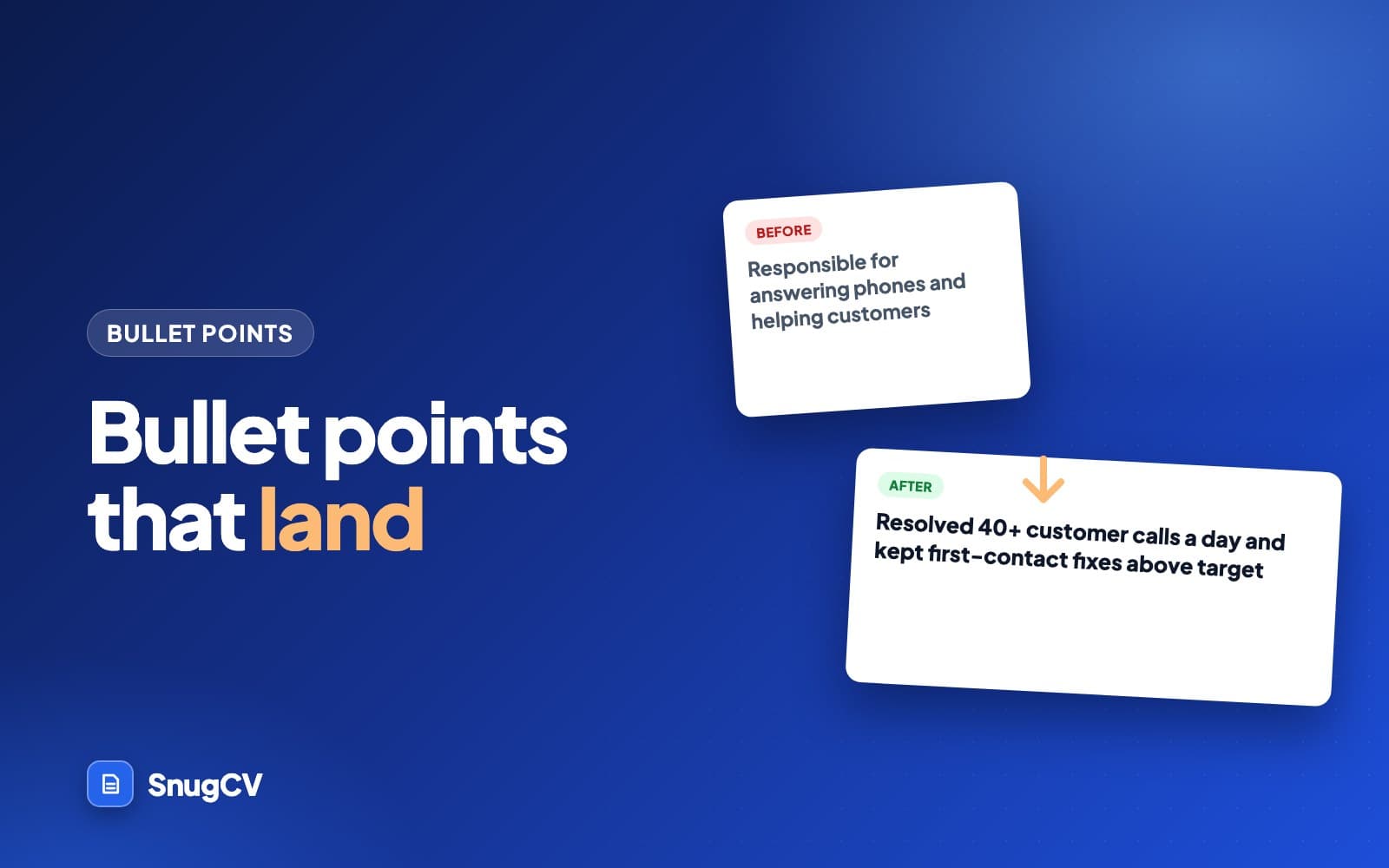
- A good bullet opens with a specific verb, names what you did and for how much or whom, and ends with a result or a responsibility.
- Four formulas cover almost every bullet: action plus task plus result, problem plus action plus result, scope plus action, and result first.
- Numbers come from counting a typical day. Estimate honestly with the word about, and use scope or responsibility when you have no number.
- Aim for 3 to 6 bullets under a recent relevant job, one to two lines each, ordered by relevance to the posting.
In this guide
- What a good bullet does
- Four formulas that cover almost every bullet
- Turn a duty into a bullet in four questions
- Open with a verb, and match the tense
- Five patterns that weaken a bullet
- How many bullets, and how long
- Where numbers hide
- When you have no numbers
- More than 30 rewrites by field
- Bullets when you are starting out
- Special cases
- Formatting the bullets themselves
- Tailoring a bullet to a posting
- Common mistakes
- An edit pass for every bullet
- Where SnugCV fits
- Keep going
Bullets are where a resume does its real work. The summary makes a claim and the skills list names the tools, but the lines under each job are the proof. They are also the part that takes longest to write well, because most people begin by describing their duties and stop there.
This guide gives you four formulas that cover almost every bullet, a way to find numbers you have never counted, what to do when there are none, and more than 30 before-and-after rewrites from retail, food service, healthcare, teaching, trades, driving, office work, finance, sales and tech. Pull the posting's terms out first with how to find the keywords in a job description, then use this guide to put them to work.
What a good bullet does
A bullet has about two lines to do one thing: show a reader what you did and how well. A line that names a duty ("Responsible for scheduling") tells them what the job was. A line that shows scope or a result tells them what you were like in it.
Header
Maya Torres
Summary
Skills
Experience
Education
- 1Each job has a title, an employer and dates. Those stay exactly as they were.
- 2Under each job, 3 to 6 bullets is a common range. Most relevant first.
- 3A bullet opens with a verb, names the work and its size, and ends with a result or a responsibility.
Here is one bullet taken apart.
- 1
Scheduled and confirmed
Verb
A specific verb in the right tense says what you did, and it is the first word the eye lands on.
- 2
40 patient appointments a day for a two-dentist office
Scope
How much, for whom, how often. This is what separates your job from the same title elsewhere.
- 3
filling cancelled slots from a waitlist
Method
How you did it. This is also where tools and the posting's keywords sit naturally.
- 4
so chairs stayed booked through the day
Result
What it led to. Without a result, a scope or a responsibility still does the job.
Put together, that is one idea in one and a half lines: "Scheduled and confirmed 40 patient appointments a day for a two-dentist office, filling cancelled slots from a waitlist so chairs stayed booked through the day."
Four formulas that cover almost every bullet
Most good bullets follow one of four shapes. Pick the one that fits what you have to say.
The default
Action + task + result
Verb, what you did, what came of it.
Trained 6 new servers on the POS and menu in a two-week program, and all six were on full sections within a month.
When something was broken
Problem + action + result
What was wrong, what you did, what changed.
Found that late deliveries came from stops sequenced against dock hours, resequenced the route and cut late arrivals from 5 a week to 1.
No result to report
Scope + action
How big, how often, what you were trusted with.
Opened the pharmacy alone three mornings a week: counted the safe, set up the dispensing area and handled first-hour pickups for about 60 customers.
When the number is the headline
Result first
The change, then how you made it.
Cut supply waste by about a fifth in six months by moving the ordering list to par levels and counting stock weekly.
To choose, ask what you have. A result with a before and an after suits the first or fourth formula. A job where you noticed something wrong and fixed it suits the second, because it also shows judgment. A routine you ran well, with no comparison to show, suits the third, which is still proof of what you were trusted with.
These shapes are close cousins of the STAR method used for interview answers, so a strong bullet is also the first sentence of a strong interview story. Behavioral interview questions and the STAR method covers the spoken version.
Turn a duty into a bullet in four questions
Most first drafts are duty statements, because duties are what you remember. The way out is four questions, asked in order about the duty you want to improve. Here they are applied to a made-up duty from a furniture store: "Scheduled deliveries."
The duty
Scheduled deliveries.
How much, how often?
About 30 deliveries a day across three trucks.
For whom, with what?
Customers in two counties, using the store's order system and a route map.
What went wrong, and what did you do?
Time windows were being double-booked, so you built a grid that showed each truck's day at a glance.
What changed?
Missed delivery windows fell from about 6 a week to 1.
Assembled, the answers give one line: "Scheduled about 30 deliveries a day across three trucks for customers in two counties, building a route grid that cut missed delivery windows from about 6 a week to 1." It is a problem, an action and a result, and it fits in a line and a half.
If the answer to the last question had been "I do not know", the bullet would stop after the grid and still beat the duty it started from. Ask the same four questions of every duty on your list. Most take a minute. A duty that has no answer to the third and fourth questions is probably routine work, and it can be dropped or folded into a skills line.
Open with a verb, and match the tense
The first word of a bullet decides how it reads. "Responsible for" says you were in the room. A specific verb says what you did.
| Type of work | Verbs to reach for | Example opening |
|---|---|---|
| Running and leading | led, ran, supervised, scheduled, trained, onboarded | Trained 6 new servers |
| Fixing and improving | resolved, corrected, reduced, replaced, rebuilt | Reduced late deliveries |
| Serving and supporting | served, answered, advised, assisted, welcomed | Advised customers on fixture choices |
| Making and building | built, installed, assembled, fabricated, wrote, repaired | Installed outlets and panels |
| Counting and checking | reconciled, audited, inspected, tracked, logged, counted | Reconciled vendor statements |
| Selling and persuading | sold, renewed, negotiated, presented, retained | Renewed 9 of 10 contracts |
| Teaching and explaining | taught, explained, demonstrated, mentored, guided | Taught reading and math |
Three small rules keep the verbs working for you:
- Use the present tense for duties you still do in a current job, and the past tense for everything finished. Mixing them inside an old job looks like a mistake.
- Vary the verb across the bullets of one job. Five lines that all start with "Managed" read as one line five times.
- Avoid openers that carry no information: responsible for, duties included, helped with, worked on, assisted in. If you really only assisted, say with what: "Assisted the pharmacist by counting and labeling prescriptions".
A longer list of verbs, grouped by type of work, is in resume action verbs.
Five patterns that weaken a bullet
Weak bullets are weak in a few predictable ways. Once you can name the pattern, the fix is usually obvious.
| Pattern | What it sounds like | The fix |
|---|---|---|
| Duty label | Responsible for scheduling. | Add how much, for whom and what came of it |
| Vague quantity | Handled various tasks for multiple departments. | Replace each vague word with a count or a name |
| Missing subject | Was involved in the rollout of a new system. | Say what you did in it: trained, tested, documented |
| Missing so what | Created weekly reports. | Say who used them and what they decided |
| Borrowed jargon | Worked cross-functionally to drive stakeholder alignment. | Say the plain thing: met weekly with sales and shipping to agree delivery dates |
Four quick tests
Run each bullet through these before you move on.
- The so-what test. Read the bullet and ask so what. If the next line answers it, the two belong together.
- The cover-the-verb test. Hide the first word. If the rest could describe anyone with your title, it needs a scope or a result.
- The interview test. Could you tell the story behind it in a minute, with a detail you have not rehearsed?
- The breath test. Read it aloud. If you run out of air, it is two bullets.
How many bullets, and how long
Length is a matter of space and priority. A reader moves quickly down the page, so the lines near the top of each job carry the most weight.
3 to 6
Bullets under your most recent relevant job. A common range, not a rule.
1 to 2 lines
For each bullet. Roughly 15 to 30 words, with one idea.
Most relevant first
Order by the posting, not by the date of the task.
The count falls as the job recedes.
| The job | Bullets to aim for | What to keep |
|---|---|---|
| Current or most recent relevant job | 3 to 6 | The ones closest to the posting |
| Two or three jobs back | 2 to 4 | Scope and results, not routine duties |
| More than 10 to 15 years ago | 1 to 2, or none | Title, employer and dates are often enough |
| Short or unrelated jobs | 1 to 2 | The transferable parts only |
To decide which bullets to cut, rank each one by how close it sits to the posting, then by how strong its proof is. Keep the top of that ranking. Cut the duties anyone with your title would have, cut any bullet that repeats another, and keep one line that shows range if you have the room.
How much total space you have is covered in how long should a resume be. Inside that budget, three to five strong bullets will do more for you than eight so-so ones.
Where numbers hide
Numbers help because they give a reader a sense of size at a glance. Most people have more of them than they realize, because they have never counted. The table lists the places to look.
| Kind of number | The question to ask | An example |
|---|---|---|
| Volume | How many per day, week or month? | About 150 transactions a shift |
| Size | How many people, accounts, units or locations? | A 12-person team, 85 accounts |
| Money | What budget, sale or saving was involved? | A $40,000 monthly budget |
| Time | How fast, or how often? | Same-day resolution, ticket times |
| Change | What was it before and after? | From 5 late deliveries a week to 1 |
| Rank or rate | Where did you stand against a target or a team? | Top 3 of 20 pickers, above the team average |
| Duration | For how long did you do it? | Every Friday for three years |
How to estimate honestly
When you do not have a report, you can still build an honest estimate from a typical day.
- 1
Count a typical day
Think of an ordinary shift. About how many invoices, calls, tables or tickets?
- 2
Multiply by what repeats
Days per week, weeks per month. Write the arithmetic down.
- 3
Round down
Take the lower figure and write about or roughly in front of it.
- 4
Check it
Would a manager from that job agree? If not, use words instead.
Where to look when the job is in the past
If you left a job years ago, the numbers are usually still recoverable. Check old performance reviews, schedules, emails you sent to a manager, thank-you notes, training records, reports you wrote and your pay stubs for overtime patterns. Ask a former coworker what a normal week looked like. A LinkedIn recommendation sometimes mentions the scope. Your own memory of a typical week is also a fair source, as long as you do the arithmetic and round down.
When you have no numbers
Plenty of good work has no number: a role that was never measured, a task you did well every day, a job where results were not tracked. There are other kinds of proof.
| Kind of proof | What it looks like |
|---|---|
| Scope | Who you served, in what setting, with what equipment or tools |
| Frequency | How often, or how regularly: every morning, each Friday |
| Responsibility | What you were trusted with: keys, cash, opening alone, training |
| Method | How you did it, such as a checklist, a system or a standard |
| Standard | What the work had to meet: an inspection, a protocol, a code |
| Change in words | What stopped happening, or what became possible |
Before
Handled customer complaints.
After
Resolved complaints at the service desk on the spot in most cases, and sent repeat issues to the store manager with a written note.
The habit of escalating with a note shows judgment and process. No number is needed.
Before
Assisted the front office.
After
Opened the front office alone each morning, set up the day's schedule and was the person staff came to when the check-in system froze.
A trusted responsibility and a concrete problem you were the answer to.
Before
Worked with a team to complete projects.
After
Part of a four-person crew on residential remodels, in charge of finish trim and punch-list items at handover.
Crew size and the part you owned replace the vague phrase.
Before
Helped improve processes.
After
Replaced a paper sign-out sheet with a shared spreadsheet, so the whole team could see which equipment was out and who had it.
The change is described in words, and the benefit is visible without a figure.
Before
Trusted with cash and keys.
After
Held keys and opened or closed the store about three times a week, made the nightly deposit and completed the closing checklist for the manager.
Frequency and specific tasks turn a vague claim into a routine a reader can picture.
More than 30 rewrites by field
Every rewrite below is made up, including the numbers and the settings. Look at what changes from the weak version to the strong one: a verb replaces a phrase, a size appears, and the line ends on a result or a responsibility. Use them as models, and swap in your own facts.
Retail and customer service
Retail and service work is full of volume. The strongest bullets say how many, how fast and how accurately.
Before
Responsible for helping customers and operating the register.
After
Processed about 150 transactions a shift at a grocery checkout and balanced the drawer at close, with no shortages logged in a year.
Volume and accuracy replace a duty label.
Before
Stocked shelves and helped with inventory.
After
Received and stocked 3 to 4 pallets each morning and counted a rotating 10 aisles a week, correcting shelf tags and system counts the same day.
Two tasks, each with a size, and a standard of timeliness.
Before
Trained new employees.
After
Trained 8 new cashiers over a holiday season on the register, returns and loyalty sign-ups, using a one-page checklist the store kept.
A group size, a content list and something that outlasted you.
Before
Upsold products to customers.
After
Offered accessories and protection plans at checkout and averaged about $400 a week in add-on sales, above the department's $250 average.
A benchmark gives the number meaning.
Before
Answered phones and helped customers with issues.
After
Resolved about 65 calls a day for a telecom provider, closing most issues on the first call and documenting every contact in the CRM.
A call volume, a first-call habit and a record-keeping habit.
Food service and hospitality
In kitchens and dining rooms, speed, covers and safety standards are the numbers readers look for.
Before
Served food and drinks to guests.
After
Served up to six tables at a time in a 120-seat restaurant, taking orders on the POS and confirming allergies before every order went to the kitchen.
Section size, venue size and a safety step.
Before
Cooked food in a fast-paced kitchen.
After
Cooked grill and saute orders to ticket times on weekend nights of up to 300 covers, keeping the station's prep list and labels current.
The tired phrase is replaced by the real volume.
Before
Cleaned the kitchen and followed health rules.
After
Kept temperature and sanitation logs for the station and passed three unannounced health inspections without a critical violation.
A record and an outcome that an inspector would recognize.
Before
Managed bar inventory.
After
Counted bar stock weekly and ordered to a par list, which cut spoilage on garnishes and mixers and kept the bar within its monthly cost target.
A method and a result in words. A number would be a bonus.
Healthcare
In clinical work, say the size of the load and the standard you worked to. Leave out patient details that identify anyone.
Before
Took care of patients on the unit.
After
Provided care for 5 to 6 medical-surgical patients per shift, including medication administration, wound care and discharge teaching.
A patient ratio and three named clinical tasks.
Before
Documented patient information.
After
Charted assessments, vitals and interventions in the EHR within the same shift, and gave a structured handover to the next nurse at each change.
A standard of timeliness and a named handover habit.
Before
Helped residents with daily activities.
After
Assisted up to 12 long-term care residents per shift with mobility, bathing and meals, and reported changes in condition to the charge nurse the same hour.
A caseload and a safety habit.
Before
Roomed patients and assisted providers.
After
Roomed and took vitals for about 30 patients a day and prepared supplies for procedures, so providers started each visit on schedule.
Daily volume and the effect on the clinic's day.
Before
Filled prescriptions.
After
Filled about 200 prescriptions a shift, resolved insurance rejections at the counter and flagged possible interaction concerns for the pharmacist.
Volume, a problem you solved and a safety step within your scope.
Teaching and education
Teaching bullets work best when they name the grade, the class size and the method, and then a visible result.
Before
Taught fourth grade.
After
Taught reading and math to a class of 26 fourth graders, using weekly checks to form small groups. The share meeting the end-of-year reading target rose from 15 students to 21.
Grade, class size, method and a before and after.
Before
Communicated with parents.
After
Held conferences with every family twice a year and sent a short progress note home each Friday for students on intervention plans.
Frequency and audience turn a label into a routine.
Before
Used technology in the classroom.
After
Built a shared class site with weekly assignments and short video lessons, so absent students could catch up within a day.
A concrete product and the problem it solved.
Before
Helped with special education students.
After
Supported 6 students with learning plans in a fourth grade classroom, adapting worksheets to their goals and recording daily progress notes for the case teacher.
A group size and two named tasks.
Trades, warehouse and driving
Hands-on work is easy to count: units, loads, hours and inspections. Safety records are worth stating plainly.
Before
Did electrical work on residential jobs.
After
Installed outlets, circuits and panels on 20 residential remodels under a journeyman, and passed rough-in inspection on the first visit for 18 of them.
Job count and a quality measure that an inspector set.
Before
Operated forklift and moved pallets.
After
Operated a sit-down forklift to load and unload 40 to 50 pallets a shift, with no preventable incidents in three years.
Volume and a safety record in one line.
Before
Drove truck and delivered freight.
After
Drove about 2,500 miles a week on regional routes with a clean inspection record, planning stops around dock hours and keeping hours-of-service logs current.
Mileage, a record and two compliance habits.
Before
Did welding in a fabrication shop.
After
Welded structural steel frames to drawing tolerances in MIG and TIG, and passed bend tests for two certifications.
The standard met and the process named.
Before
Worked in a warehouse picking orders.
After
Picked and packed about 250 lines a shift on a handheld scanner at 99 percent accuracy, one of the top three pickers on the shift for the quarter.
Rate, accuracy and rank in a single line.
Office, administration and finance
Office bullets get weaker the more they sound like job descriptions. Name the size of the operation and the standard of accuracy.
Before
Managed schedules for executives.
After
Managed calendars for three executives across two time zones, rescheduling about 15 meetings a week without double-booking.
How many people, how many time zones, how much change.
Before
Responsible for processing invoices.
After
Processed about 400 invoices a month, matched each to a purchase order and resolved vendor questions within two business days.
Volume, a control and a response time.
Before
Answered phones and greeted visitors.
After
Handled the main phone line and greeted about 40 visitors a day for a 60-person law firm, routing calls and logging deliveries in the visitor system.
Firm size, volume and two systems of record.
Before
Did bookkeeping for small businesses.
After
Kept monthly books for 20 small business clients in QuickBooks, reconciled accounts and prepared sales tax filings on schedule.
Client count, a tool and a deadline.
Before
Helped with payroll.
After
Processed biweekly payroll for 85 employees, checked hours against timesheets and corrected errors before the pay run closed.
Headcount and a control step.
Sales, marketing and tech
These fields reward results and named tools. Where the work is a tool, say what you built or fixed with it.
Before
Sold products to small businesses.
After
Managed 120 small business accounts and closed about 15 new deals a month, renewing 9 of 10 expiring contracts.
Book size, pace and renewal rate.
Before
Managed social media accounts.
After
Wrote and scheduled 12 posts a week across three locations and reported monthly reach and sign-ups to the owner.
Cadence, scale and a reporting habit.
Before
Fixed computer problems for employees.
After
Resolved about 25 tickets a day for a 400-person company, escalated unresolved cases with full notes and wrote 30 knowledge base articles.
Volume, an escalation standard and a lasting product.
Before
Developed backend features.
After
Wrote and maintained 14 REST endpoints in Python for the payments service, with unit tests that run on every merge.
Count, language, system and a quality practice.
Bullets when you are starting out
With little paid experience, the same formulas apply to the places you do have: school, volunteering, informal work and a first part-time job. The reader wants to see that you can do things reliably, so treat these like jobs, with a role, a setting, dates and bullets.
Coursework
School project
Led a five-person group project on a school budget, tracking 30 line items in a shared spreadsheet and presenting the results to a panel of three teachers.
Unpaid work
Volunteering
Sorted and shelved about 200 donated items each Saturday at a community pantry, and trained two new volunteers on the intake log.
Self-employed
Informal work
Maintained lawns for 8 regular clients over three summers, scheduling visits around the weather and collecting payment each week.
Hourly work
First part-time job
Greeted and seated about 60 guests per shift at a family restaurant, keeping the waitlist current and texting guests when tables opened.
Each of those has a verb, a size and a detail that shows you did it. The wider question of what else goes on a page like that is covered in resume with no experience.
Special cases
Some situations do not fit the usual one-job, one-block layout.
Several titles
Promoted at one employer
List each title with its own dates under one employer heading, and give each title its own bullets, with fewer for the earlier one. The change in scope between titles is often the best proof you have, so show the climb instead of merging the titles.
Short stints
Contract, temp and gig work
Group short assignments under one heading, such as temporary assignments with a date range, and write two or three bullets that cover the kinds of work. Name the settings, and respect any confidentiality terms in your contracts.
Gaps
Returning after a break
Do not fill the space with a bullet about the break. Let the dates stand, and put any relevant training, volunteering or freelance work under its own heading with bullets in the usual formulas.
Shared credit
Team results
Describe your part of a group result. "Part of a five-person crew that finished the remodel two days early, owning all finish trim" says more than an unattributed we. Avoid claiming the team's whole total as yours.
Formatting the bullets themselves
A few small choices keep the page clean and easy to read in any system.
- Use one plain bullet symbol, such as a solid dot, all the way down. Unusual symbols can turn into boxes in some programs.
- Keep a single level of bullets. Sub-bullets add length and rarely add information.
- Do not bold phrases inside bullets. Bold keywords look like highlighting, and plain lines read as more natural.
- Choose a punctuation style, with periods or without, and apply it to every bullet in the document.
- Keep experience in plain text lines, not in a table or a text box, so it reads in order.
Layout and template choices are covered in how to choose your resume template, font and section order, and the wider formatting rules for systems that read resumes are in ATS-friendly resume.
Tailoring a bullet to a posting
The same fact can be written in a way that answers a posting and in a way that does not. Here is a made-up posting for a kitchen job, and the bullets of a cook who has done everything it asks.
Job posting (made up for this guide)
Line Cook, Harbor Bistro
Prepare and cook menu items to ticket times on grill and saute stations in a high-volume kitchen. Follow food safety and sanitation standards and keep temperature logs. Maintain prep lists and station inventory. Train new cooks on stations. 1+ year of line experience. Food handler card required.
Before
Cooked food for customers in a busy kitchen.
After
Cooked grill and saute orders to ticket times in a high-volume kitchen, serving up to 300 covers on weekend nights.
The posting's station names, its phrase high-volume kitchen and a real volume.
Before
Cleaned up and followed health rules.
After
Kept temperature and sanitation logs for the station and followed food safety standards on every shift.
Logs and standards appear as the posting words them, because the cook did exactly this.
Before
Helped with prep and stock.
After
Maintained the station's prep list and counted its inventory at close, ordering to par levels.
Prep lists and station inventory are the posting's own noun phrases.
Before
Helped new people.
After
Trained three new cooks on grill and saute stations over their first two weeks.
Train new cooks is a posting requirement, and this is the evidence.
A bullet needs only one or two terms from the posting. A line crowded with four reads like a list and is harder to believe. If a term does not fit naturally in a bullet, it can live in the skills section or the summary instead.
The food handler card stays out of the bullets. A card is a credential, and it belongs in a certifications section where a screener can find it. The bullets then do the job only they can do, which is to show the work. The method for finding a posting's terms and matching them to proof is in how to find the keywords in a job description, and the opening lines that sit above the bullets are covered in resume summary examples.
Common mistakes
Do
- Open with a specific verb in the right tense
- Put the scope or the result in the same line as the task
- Keep each bullet to one idea
- Order bullets by relevance to the posting
- Use the posting's words where they describe what you did
- Check every bullet against what you could explain in an interview
Avoid
- Start with responsible for, duties included or helped with
- Pack three tasks into one run-on line
- Invent or inflate a number
- Open five bullets with the same verb
- Copy a sentence from the posting
- Write bullets that wrap to four lines, or paragraphs in place of bullets
An edit pass for every bullet
Bullet check
0 of 8 done
Where SnugCV fits
SnugCV rewords the bullets under each job in the posting's language when you tailor, using the facts already in the profile you built from your uploaded PDF resume. Employers, titles, dates and education are copied unchanged, and every changed bullet comes with a plain-language note so you can check it against what you actually did. You can edit any line in the editor and watch the preview update before you download the PDF. Your first few tailored resumes are free with no card.
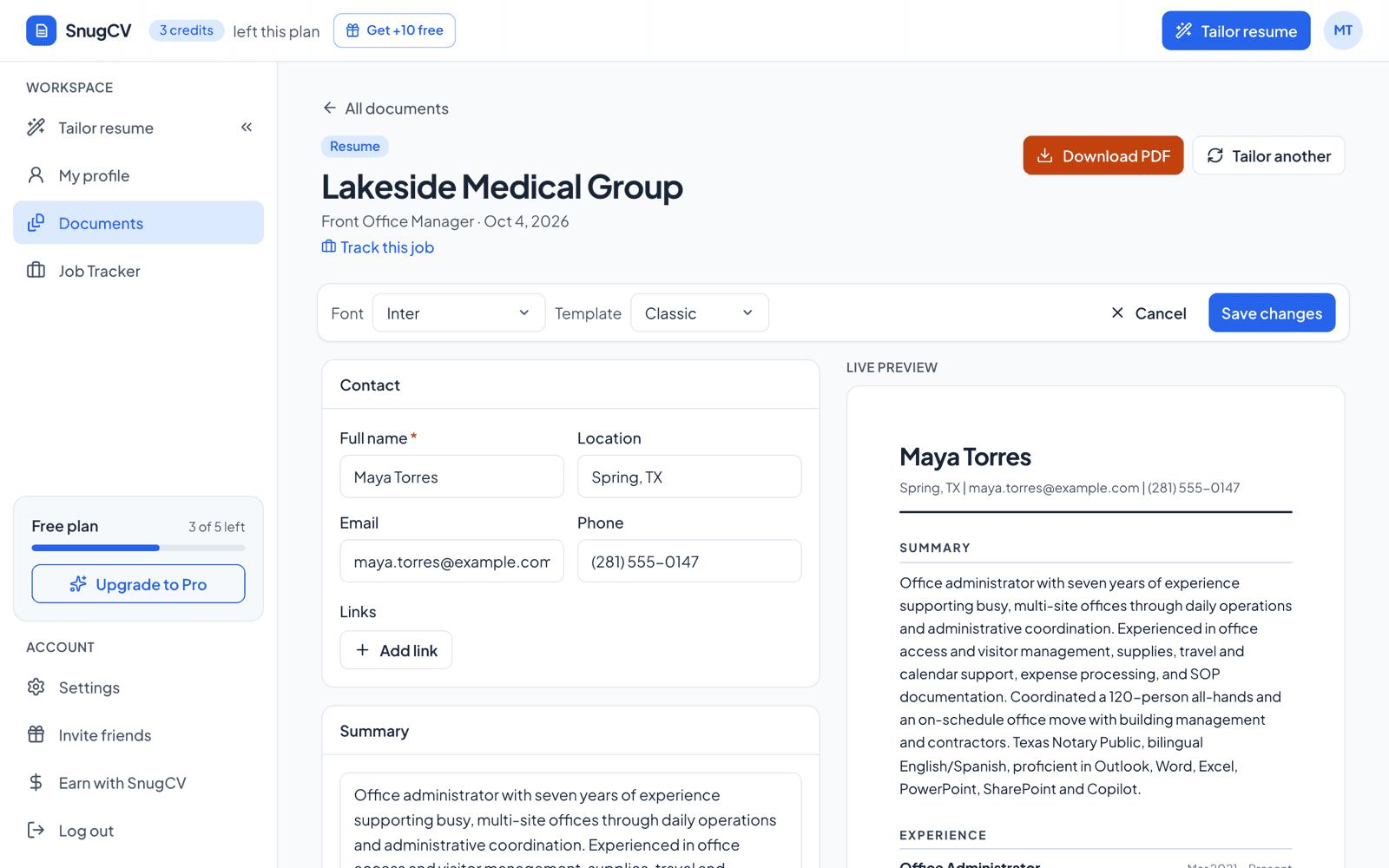
How to edit and download your tailored resume walks through the editor, and how to read your tailored resume explains the change log.
Keep going
Bullets work best next to a clear opening and an honest skills list. Resume summary examples covers the top of the page, and skills to put on a resume covers the list. For stronger verbs, see resume action verbs, and if you are changing fields, career change resume shows how to describe old work in a new posting's vocabulary. To see bullets in one trade's vocabulary, the EMT, firefighter, store manager and bartender resume guides each have before and after lines.
Questions people ask
How many bullet points should each job have?
A common rule of thumb is 3 to 6 bullets under your most recent relevant job, 2 to 4 for jobs before that, and one or two for older or unrelated roles. Choose the bullets closest to the posting rather than every duty you had. If a job has 10 bullets, the three that matter are hard to find.
How long should a resume bullet point be?
One to two lines, roughly 15 to 30 words. Each bullet should carry one idea. If a bullet wraps to a third line, it is usually two bullets glued together, or it has a clause that explains rather than proves. Split it, or cut the part a reader can do without.
Do I need a number in every bullet?
No. A number helps when you have an honest one, because it gives the reader a sense of size. When you do not, scope (who you served, how often, with which tools), a responsibility someone trusted you with, or a change described in words can carry the same weight. Never invent a figure to fill a gap.
Should resume bullets end with a period?
Either works, as long as you are consistent. Many resumes leave periods off short fragments, and many use them when bullets run to a full sentence or two. Pick one style for the whole document and check it on every line. The same goes for the tense of your verbs and the type of bullet symbol.
What tense should I use for resume bullets?
A common convention is the present tense for duties you still do in your current job and the past tense for everything finished, including finished projects in a current job. Mixing tenses inside one old job reads like a mistake. Read each job top to bottom and check that the verbs agree.
What if I do not know my numbers?
Estimate from a typical day, multiply by what repeats, round down and write about. Old schedules, emails, reports and former coworkers can confirm a figure. If a manager from that job would not agree with your estimate, do not use it. Describe the scope in words instead, which is still proof.
Can I use the same bullets for every application?
Keep one master set, then reorder and reword for each posting. Put the bullets closest to the job first and use the posting's terms where they describe what you did. Every fact stays the same, and you will find the edit takes minutes once the master exists.
Was this guide helpful?
Get the free resume checklist and new guides
Twenty checks to run before you send a resume, as a one-page PDF. After that, a short email when new guides go up, at most once a week.