Key takeaways
- In the United States and Canada a resume is a short, tailored document for most jobs, and a CV is a long, complete record used for academic, research and some medical roles.
- In the UK, Ireland, Australia, India and many other countries, CV is the ordinary word for the short document that Americans call a resume, usually one to two pages.
- Length, tailoring and personal details such as photos follow local convention and the individual employer. The posting's own wording and instructions are the best guide.
- Keep one master document with everything in it, and cut it down for each application.
In this guide
You will see both words on job boards, and the advice online often seems to contradict itself. The reason is that the words mean different things in different places, so two people can give opposite answers and both be right for where they live.
This guide sorts it out. You will see how the two documents differ, how the words are used in different regions, what each contains, and how to turn one into the other. It also shows how to decide quickly when a posting says CV and you are not sure what it means. If length is the question you came with, how long should a resume be goes deeper on one page versus two.
The short answer
In the United States and Canada, a resume is a short document, usually one or two pages, rewritten for each job. A CV (curriculum vitae, Latin for course of life) is a long, complete record of your career, used mainly for academic, research, scientific and some medical positions. In most of the rest of the English-speaking world, including the UK, Ireland and Australia, and in many other countries, people say CV for the same short document that Americans call a resume.
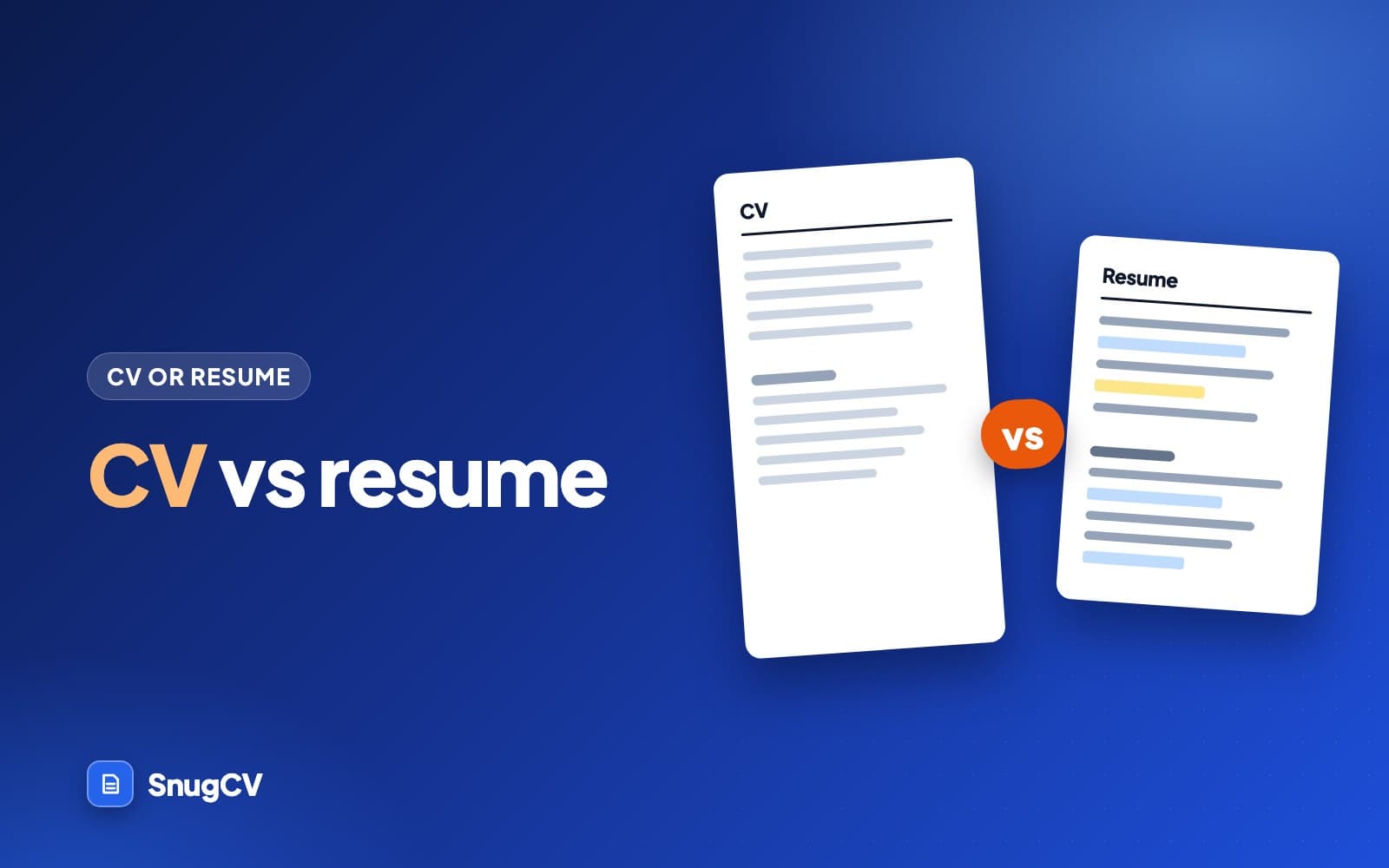
So "CV or resume?" has two answers depending on the country, and sometimes the employer's own habits override both. This table uses the North American meanings, where the two documents really do differ.
| Resume | Academic-style CV | |
|---|---|---|
| Purpose | Get an interview for a specific job | Give a complete record of your academic and professional work |
| Typical length | One page, two for a long career | Three or more, no fixed limit, grows over time |
| Tailored per job | Yes, each time | Mostly a stable record, with sections reordered for the role |
| Leads with | A summary and the experience that fits the job | Education, then research, publications, grants and teaching |
| Contents | Selected jobs, skills and results | Everything: publications, presentations, grants, awards, service |
| Used for | Most jobs in business, retail, trades, healthcare and technology | Faculty and research posts, fellowships, grants, some medical and scientific roles |
1 to 2 pages
a common length for a US or Canadian resume
2 pages
a common maximum for a UK-style CV
No fixed limit
an academic CV, which grows with your career
These are conventions, and conventions are not laws. The length that looks normal to one recruiter looks short or long to another, so treat the numbers as starting points.
Why the words confuse people
The same document goes by different names depending on where the employer is. This table summarizes the general conventions. Individual employers, industries and recruiters differ, and norms change over time, so read it as a map and not a rulebook.
| Where | Word usually used | Typical length | Photo and personal details |
|---|---|---|---|
| United States | Resume for most jobs. CV for academic, research and some medical roles | One page early in a career, two with a long history | A photo is not expected. Age, marital status and similar details are usually left off |
| Canada | Resume in English for most jobs. CV for academic and research roles. In French, CV is the everyday word | One to two pages | A photo, date of birth and marital status are generally left off |
| United Kingdom and Ireland | CV for almost everything. Resume is understood but used less | Two pages is the usual maximum for most roles | A photo is not expected. Official UK careers guidance says to leave out age, date of birth, marital status and nationality |
| Australia and New Zealand | Resume and CV, often used interchangeably | Often a little longer than in the US, with employer maximums taking priority | A photo is not usual. Some employers ask for named referees, so check the posting |
| Continental Europe | CV, or the local word such as Lebenslauf in German | Often one to two pages. Europass is a standard format | Practice varies by country. A photo and more personal details are normal in some places |
| India and parts of South Asia | CV and resume are both used for the ordinary document | Varies by employer and sector | Some employers expect more personal details than in the US or UK, so check the posting |
The pattern is that CV is the short, everyday word in many places outside North America, and in North America it means a longer academic record. An American applying to a London employer should say CV and mean the short tailored document. A British academic applying to a US university should expect the department to want the long version, which they will also call a CV.
The three documents side by side
The easiest way to see the differences is to follow one person. Dr. Nadia Rahman is a made-up environmental scientist with a PhD, three years as a postdoctoral researcher and four years in a consulting firm. She applies to three places: a university lectureship, an environmental consultancy in Leeds and an environmental firm in Chicago. The history is the same each time. The documents are not.
One to two pages, tailored
US resume
Opens with a three-line summary about water quality and consulting delivery. Experience comes first, with bullets that echo the posting. Publications shrink to one line: co-author of 11 papers on stream water quality. Teaching and conference talks may not appear at all.
Two pages, tailored
UK-style CV
Opens with a personal profile of a few lines. Key skills, then employment history in reverse order. Education and qualifications follow. Three selected publications, with the full list available on request. No photo, no date of birth.
Three pages or more, no fixed limit
Academic CV
Education with dissertation title. Appointments. All publications in full citation form. Grants and fellowships. Teaching. Presentations. Service and memberships. Named referees. It reads as a complete record, and most of it is not tailored.
A US or Canadian resume
A resume is built to be skimmed in seconds. It leads with a short summary and the experience that matches the posting, picks the bullets that match what the employer asked for, and drops anything that does not help this application. That tailoring is what separates it from a CV in the North American sense: the same person has a different resume for every job.
Header
Maya Torres
Summary
Skills
Experience
Education
- 1A short summary at the top says in two or three lines who you are and what the job needs from you.
- 2Experience carries the page. Each job gets a few bullets that show results and use the posting's wording where it is accurate.
- 3Education is brief and sits near the end, unless you are a new graduate and it is your strongest credential.
For the reasoning behind rewriting it each time, see why tailor a resume for each job.
A UK-style CV
The short CV used in the UK, Ireland and many other countries serves the same purpose as an American resume and looks similar. Official UK careers guidance lists contact details, a short introduction, education and work history, with references as an option, and advises leaving out age, date of birth, marital status and nationality. The usual maximum is two pages of A4, and a page that is half empty looks weaker than one that is full, so aim for one full page or two.
Example: the top of a UK-style CV (made up)
NADIA RAHMAN
Leeds · 07700 900123 · nadia.rahman@example.com
PERSONAL PROFILE
Environmental scientist with seven years of research and four years of consultancy experience in water quality monitoring and reporting. Experienced in field sampling, data analysis and writing client reports to regulatory deadlines. Looking for a senior consultant role in water and environmental assessment.
KEY SKILLS
Field sampling and laboratory analysis · Data analysis in R · Environmental impact reporting · Client communication · Project delivery to deadline
EMPLOYMENT HISTORY
Research Scientist, Fenwick Environmental Consulting, Leeds, 2022 to present
- Lead water quality sampling programs for clients across three river catchments
- Write and quality-check technical reports for regulators and local authorities
- Supervise two junior analysts
Postdoctoral Researcher, Northern University, 2019 to 2022
- Designed and ran a three-year field study of nitrate in headwater streams
- Presented findings at two national conferences and in three peer-reviewed papers
EDUCATION AND QUALIFICATIONS
PhD Environmental Science, Northern University, 2019
MSc Hydrology, Riverside University, 2015
SELECTED PUBLICATIONS
Rahman, N., Ellis, T. and Vargas, M. (2021). Seasonal nitrate loads in lowland streams. Journal of Applied Freshwater Science, 14(2).
Rahman, N. and Vargas, M. (2020). Sampling design for headwater streams. Freshwater Methods Review, 8(1).
Ellis, T., Rahman, N. et al. (2019). Nitrate and land use in three catchments. Catchment Science Letters, 5(3).
Full list available on request.
REFEREES
Available on request.
An academic CV
An academic CV is the full record of your scholarly work, laid out so a hiring committee can inspect it. It lists degrees, appointments, publications, grants, teaching and service. University career centers consistently list the same core sections, and the order shifts with the job: research posts put publications and grants early, teaching posts put teaching early.
- 1
PhD, Environmental Science, Northern University, 2019. Dissertation: Nitrate dynamics in headwater streams
Education
Degrees in reverse order, usually with the dissertation title and advisor. This is typically the first section.
- 2
Postdoctoral Researcher, Northern University, 2019 to 2022
Appointments
Academic and research positions with dates. Industry roles usually appear here too, in date order.
- 3
Rahman, N., Ellis, T., and Vargas, M. (2021). Seasonal nitrate loads in lowland streams. Journal of Applied Freshwater Science, 14(2), 101-118.
Publications
Full citations in your field's style, newest first, often split into peer-reviewed work and other output.
- 4
Principal Investigator, Regional Water Fund, Stream Nitrate Study, 2021 to 2022, $38,000
Grants and fellowships
Grant name, funder, dates and purpose. The amount is optional, and common in some fields.
- 5
Nitrate loads in lowland streams. National Freshwater Science Conference, Denver, 2021
Presentations
Title, event, place and date. Some CVs separate invited talks from contributed ones.
- 6
Teaching Assistant, Environmental Chemistry Laboratory, Northern University, 2015 to 2018
Teaching
Courses, institution, your role and dates. Teaching-focused jobs may move this section near the top.
- 7
Reviewer, Journal of Applied Freshwater Science. Member, Freshwater Science Society
Service and memberships
Committees, peer review and professional societies show standing in the field.
The same CV usually ends with named references, and many applicants keep a "kitchen sink" master version with every entry, then cut it down to fit each application. References on a resume covers how to choose and prepare the people who will vouch for you.
Which one to send
When a posting says CV and you are unsure what it means, three questions settle most cases.
- 1
Read the posting's wording
If it says resume, send a resume. If it says CV, continue.
- 2
Check the kind of job
Faculty, research, fellowship and many medical posts expect a full CV.
- 3
Check the country
In the UK, Ireland and many other places, a CV is the short document.
- 4
Ask, or go short
When it is still unclear, ask the contact, or send the short tailored version and keep the long one ready.
Applied to common situations:
| The posting says | You are applying for | Send |
|---|---|---|
| Send your resume | A business, trades, retail, healthcare or technology job in the US or Canada | A one or two page resume tailored to the posting |
| Send your CV | A job in the UK, Ireland, Australia or a similar country | A short, tailored CV of one to two pages |
| Send your CV | A faculty, research or postdoctoral post, anywhere | A full academic CV |
| Send your CV | A US job outside academia | Usually a tailored resume. If the role is research-based, add a short selected publications section |
| Submit a curriculum vitae | A medical or scientific post | A full CV, because those fields use it as a complete record |
| A government job announcement | A US federal or other public sector job | Follow the announcement. US federal jobs on USAJOBS take a resume of two pages at most since September 27, 2025 (OPM's guidance) |
Real jobs do not always fit the table. Here are four in-between cases, from different fields.
Lab and R and D roles
Industry researcher
You have publications or patents and the job is at a company. Send a resume of one or two pages with a short section of selected publications and patents, limited to the three or four that fit the role. Keep the full list ready for when someone asks.
Medicine and clinical research
Physician or clinical researcher
Medical and research posts commonly expect a CV: training, licensure, certifications, appointments, publications and presentations. A hospital administration or industry role in the same field may want a resume instead, so read the posting.
Schools and colleges
Teacher changing countries
School jobs in many countries ask for a short CV with qualifications, registration and subjects taught. A university teaching post wants the long record. Check which kind of institution is hiring, and include the teaching registration details that the country requires.
Trades and logistics
Tradesperson or driver abroad
A short CV of one to two pages with licenses and tickets near the top is the usual shape. Name each license, its class and its issuing body, because a license from one country may not carry over, and the employer needs to see exactly what you hold.
When you are not sure what an employer expects, asking is better than guessing. A short email like this one works.
Template: asking which document the employer wants
- To
- [recruiter name]
- Subject
- Question about the application format for [job title]
Hello [name],
I am preparing my application for the [job title] position. The posting asks for a CV. Would you like a short, one or two page document focused on this role, or a full CV that includes publications and teaching? I am happy to send either.
Thank you,
[your name]
Converting between them
The practical way to work is to keep a master document that holds everything: every role, every project, every publication, every course. Then cut it down for each use. A short version is made by deleting and rewording. A long version is made by adding back.
| In a long CV | On a resume |
|---|---|
| Education with dissertation title and advisor | Degree, school and year. One line on the dissertation if the topic fits the job |
| Appointments | Experience with two to four bullets per role, aimed at the posting |
| Publications | One summary line, or two or three selected titles |
| Grants and fellowships | A bullet if it shows leading a project or managing a budget |
| Presentations | One line, unless the job involves speaking or training |
| Teaching | Training, mentoring or presenting, in plain terms |
| Service and memberships | A short line of professional memberships |
| Referees | Leave off. Have them ready when asked |
Here is how three made-up CV entries become resume lines for an industry job.
Before
Principal Investigator, Regional Water Fund, Stream Nitrate Study, 2021 to 2022, $38,000.
After
Led a one-year study of stream nitrate with a team of three, on a $38,000 grant, and reported the findings to the funder.
A grant entry becomes evidence of project ownership and budget responsibility.
Before
Rahman, N., Ellis, T., and Vargas, M. (2021). Seasonal nitrate loads in lowland streams. Journal of Applied Freshwater Science, 14(2), 101-118.
After
Co-author of 11 peer-reviewed papers on stream water quality, including a study of seasonal nitrate loads.
A citation becomes a sentence. A hiring manager outside the field needs the topic and the volume, not the page numbers.
Before
Teaching Assistant, Environmental Chemistry Laboratory, Northern University, 2015 to 2018.
After
Taught lab technique and safety procedures to undergraduate groups each term, and graded their lab reports.
Teaching becomes training and quality control, which an employer can map to their own needs.
Going the other way, from a resume to a CV, is mostly collecting. The resume has no place for the fuller material, so gather it: publication citations in the field's style, presentation dates, grant amounts, courses taught, committee work. Start from the master document and keep adding to it every term, because those details are easier to record when they happen than to reconstruct five years later.
Set up a master document once
Whichever direction you convert, the work is easier from a single source. Build the master document once and treat every version as a cut of it.
- 1
Collect everything
Every role, project, course, license, publication, talk and award, with exact dates.
- 2
Tag each entry
Mark it as research, teaching, industry, service or general, so you can filter quickly.
- 3
Fix the facts once
Titles, employers and dates live in one place, so versions cannot disagree.
- 4
Cut a version per use
A short resume for each industry posting, a full CV for academic posts, a UK-style CV where it is the local word.
- 5
Name the files clearly
Your name plus the document and the use, such as nadia-rahman-cv-academic.pdf.
A reader going through many applications wants to find a section fast, so use the same headings every time, put dates in a consistent place and keep the order predictable.
Writing for another country
Moving a document across a border is mostly a matter of vocabulary and conventions. The facts stay the same, and the labels and the order of the details change. These are the words that most often differ.
| In the US and Canada | In the UK and Ireland | Note |
|---|---|---|
| Resume | CV | Both words are used in Australia |
| Summary | Personal profile or personal statement | A few lines in either case |
| Experience | Employment history or work history | Most recent first in both |
| Education | Education and qualifications | List results where the local system expects them |
| High school diploma | GCSEs and A-levels (UK), Leaving Certificate (Ireland) | Name the qualification and the year |
| GPA | Degree class, such as a first or a 2:1 (UK) | Use the measure the employer's country uses |
| References available on request | Referees available on request | Same idea, different word |
| Zip code | Postcode | Format follows the country |
| Letter paper | A4 paper | Set the page size before you export the PDF |
| Color, organization | Colour, organisation | Match the spelling to the audience |
Here is how a made-up warehouse supervisor from Dublin might adapt an Irish CV for a posting in Toronto.
Before
Header with a photo, date of birth and nationality under the heading Personal details.
After
Name, phone, email and city only.
A photo and date of birth are generally left off in Canada. If the posting asks about work authorization, answer in one factual line.
Before
Personal profile: Conscientious and reliable warehouse professional seeking a challenging role with a progressive organisation.
After
Summary: Warehouse supervisor with six years of inbound and outbound experience, a forklift license and a team of 12. Seeking a shift supervisor role in distribution.
The heading changes, and so does the content: the second version names the job, the years and a credential.
Before
Leaving Certificate, 2012. Level 6 Advanced Certificate in Logistics, 2014.
After
High school diploma (Leaving Certificate, Ireland), 2012. Advanced Certificate in Logistics (Level 6, Ireland), 2014.
Name the qualification and the country, so a reader in another system can place it.
Before
Interests: football, cooking, travel. Referees available on request.
After
Interests dropped, or one line that relates to the role. Reference details kept ready for when they are requested.
A long interests section takes space that a North American resume uses for results.
The same exercise runs in reverse. A US resume going to a London employer gains a personal profile heading, loses a GPA in favor of the degree classification the employer will recognize, and moves to A4 paper and British spelling.
Photos and personal details: what to do when you are unsure
Conventions on photos, date of birth, marital status and nationality vary more than anything else in this topic. In the US, Canada and the UK, employers generally do not expect them and many applicants leave them off. In some other countries a photo and more personal details are normal on a CV. What an employer may ask or consider also depends on local rules, which differ.
Do
- Follow any instruction in the posting about photos, personal details or documents
- Look at examples or templates that come from the employer's country
- Keep the contact details to name, phone, email and city when you are unsure
- Answer a stated question about work authorization in one factual line
- Ask the recruiter if the posting gives no guidance
Avoid
- Add a photo because a template has a space for it
- Copy personal details from a template made for another country
- Assume your own country's habits apply to an employer abroad
- Leave out something the posting explicitly asks for
- Include details you are uncomfortable sharing without a reason
Other names you will meet
Job boards and employers use several other terms, and some of them mean specific things.
Names for the same family of documents
- Resume
- Résumé
- CV
- Curriculum vitae
- Academic CV
- Europass CV
- Lebenslauf
- Biodata
- Federal resume
- Professional bio
Résumé is the same word as resume with the accents kept, and both are fine. Lebenslauf is the German word for a CV. Europass is a standard CV format published by the European Union, with an online builder, and employers in many European countries recognize it. Biodata is a term used in some countries for a short, personal-details-heavy summary, so check the local format if a posting asks for it. A federal resume is the detailed resume that US government job announcements ask for. A professional bio is a short paragraph about you for a website or a conference program, and it is a separate document altogether.
Common mistakes and a final check
Do
- Read the posting for the word it uses and follow its instructions on length and format
- Keep a master document with everything, and cut it down for each job
- Tailor the short version to the posting each time
- Match the page size, spelling and conventions to the employer's country
- Keep an academic CV complete and update it each term
- Make dates, titles and employers match across every version
Avoid
- Sending a seven-page academic CV for an industry job
- Sending a two-page resume to a faculty search that expects a full record
- Adding a photo or birth date because a template had a slot
- Treating the words as interchangeable without checking the country
- Leaving out something the posting asked for
- Letting two versions disagree about a date or a title
Before you send it
0 of 8 done
Where SnugCV fits
SnugCV is built around the short, tailored document: one or two pages, rewritten for each posting. Upload your resume once to build a profile, paste a posting, and tailoring takes about a minute, with a plain-language note on every change and employers, titles, dates and education copied unchanged. Templates, fonts and section order are settings, and you can make the resume in Spanish, German, French, Polish or Serbian, which helps when conventions differ by country. A long academic CV with a full publication list is a document you maintain yourself, and SnugCV helps with the shorter, tailored version you send for most jobs. Your first 5 tailored resumes are free with no card.
See how to make a resume in Spanish, German, French, Polish or Serbian and how to choose your resume template, font and section order for the settings.
Keep going
If the posting names a particular layout, resume formats: chronological, functional or combination compares the three standard structures. For the education section on either document, education on a resume covers degrees, unfinished courses and international qualifications. And once you have the right document, how to find the keywords in a job description shows how to match it to a posting.
Questions people ask
Is a CV the same as a resume?
It depends on where you are. In the United States and Canada they are different documents: a resume is short and tailored, a CV is a long record of your academic and professional history. In the UK, Ireland and many other countries, CV is simply the name for the short document used to apply for most jobs.
Which should I send for a job in the US?
A resume, unless the role is academic, research or a field such as medicine where a full CV is the norm, or the posting names a CV and describes a research position. For most business, trades, retail, healthcare and technology jobs, send a one or two page resume tailored to the posting.
How long should a CV be?
For most jobs in the UK and similar countries, two pages is the usual maximum, and one page is fine early in a career. An academic CV has no fixed limit and grows with your career, often to many pages. Follow any length the employer states, because that overrides general convention.
Should I put a photo on my CV?
In the US, Canada and the UK a photo is not expected, and many applicants leave it off. In some other countries it is common. Check the posting and local practice, and when you are unsure, leave it off unless the employer asks. Do not add one only because a template has a space for it.
A US posting asks for a CV for a non-academic job. What do I send?
Usually they mean a resume, particularly if the posting is for an ordinary business or service role. Send a tailored one or two pages. If the job is research-based and mentions publications or grants, add a short, selected publications section. When it remains unclear, a one-line email to the contact settles it.
Can I use one document for both?
Keep one master document with everything, and make each version from it. A short tailored version suits most applications, and the full version is for academic and research posts that expect a complete record. Dates, titles and employers should match across versions, because they will be compared.
What does curriculum vitae mean?
It is Latin for course of life. The term describes a full account of your education and work, which is why it became the name for the long, complete document used in academia. In many countries the shortened form CV now simply means the document you send with a job application.
Was this guide helpful?
Get the free resume checklist and new guides
Twenty checks to run before you send a resume, as a one-page PDF. After that, a short email when new guides go up, at most once a week.