Key takeaways
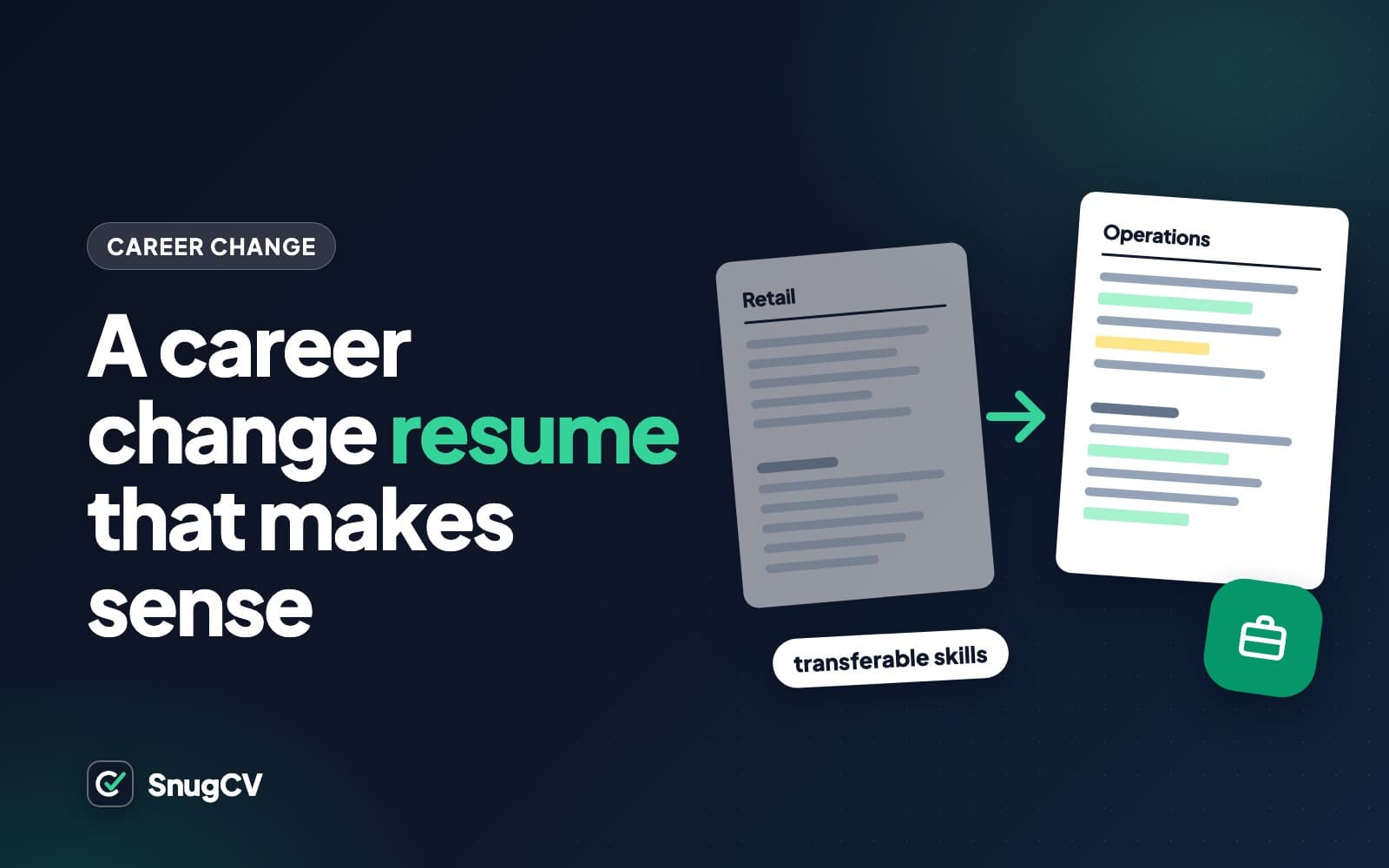
- A career change resume has one job: make the move look reasonable. It does that by translating your past work into the new field's words, truthfully.
- Start from the target posting, not your history. Work out what the new role needs in plain words, then find the real work that matches each need.
- Name the move in the summary, keep every real title and date, and put the most relevant work first inside each job.
- Gaps are normal. Close the ones you can with a course, project or volunteer work, and never claim what you have not done.
In this guide
- What the reader is asking when you change fields
- Start from the posting, not your history
- Transferable skills: what counts and what does not
- Worked example: from teacher to training coordinator
- Worked example: from retail supervisor to operations coordinator
- Write a summary that names the move
- Order the page: sections and layout
- Edit your history: what to cut, shrink and keep
- Close the gaps you can, and never claim the rest
- The cover letter line and the interview answer
- Mistakes and a checklist
- Where SnugCV fits
- Keep going
When you stay in your field, your resume is read for fit. When you change fields, it is read for a question: does this move make sense? If the page does not answer it, the reader fills in the answer themselves, and they often guess no.
This guide shows how to answer that question on the page without claiming anything you have not done. It follows two made-up career changers all the way through, a classroom teacher moving into training and a retail supervisor moving into operations, with the target posting, the mapping from old work to new vocabulary and the rewritten lines. Then it covers the summary, the order of sections, what to cut, how to word an old title honestly, the cover letter line and what not to claim.
If the idea of changing a resume for each job is new to you, why tailor a resume for each job explains the reasoning. A career change is the strongest case for it.
What the reader is asking when you change fields
A hiring manager skimming a career change resume has three questions. Each one has a place on the page where it gets answered.
| The question | What the reader looks for | Where the resume answers it |
|---|---|---|
| Can this person do the work? | Duties that match the posting's duties | Bullets, skills, certifications |
| Why this move, and why now? | A reason that sounds like a decision | Summary, cover letter |
| Will they stay and be good at it? | Signs of real effort: training, projects, volunteering | Education, projects, summary |
Notice what is missing from the list: an apology. A career change is a normal thing to do, and a resume that explains itself in a defensive tone gives the reader a reason to hesitate. State the move, show the overlap and let the evidence do the persuading.
Start from the posting, not your history
The usual instinct is to start with everything you have done and hunt for what might be relevant. For a career change, work in the other direction. The target posting tells you what the new field calls the work, and your history is the supply you draw on to meet it.
- 1
Pick two or three postings
Real ones, for the role you want, from different employers.
- 2
List the must-haves
The duties, tools and credentials that repeat or are marked required.
- 3
Say each in plain words
Strip the field's jargon and describe the action.
- 4
Find your real example
One true example from any job, project or volunteer role for each need.
- 5
Decide the story
One sentence: from what, to what, and why it fits.
- 6
Build the page
Summary, skills, bullets and order, all from the evidence you found.
Step 3 is the one people skip, and it does most of the work. Postings in your target field are written in that field's vocabulary. Rewrite each requirement in plain words: "stakeholder alignment" becomes getting people who disagree to agree on a plan, and "learning needs analysis" becomes working out what people need to be taught. Once a requirement is in plain words, your old job often has an obvious match for it in different clothes.
The method for pulling and sorting a posting's terms is in how to find the keywords in a job description. Use it on two or three postings so you see what repeats across employers instead of the quirks of one.
Transferable skills: what counts and what does not
A transferable skill is something you can do that works in more than one setting, and that you have already done. The second half matters. "Good with people" is a trait. "Explained complex rules to anxious customers and got them to a decision" is a skill with evidence, and it is the version that travels.
The table shows eight made-up moves from different fields. The middle column is the real work. The right column is one way the new field might word it. Every row is a translation of facts, with nothing added.
| Old role | What the work really was | How the new field words it |
|---|---|---|
| Classroom teacher | Planned lessons, ran groups of mixed ability, tracked progress, reported to families | Instructional design, facilitation, learner assessment, stakeholder updates |
| Retail shift supervisor | Scheduled staff, counted stock, reconciled the till, settled escalations | Workforce scheduling, inventory control, reconciliation, escalation handling |
| Restaurant server or bar lead | Held several time-pressured tables at once, recommended items, settled complaints | Client service, upselling, account handling, conflict resolution |
| Nurse | Prioritized patients, documented care, handed over clearly between shifts | Prioritization, accurate documentation, handoff communication, care coordination |
| Warehouse picker or forklift operator | Followed procedures to pick and ship accurately, kept to safety rules | Order accuracy, quality checks, safety compliance, inventory movement |
| Administrative assistant | Scheduled meetings, prepared documents, coordinated vendors | Project coordination, vendor management, operations support |
| Electrician | Read drawings, estimated materials, inspected work to code | Estimating, quality and safety inspection, project coordination |
| Customer service representative | Diagnosed problems by phone, documented cases, escalated | Troubleshooting, case documentation, technical support triage |
Worked example: from teacher to training coordinator
Priya Raman is a made-up fifth-grade teacher with seven years in the classroom. She is applying for a training coordinator role at a supply company. Here is the posting, with the candidates highlighted.
Job posting (made up for this guide)
Training Coordinator, Fernhill Supply Co.
Fernhill is looking for a Training Coordinator to support onboarding and ongoing training for our warehouse and office teams.
You will schedule and coordinate training sessions, prepare materials with our trainers, maintain training records in our learning management system and collect feedback after each session. You will meet with department managers to identify skills gaps and report completion and attendance each month.
You will need two or more years in education, training or HR support, strong organization and clear communication with adult learners. Experience with an LMS is a plus.
Priya looks at the highlighted terms in plain words and finds a match for most of them.
| What the posting needs | Priya's real work | Words to use |
|---|---|---|
| Schedule and coordinate sessions | Built daily and weekly schedules for a class of 28, and coordinated testing windows and assemblies with four colleagues | scheduling, coordinating sessions |
| Maintain training records | Recorded attendance, grades and assessment data in the district gradebook and learning platform | records, attendance, completion tracking |
| Prepare materials | Wrote and adapted lesson materials for three ability levels | training materials, instructional design |
| Collect feedback | Ran quick assessments after each unit and gathered parent feedback forms | feedback, assessment |
| Identify skills gaps | Used assessment data to find what groups had not learned and changed the plan | needs analysis, skills gaps |
| Communicate with adult learners | Ran two staff workshops on classroom technology for about fifteen colleagues | facilitation for adults (a real example, but a short one) |
| LMS | Used the district's learning platform daily, not a corporate LMS | same kind of tool, say which one |
Two rows deserve a second look. Her adult-learner evidence is two workshops. That is real, and it goes on the page with its size stated, and she should expect a question about it. The LMS row is a partial match, so she names the platform she used and does not write "LMS" as if it were the same product.
Before
Taught fifth-grade math and reading to 28 students.
After
Designed and delivered daily instruction for groups of 28 students, using assessment data to adjust content and pace.
The same fact. The verbs now match instructional design and needs analysis.
Before
Communicated with parents.
After
Reported progress to families through scheduled conferences and written updates, and answered questions about goals and next steps.
Reporting on progress to people who rely on it is the new field's stakeholder update.
Before
Ran after-school workshops for teachers.
After
Facilitated two staff workshops on classroom technology for about fifteen colleagues and collected written feedback after each.
Adult learners, a topic, a size and a feedback loop, all real and all named.
Before
Led the school technology committee.
After
Led a four-person committee that trialed two learning platforms and recommended one to the principal.
Evaluating and recommending a learning system is directly relevant to an LMS role.
What stays exactly as it was: the title "Fifth Grade Teacher", the school and the dates. What changed is the vocabulary under the title and the order of the bullets inside the job, with the training-relevant ones first.
Worked example: from retail supervisor to operations coordinator
Marcus Bell is a made-up shift supervisor at a home improvement store with five years of retail experience. He is applying to be an operations coordinator at a fulfillment company.
Job posting (made up for this guide)
Operations Coordinator, Tallgrass Fulfillment
Support daily operations on the floor and in the office. Coordinate shift schedules and coverage for hourly teams, monitor inventory levels and reconcile counts against the system, resolve vendor and customer issues and track daily performance numbers for the weekly report. Maintain safety and compliance records.
Requirements: two or more years supervising in retail, warehouse or logistics, comfort with spreadsheets and an inventory or warehouse system.
| What the posting needs | Marcus's real work | Words to use |
|---|---|---|
| Coordinate shift schedules and coverage | Built weekly schedules for up to eleven associates a shift and filled call-ins | scheduling, shift coverage |
| Monitor inventory and reconcile counts | Ran weekly cycle counts and a monthly full count, reconciled to the store system | cycle counting, reconciliation |
| Resolve vendor and customer issues | Handled escalated customer complaints and vendor delivery problems at receiving | issue resolution, vendor coordination |
| Track daily performance numbers | Reported daily sales and shrink numbers to the store manager | daily reporting |
| Safety and compliance records | Completed opening checklists and incident logs | compliance records |
| Spreadsheets | Kept the schedule and the count sheets in a spreadsheet | spreadsheets |
| Inventory or warehouse system | Used the store's inventory system and handheld scanner | same kind of tool |
Before
Supervised cashiers and floor staff.
After
Scheduled and coordinated up to eleven associates per shift across the floor, registers and receiving, adjusting coverage as call-ins and rushes arrived.
Scheduling and coverage are the posting's first duty, and the old line did not name either.
Before
Did cash office and deposits.
After
Reconciled registers and prepared daily deposits, investigating variances before close.
Reconciliation is the word the posting uses, and the work was the same.
Before
Handled customer problems.
After
Resolved escalated customer and vendor issues, and logged recurring causes so the store manager could fix them.
The posting wants vendor issues too. Receiving shows the vendor side of the job.
Before
Counted stock.
After
Ran weekly cycle counts and monthly inventory counts, reconciled results against the system and corrected location errors.
The same duty with its cadence and its checking step.
Marcus keeps "Shift Supervisor" as his title. The operations vocabulary lives in the bullets, where it is true.
Write a summary that names the move
A career change summary has three jobs: say who you are now in a frame the new field recognizes, say what you bring that the posting needs, and name the move. It takes two or three sentences.
- Who you are now. Your current field, your years, the work you do, in words the new field understands.
- What you bring. One or two specifics that match the posting: a skill with its scale or a credential you hold.
- The move. Where you are heading, stated plainly and in a positive form.
Here are the summaries for Priya and Marcus, written from the evidence above.
Summary: teacher moving into training (made up)
Classroom teacher with seven years of experience, moving into corporate training and development. Designs and delivers lessons for mixed-level groups, tracks progress with assessment data and has facilitated staff workshops on classroom technology. Completing a certificate in instructional design.
Summary: retail supervisor moving into operations (made up)
Shift supervisor with five years in high-volume retail, scheduling teams, reconciling inventory and resolving vendor and customer issues. Looking to move into operations coordination, where daily coverage and accurate counts are the job. Comfortable in spreadsheets and handheld inventory systems.
Four more, from other fields, so you can see the shape repeat.
Healthcare
Nurse into clinic operations
Registered nurse with eight years on a medical-surgical unit, moving into clinic operations. Experienced in patient flow, charting standards and staff handoffs, and in explaining procedures to patients and families.
Hospitality
Server into account management
Restaurant server and bar lead with six years in high-volume service, moving into client account management. Built a regular customer base, recommended menu items that raised check averages and settled complaints on the spot.
Trades
Electrician into estimating
Journeyman electrician with eleven years in commercial renovation, moving into project estimating. Reads drawings, takes off materials and has priced small jobs for the crew lead, with a working knowledge of local code.
Office
Administrative assistant into HR support
Administrative assistant with four years supporting a forty-person office, moving into HR coordination. Handled new-hire paperwork, personnel files and scheduling, and kept confidential records accurate and organized.
Two rules apply to every one of them. Say what you are moving toward and leave the reasons for leaving the old field for an interview, if anyone asks. And write only claims you could support in the conversation that follows.
Before
Hard-working professional seeking a new challenge in a growing company where I can use my skills and develop my career.
After
Fifth-grade teacher with seven years of experience, moving into corporate training. Designs and delivers lessons for mixed-level groups, tracks progress with assessment data and has facilitated staff workshops.
The first version could be pasted on any resume. The second names the old field, the new one and the proof.
For a wider range of summaries across situations, resume summary examples has many more.
Order the page: sections and layout
The rule for order is to put what is most relevant to the new job nearest the top, without hiding where it happened.
- Header with name, contact details and location.
- Summary that names the move.
- Skills, built from the new posting, listing only what you can back up.
- Relevant training and certifications, when they are recent and related.
- Experience, newest first, with the most relevant bullets first in each job.
- Volunteer work or projects, when they are direct evidence. Move this up above education if it is your best proof.
- Education.
Header
Maya Torres
Summary
Skills
Experience
Education
- 1The summary carries the move. It sits above everything else, so a reader gets the story before the details.
- 2The skills list below it is built from the new posting, so the reader sees familiar terms early.
- 3Experience stays in order by date, with the relevant bullets leading inside each job. The timeline stays visible.
There are three common layouts, and they handle a career change differently.
Chronological
Jobs newest first. Works when your recent work is relevant. The hardest on a changer, because the newest titles shown first belong to the old field.
Functional
Skills first, history in a short list. Tempting for changers. Many readers distrust it, because they cannot see when and where the work happened.
Combination
A summary and skills first, then a full history. The best fit for most career changers. The story is up top and the proof is below.
A purely skills-based resume feels like the obvious answer, because it moves the old job titles out of the spotlight. The cost is that the reader cannot check anything. Dates and employers are how a skeptical reader confirms that the work was real, and taking them away takes away the reason to believe you. The combination layout gives you the same top-of-page focus and keeps the timeline. Resume formats compares the three in more detail, and how to choose your resume template, font and section order shows where to set the order in SnugCV.
Edit your history: what to cut, shrink and keep
You do not have to describe every job equally. You do have to keep every job in the timeline, because a missing job is a gap, and a gap raises questions that a shrunk job does not.
| Item | What to do | Why |
|---|---|---|
| Duties unrelated to the new role | Cut, or compress to one line | Space is limited and the reader is looking for fit |
| An old job with no bearing | Keep as one line: title, employer, dates, no bullets | The timeline stays continuous |
| Awards from the old field | Keep those that show a quality the new role values, such as training new staff | They are proof, in a different setting |
| Old-field jargon | Replace with plain words | A reader from another field may not know the term |
| Old-field credentials | Keep if valid and relevant. Otherwise, one short line | They show a path, and they take little room |
| An objective statement | Replace with the summary that names the move | The summary does the same job with proof |
Wording an old title honestly
The title on each job is a fact that an employer could confirm, and some employers do confirm titles and dates, so a mismatch can surface late and cost you the offer. Leave each title exactly as your employer would state it. What you can change is how well the work beneath it matches.
| Situation | Honest move | What to avoid |
|---|---|---|
| Your official title is unusual, such as Guest Experience Lead | Keep it. Add a plain description beside or beneath it, such as front desk and guest relations supervisor | Replacing it with Front Desk Manager |
| You did lead work without the title | Keep the official title. Show the lead duties in the bullets, such as acting as the shift's point person and covering call-ins | Writing Supervisor as the title |
| Your title sounds more senior than the work | Keep it and let accurate bullets set the scale | Padding bullets to match the title |
| You were self-employed | Use an honest label such as Owner or Freelance plus the service, with the business name | Inventing a company name that sounds larger |
| You held an acting role | State it as it was: acting, interim or covering | Dropping the word acting |
Close the gaps you can, and never claim the rest
Every career changer has gaps. A gap is a must-have in the posting that your history does not show. The honest options are to describe the closest true thing, to close the gap with real work, or to leave it.
| Gap | A real way to close it | How to list it honestly |
|---|---|---|
| A tool you have not used, such as an LMS | A short course or a free trial, then build one small real thing | Under training: the course, plus what you built, with its size |
| A credential the field expects | A certificate program, with the status stated | Name the credential and add in progress with the expected month, only if you are enrolled |
| No experience with the audience | Volunteer work for a group that needs it | Under volunteer experience, with dates and what you did |
| Little field knowledge | Reading and conversations, then work samples | In the summary only what you could discuss, and a sample in a portfolio link |
Equally important is the list of things not to say, because the temptation to stretch is strongest in a career change. Each of these stretches is easy to write and hard to defend.
| The tempting claim | The honest version |
|---|---|
| Experience in training and development | Seven years of classroom instruction, plus two staff workshops facilitated |
| Project management | Planned and ran a school-wide book fair with five colleagues and a team of parent volunteers |
| Proficient in the new field's tool | Completed an introductory course in the tool and built a small sample project |
| Ten years in the new field | Ten years in retail, including five supervising scheduling and inventory work |
| Operations manager (as a title) | Shift Supervisor, covering scheduling, inventory and the cash office |
The cover letter line and the interview answer
The resume stays factual and compact. The cover letter is where one or two sentences can say why. A reliable shape is the move, the reason, the overlap and what you added to close the gap.
Cover letter line for a career change (template)
I am moving from [your current field] into [the new field] because [one honest, positive reason]. The part of my work that carries over most directly is [a specific duty], which I did for [scale or period], and I have added [a course, project or volunteer role] to cover [the specific gap].
The same line, filled in for Priya (made up)
I am moving from the classroom into corporate training because the part of teaching I enjoy most is helping people learn to do something on their own. The part of my work that carries over most directly is planning and delivering instruction and tracking who has learned what, which I did for seven years, and I am completing an instructional design certificate and have run two staff workshops to cover adult learners.
How to write a tailored cover letter from a job posting covers the whole letter. The same story comes up in the interview, usually as "why the change?", and the answer has the same four parts.
Interviewer
You have seven years in a classroom. Why training, and why now?
You
The part of teaching I like most is explaining something until people can use it on their own. In school that was fifth graders. In the last two years I have run staff sessions, and that is the part I keep wanting more of. Training is that work for adults in a company.
Interviewer
What will be hardest for you?
You
The company systems and the vocabulary. I started an LMS course last month, and I am using it to build a short onboarding module, so I can show you something I made instead of describing what I could do.
Mistakes and a checklist
Do
- Start from two or three real postings in the new field
- Translate your work into the new field's plain words, with the same facts
- Name the move in the summary and keep the tone matter-of-fact
- Keep every title, employer and date exactly as it was
- Put the most relevant bullets first inside each job
- Label training, projects and volunteer work for what they are
Avoid
- Rename a past title to something you never held
- Delete jobs or blur dates to hide the old field
- Use a purely skills-based layout with no dates to avoid explaining the move
- Copy the new field's jargon without being able to explain it
- Describe coursework as professional experience
- Write a summary that could belong to anyone
Career change pass
0 of 8 done
Where SnugCV fits
The mapping step is the slow part of a career change resume, and it has to be repeated for each posting.
SnugCV works from the profile you build once from your own resume. When you paste a posting, it rewrites the summary, reorders your skills and rewords bullets in the posting's language, and it lists the keywords your history supports and the gaps it does not. Employers, titles, dates and education are copied unchanged, and each change comes with a plain-language note. For a career changer, the gap list is the most useful part, because it shows which must-haves your history does not yet cover. You decide what to do about each one. How to read your tailored resume explains the panels. Your first few tailored resumes are free with no card.
Keep going
The vocabulary you borrow from the new field is covered in resume keywords, and the verbs that open each line are in resume action verbs. For the skills section, skills for a resume lists examples by field. When the interview comes, tell me about yourself shows how to tell the same move out loud.
Questions people ask
Which resume format is best for a career change?
A combination layout works for most people: a short summary that names the move, a skills section built from the new posting, then a normal reverse-chronological work history with the most relevant bullets first. A purely skills-based resume with no dates asks the reader to take your word for the work, and many readers are wary of it.
Should I put an objective on a career change resume?
A short summary that names the move does the job of an objective and adds proof. A line such as seeking a challenging role tells the reader nothing. A line that names the old field, the new one and the overlap gives them a reason to keep reading. Keep it to two or three sentences and name the target field in the first.
How do I handle a job title that does not match the new field?
Keep the title as your employer would confirm it. Make the work beneath it match: describe your duties in the new field's terms. If the official title would mislead a reader, keep it and add a plain description beside or beneath it. Do not replace it with a title you never held.
How far back should a career change resume go?
Show every job in the timeline and shrink the unrelated ones. A job from a decade ago with no bearing on the new role can be one line with the title, employer and dates, with no bullets. Deleting jobs creates gaps, and gaps raise questions you did not mean to raise.
What if I have no experience in the new field at all?
Use the closest honest evidence: parts of your current work that match, volunteer work, courses, certifications, freelance projects or a portfolio. Put them where a reader will see them, with dates and real descriptions. Label coursework as coursework and never describe a class project as a job.
Should my cover letter explain the career change?
Yes, in one or two sentences. State the move, give an honest reason in a positive form and name the overlap that makes it work. The cover letter is the right place for that short explanation, which lets the resume stay factual and compact.
Can I list skills I am still learning?
Yes, if you label them honestly: in progress or learning, with the course or project that backs it, and only if you could talk about what you have done so far. A tool you touched once in a tutorial is not a tool you list as proficient.
Was this guide helpful?
Get the free resume checklist and new guides
Twenty checks to run before you send a resume, as a one-page PDF. After that, a short email when new guides go up, at most once a week.