Key takeaways
- A resume keyword is a skill, tool, duty, credential, method or title that an employer names and that you can back up with real work.
- Put keywords where a reader will find them (headline, summary, skills list) and where they are believed (bullets that show the keyword in use).
- Use the posting's wording for work you really did, and leave out any keyword you could not defend in an interview.
- Keyword lists by field are a mirror for your own history. The posting in front of you outranks any list, including the ones on this page.
In this guide
- What counts as a resume keyword
- A worked example: sorting one posting by kind
- What keywords do for you, and what they cannot do
- Where keywords go on the page
- Example keyword sets by field
- One idea, many names
- Soft skills as keywords
- How many keywords is too many
- Build your own keyword bank
- From keyword to bullet: worked rewrites
- Mistakes that cost interviews, and a checklist
- Where SnugCV fits
- Keep going
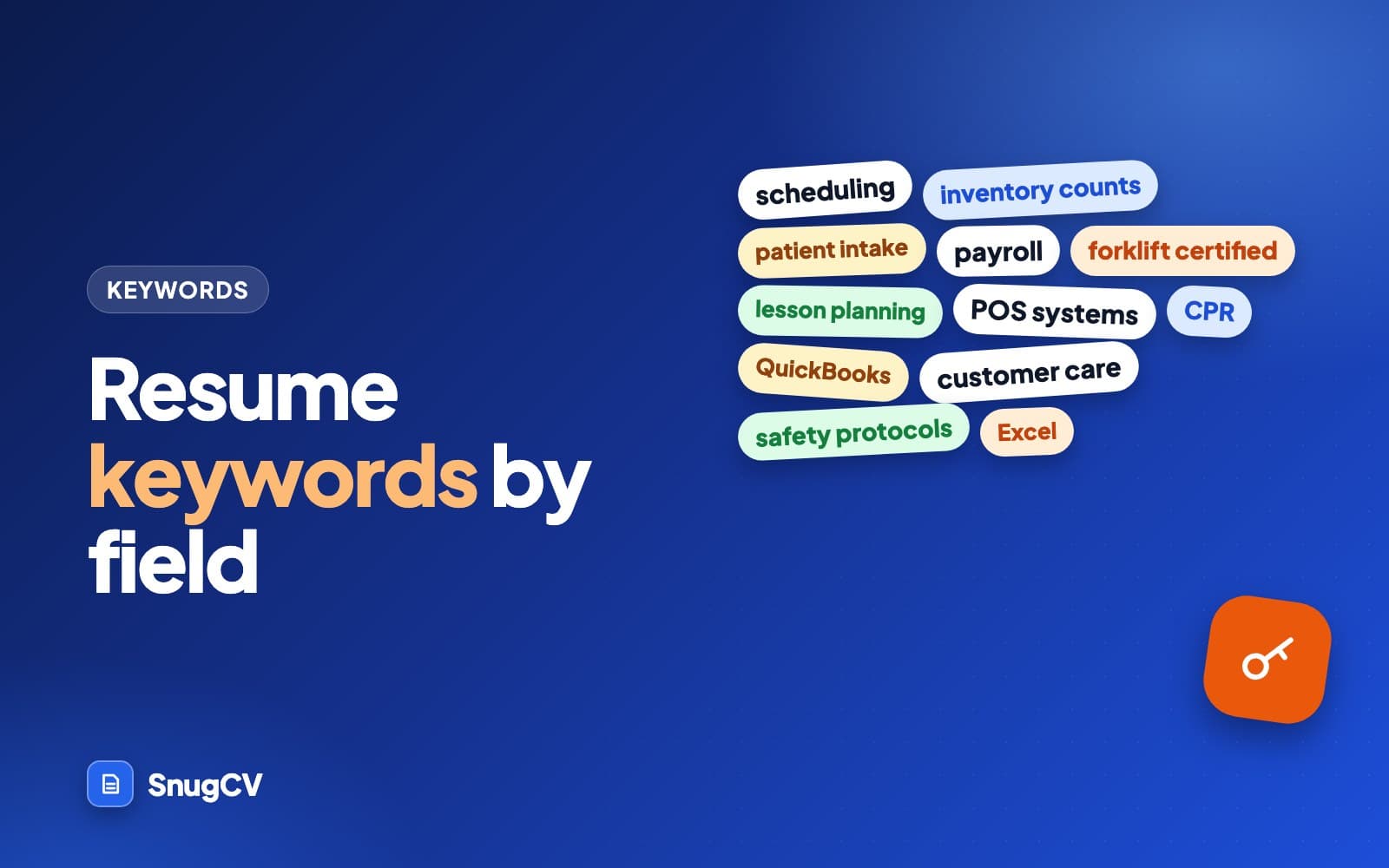
A resume keyword is the employer's word for a piece of the work: a tool, a duty, a credential, a method or a job title. The word "keyword" sounds technical. In practice it is a plain noun phrase such as "patient intake", "forklift certified" or "lesson planning", and every field has its own set.
This guide explains what counts as a keyword, where each kind belongs on the page, and gives example keyword sets for twelve fields so you can see the vocabulary of work you may not know. It also covers the part keyword lists tend to skip: why a keyword you cannot back up costs you more than one you leave out.
If you have a posting open and want the step-by-step method for pulling terms out of it, read how to find the keywords in a job description alongside this page. That one is the procedure. This one is the reference.
What counts as a resume keyword
A keyword is a word or short phrase that names something an employer wants to see: a thing you do, a thing you use, a thing you hold or a thing you are called. Most are nouns. A few are verbs. Each is easier to recognize on a page than a general claim such as "hard worker".
| Kind | What it names | Examples across fields | Usual home on the page |
|---|---|---|---|
| Duties and skills | Work you do | appointment scheduling, cash handling, lesson planning, payroll, route planning | Bullets and summary |
| Tools and systems | Software and equipment | Epic, QuickBooks, a point-of-sale system, a MIG welder, Google Classroom | Skills list and bullets |
| Credentials | Licenses and certifications | RN license, CDL Class A, ServSafe, teaching license, CPR | Certifications or skills, summary if central |
| Titles | The name of the job | medical assistant, line cook, accounts payable clerk | Headline and experience entries |
| Methods and standards | How the work is done or checked | HIPAA, OSHA, Lean, GAAP, differentiated instruction | Bullets and skills |
| Field terms | The field's own nouns | triage, planogram, cycle count, mise en place, accounts receivable | Bullets |
| Qualities | Traits and soft skills | attention to detail, empathy, dependability | Shown through bullets |
The first six rows are specific. They can be searched for, skimmed for and checked, which is why they carry most of the weight. The last row shows up in almost every posting and almost every resume, so it separates very few people. It still matters, and a later section covers how to handle it.
A worked example: sorting one posting by kind
Sorting by kind is easier to see than to describe. Here is a made-up posting for a home care aide, with the keyword candidates highlighted. Read it once, then look at how the terms fall into the types above.
Job posting (made up for this guide)
Home Health Aide, Willow Bend Home Care
Provide in-home personal care for older adults and adults with disabilities, including bathing, dressing and grooming and meal preparation. Assist with mobility and transfers using safe lifting techniques. Document each visit in the agency's care notes system and report changes in condition to the care coordinator.
You will need a valid driver's license and a reliable vehicle. Current CPR certification is required. State home health aide certificate preferred. Dementia care experience a plus.
| Term in the posting | Kind | How much it seems to matter |
|---|---|---|
| Bathing, dressing, grooming (personal care) | Duty | Core: it is the first thing the posting lists |
| Meal preparation | Duty | Core |
| Mobility and transfers, safe lifting | Duty and method | Core: named twice in different words |
| Documenting visits in care notes | Duty and tool | Core: it shows the job includes written records |
| Reporting changes in condition | Duty | Supporting |
| Driver's license and vehicle | Credential | Gate: yes or no |
| Current CPR certification | Credential | Gate: marked required |
| State home health aide certificate | Credential | Nice-to-have: marked preferred |
| Dementia care | Field term | Nice-to-have: marked a plus |
Two things stand out. First, some of the most important terms are not skills at all. A license and a CPR card are yes or no, and they can end an application before anyone reads your bullets. Second, "document each visit" is a duty and a tool at once. A resume for this role should name the paperwork, because the paperwork is part of the work.
To see the same sorting for a posting of your own, paste it into the free keyword finder.
Job description keyword finderFree
Paste a job posting to see which skills, tools and requirements it stresses, and how often. One free run, no account.
What keywords do for you, and what they cannot do
Three things can happen to a resume after you send it, and keywords play a part in each.
- A person or a system searches. Many hiring teams keep applications in a database and can search it for a skill, a tool or a title, the way you search your email. A resume that says "booked patients" may not appear in a search for "appointment scheduling", and you cannot count on a system being forgiving about synonyms.
- A person skims. A hiring manager with a stack of applications looks for a few terms that mean "has done this before". Words that match the posting are quick to spot. Words that do not match take effort.
- A form filters. Some applications ask direct questions, such as whether you hold a license or how long you have used a tool. Those answers are keywords with a yes or no attached.
Keywords cannot carry a weak resume, and they guarantee nothing. How one employer's system treats an application is not public, and it differs between companies and between roles at the same company. A resume packed with the right words and no evidence loses to a plainer one that shows the work.
For a plain-language look at the systems involved, see what is an ATS. To see why the same resume should change from one posting to the next, read why tailor a resume for each job.
Where keywords go on the page
A keyword has two jobs. The first is to be found. The second is to be believed. Different places on the page do different jobs.
| Place | What it does | Best used for |
|---|---|---|
| Headline, the line under your name | Names the role in the posting's words | Your current title or field, one or two credentials |
| Summary | The first thing a skimmer reads | The top two or three must-haves |
| Skills section | Easy to scan | Tools, systems, certifications and methods |
| Experience bullets | Shows the keyword in use, with proof | Every duty and skill you want believed |
| Certifications and education | Credentials with issuer and status | Licenses, certificates, relevant coursework |
Header
Maya Torres
Summary
Skills
Experience
Education
- 1The skills section is where tools, systems, certifications and methods go, in the order the posting ranks them.
- 2Each item in the list should have a bullet somewhere below that shows it in use. A skill with no bullet is a claim with no proof.
- 3Keep it short enough to scan in a few seconds. A list of thirty items hides the six that matter.
The example below shows one keyword set appearing in five places on a made-up warehouse resume. The same term is not repeated mechanically. Each place carries it in a different form for a different reader.
- 1
Warehouse associate, forklift certified, inventory control
Headline
The title in the posting's words plus the two credentials a posting for this job checks first. Say only what is true now.
- 2
Warehouse associate with four years in distribution centers, picking, packing and cycle counting to daily accuracy targets. Certified on sit-down and stand-up forklifts. Comfortable with handheld scanners and a warehouse management system.
Summary
Three must-haves in two sentences. A skimmer learns the fit before reaching the jobs.
- 3
Forklift (sit-down, stand-up), RF scanner, WMS, cycle counting, pallet building, OSHA safety procedures, shipping and receiving
Skills
Tools, equipment and methods in a list a reader can scan. Each one has a bullet below that proves it.
- 4
Counted and reconciled two aisles of inventory each week in the WMS, correcting location errors before the next pick wave.
Experience bullet
Cycle counting, WMS and inventory appear in use. The bullet carries the proof the skills list cannot.
- 5
Forklift operator certification (sit-down and stand-up), employer-issued, current
Certifications
A credential named as issued, with its status. Postings for licensed work often check this line first.
A headline should say what you are or do now. "Warehouse associate, forklift certified" is a headline. "Aspiring operations leader" is a wish, and it spends your most visible line on something nobody can verify. If you are changing fields, the headline gets more careful, and career change resume shows how to write the move without claiming a job you have not held.
Titles are keywords too
Job titles are the keywords people forget to treat as keywords, and many searches start with one. Your title at a past job may differ from the one a posting uses for the same work: a "Guest Experience Lead" at your last employer may be a front desk supervisor to the next.
Leave the title on each job exactly as your employer would confirm it. A title is a fact that can be checked, and a changed one is the fastest way to lose a reader's trust. What you can do is make the work under the title easy to match. Describe the duties in the posting's terms, let the headline say what you do, and, if the official title would mislead a reader about the function, keep it and add a plain line beneath it, such as "Guest Experience Lead (front desk and guest relations supervisor for a small hotel)".
Keywords beyond the resume
The same vocabulary shows up in three other places, and they should agree with the resume.
- The application form: a skills box or a screening question should use the wording from your resume, so that a reader comparing them sees one person.
- Your profile on a professional networking site: the headline and the about section are searched in the same way, so the field's own terms belong there.
- The cover letter: one sentence naming the top two must-haves, each with a specific example, does more than a paragraph of adjectives. How to write a tailored cover letter shows how.
Example keyword sets by field
The sets below are samples of vocabulary. They are not checklists, and no one has done everything on a list. Take only the terms you have really used, and check each against the posting you are answering, because the posting's wording outranks anything printed here.
They are written the way postings usually phrase them, since that is the form a reader looks for.
Healthcare: nursing and medical office
Healthcare keywords
- patient assessment
- vital signs
- medication administration
- care plans
- charting
- electronic health records
- Epic or Cerner
- HIPAA compliance
- infection control
- triage
- patient education
- discharge planning
- IV therapy
- wound care
- telemetry
- BLS
- ACLS
- RN license
- insurance verification
- patient scheduling
- medical terminology
Clinical postings are specific about setting and patient group, so the unit and the population are keywords too: medical-surgical, pediatrics, long-term care, outpatient. List credentials exactly as the issuing body names them, with the state or expiry where it applies. Patient details never belong on a resume.
Retail and sales floor
Retail keywords
- cash handling
- point-of-sale
- opening and closing procedures
- visual merchandising
- planograms
- inventory counts
- receiving
- stocking and replenishment
- loss prevention
- returns and exchanges
- upselling
- product knowledge
- clienteling
- keyholder
- shift leadership
- till reconciliation
- daily deposits
- store audits
Retail postings often name the same dozen duties in a different order. What separates one resume from another is scope: the size of the store, how many people you led, and whether you handled the cash office. Say which, because "supervisor" alone covers very different jobs.
Education
Teaching keywords
- lesson planning
- curriculum development
- classroom management
- differentiated instruction
- formative assessment
- standards-aligned instruction
- IEP implementation
- small-group instruction
- progress monitoring
- behavior support
- parent communication
- ESL strategies
- learning management system
- state teaching license
- student engagement
Teaching postings lean on named methods and tools. Use the exact term for your subject and grade band, and name the platform you used rather than "educational technology". Describe outcomes at class or group level and leave out student names and records.
Skilled trades and construction
Trades keywords
- blueprint reading
- OSHA 10
- OSHA 30
- framing
- finish carpentry
- MIG welding
- TIG welding
- conduit bending
- wiring and panels
- troubleshooting
- preventive maintenance
- HVAC service
- plumbing repair
- code compliance
- estimating
- site safety
- hand and power tools
- journeyman license
- apprenticeship hours
Trades keywords are among the most specific of any field. A process, a material, a code and a license level beat "experience with welding" every time. If you hold a license or have completed an apprenticeship, say which, because those are often the first thing a posting checks.
Finance and accounting
Finance keywords
- accounts payable
- accounts receivable
- general ledger
- month-end close
- bank reconciliation
- financial reporting
- budgeting
- forecasting
- variance analysis
- GAAP
- payroll processing
- audit support
- invoice processing
- expense reports
- QuickBooks
- Excel pivot tables
- tax preparation
- internal controls
Accounting postings name systems and cycles: the ledger, the close, the reconciliation. Add the cadence or the volume when you know it, such as weekly payroll or a monthly close, because it tells a reader the size of the job without a headline number.
Office administration
Administrative keywords
- calendar management
- scheduling
- travel arrangements
- data entry
- records management
- document preparation
- minute-taking
- reception
- visitor management
- Microsoft Outlook
- Excel
- Google Workspace
- vendor coordination
- purchasing
- supply ordering
- mail handling
- expense reporting
- customer correspondence
Administrative titles vary widely, so the duties do the work. Name the calendars, the systems and who you supported, whether that was a team, a department or a director. Software versions rarely matter. The suite does.
Hospitality and food service
Hospitality keywords
- food safety
- ServSafe
- HACCP
- mise en place
- menu knowledge
- table service
- banquet service
- reservations
- guest relations
- front desk
- property management system
- housekeeping
- inventory and ordering
- cost control
- line cooking
- food prep
- allergen awareness
- upselling
- event setup
- responsible alcohol service
Food and hotel postings often screen on certifications and on pace. Food-handler and alcohol-service certificates vary by location, so name yours as issued and check which one the posting means. The number of covers per shift, rooms in the hotel or guests at an event makes the pace visible.
Logistics, warehouse and transport
Logistics keywords
- pick and pack
- shipping and receiving
- cycle counting
- inventory control
- warehouse management system
- RF scanner
- forklift certification
- pallet jack
- dock scheduling
- route planning
- DOT regulations
- CDL Class A
- hours-of-service logs
- pre-trip inspection
- bill of lading
- dispatch
- order accuracy
- 5S
Logistics postings often list equipment by type and license by class, and both can be gates. State the equipment you are certified on and the systems you have scanned or entered orders in. Accuracy and pace targets are the outcome keywords in this field.
Marketing and communications
Marketing keywords
- content calendar
- social media management
- copywriting
- email campaigns
- newsletter production
- SEO
- Google Analytics
- campaign reporting
- A/B testing
- brand guidelines
- CRM
- content management system
- press releases
- event promotion
- audience research
- paid social
- Canva
- Adobe Creative Suite
Marketing postings name channels and platforms. A keyword tied to a channel and an outcome, such as "email newsletters with monthly open-rate reporting", is the strongest form. List only tools you have used for real work, and skip tools you have only watched a tutorial for.
Information technology
IT keywords
- help desk
- ticketing system
- Active Directory
- troubleshooting
- hardware installation
- network configuration
- user onboarding
- patch management
- backup and recovery
- endpoint security
- Windows and macOS support
- Microsoft 365
- SQL
- PowerShell
- documentation
- incident response
- service-level agreements
- ITIL
IT postings are crowded with product names. Add the scale when it matters, such as user count, number of devices or number of sites, and group tools by kind so a reader can scan them. A tool you used for one afternoon belongs in a bullet with that context, or nowhere.
Customer service and call center
Customer service keywords
- inbound calls
- live chat
- email support
- ticket resolution
- de-escalation
- CRM software
- first-contact resolution
- call handling
- escalation procedures
- service-level targets
- product troubleshooting
- account maintenance
- complaint resolution
- order processing
- refunds and credits
- knowledge base
- quality assurance scores
- bilingual support
Customer service postings are heavy on soft skills, which makes the tool and process keywords stand out. Name the channel (phone, chat, email), the system and the kind of contact: complaints, orders, technical support or billing.
Care work and social services
Care work keywords
- case notes
- intake assessments
- care plans
- activities of daily living
- medication reminders
- client advocacy
- crisis intervention
- community resources
- mandated reporting
- family communication
- child development
- CPR and first aid
- behavior support
- documentation
- mobility assistance
- group facilitation
- trauma-informed care
Care and social service postings combine duties with standards: documentation, safety and privacy. Name the population you worked with, the setting and any training you have completed. Keep client details out of every line.
Adjusting a set to your level
A set that suits a ten-year veteran does not suit someone applying for a first job. The terms stay the same. The weight shifts.
| Where you are | What carries the weight | Retail example |
|---|---|---|
| Starting out | Training, certificates and tools from school, volunteering or short jobs, with one real example for each | Food handler card, point-of-sale training, helping customers at a school fundraiser stall |
| Experienced | Tools and duties with their scope: how big, how often, for whom | Point-of-sale, cash office, receiving, a team of eight |
| Lead or manager | Scope, budgets, hiring, methods and decision rights | Scheduling for a team, vendor orders, store audits, coaching associates |
Notice that the right-hand column is still all nouns a posting would use. What changes is how much each one has to prove. A first-job resume proves a term with a school project or a volunteer shift. A manager's resume proves it with the size of what they ran.
One idea, many names
The most common keyword problem is a skill you have, filed under a different name. Employers describe the same work in different words, and your last employer's vocabulary may not match this one's. Where the work is the same, use the posting's term.
| The posting says | You may have written | Swap only if you |
|---|---|---|
| Patient intake | Checked patients in at the front desk | Collected demographics, insurance and consent forms |
| Inventory control | Did stock checks and ordering | Counted, recorded and reconciled stock against a system |
| Cash handling | Worked the register | Balanced a till and prepared deposits |
| Lesson planning | Prepared my classes | Wrote plans against standards or a set curriculum |
| Preventive maintenance | Did routine checks on the machines | Followed a schedule of inspections and servicing |
| Stakeholder communication | Emailed managers about the project | Reported progress to the people relying on the work |
| Customer retention | Looked after regular clients | Followed up to renew or keep specific accounts |
| Data entry | Typed up records | Entered records into a named system or database |
The third column is the whole rule. A swap is a translation when the work is the same and a claim when it is not. "Looked after regular clients" does not become "customer retention" because the posting asked for it. It becomes that when you can describe what you did to keep those clients, in a sentence, without notes.
Acronyms and spelled-out forms
When an abbreviation is common, write both forms the first time the term appears: electronic health record (EHR), customer relationship management (CRM), point of sale (POS). A reader who looks for one form finds the other, and a reader who knows only one still understands. After the first mention, use whichever form the posting uses.
Small spelling choices follow the same logic. Match the spelling convention of the country you are applying in, such as license or licence and color or colour. Write a certification's name as the issuing body writes it. "Certified Nursing Assistant" and "nursing aide certificate" are not interchangeable, and some fields treat a certificate and a certification as different things.
Soft skills as keywords
Postings name qualities such as communication, teamwork, adaptability and attention to detail. A reader cannot check a quality, so a bare word costs a line and proves nothing. Two moves make it count. Replace the quality with the behavior that shows it, and keep the posting's word nearby if it fits naturally.
Before
Strong communication skills.
After
Explained care plans to patients and families at the bedside and used teach-back to confirm they understood the next steps.
A made-up nursing example. The quality is now a visible behavior with a named method.
Before
Team player.
After
Covered colleagues' stations during dinner rush and swapped shifts to keep both lines staffed through the holidays.
A made-up kitchen example. Teamwork is what the person did for others.
Before
Attention to detail.
After
Checked every outgoing pallet against the pick list and bill of lading before it left the dock.
A made-up warehouse example. The detail is a check anyone can picture.
Before
Adaptable and flexible.
After
Moved between the front desk, the phones and the billing queue as the day required, and trained two new hires on each.
A made-up office example. Adaptability shows as range and as passing the range on.
How many keywords is too many
There is no right count, and there is a point where more makes a resume worse. A reasonable rule of thumb: cover every must-have once, repeat the top two or three where your work really repeats them (usually the summary, the skills list and one or two bullets), and stop.
Stuffing fails for three plain reasons. Space is fixed, so every extra term pushes out something that explained your work. A sentence built to hold four keywords reads as a list. And a person who reads the resume next can tell the difference between a resume written about a job and a resume written about a posting.
Before
Customer service professional with customer service experience providing customer service, customer support and customer care to customers.
After
Customer service representative with three years of phone and chat support for a mobile phone retailer, resolving billing and device issues and escalating faults to the repair team.
The first version repeats the keyword five times and tells the reader nothing. The second uses it once and carries facts.
Build your own keyword bank
A keyword bank is a private master list of everything you can honestly claim, kept in the words your field uses. You draw from it for each application instead of starting from a blank page, and it grows as you work.
- 1
Collect postings
Gather five to ten postings for the role you want, from different employers.
- 2
Mark repeats
Highlight every noun phrase that appears in more than one posting.
- 3
Group by kind
Sort into duties, tools, credentials, titles, methods and field terms.
- 4
Attach proof
For each term you can claim, write one real example and where it happened.
- 5
Mark the gaps
Note repeated terms you cannot claim. They are the field's price of entry.
- 6
Keep it current
Add new tools and certifications when you earn them, and note the date.
Here is what the bank looks like in practice. The proof column is the part that matters, because it is what you will say in an interview.
| Keyword | Proof from my history | Where I can use it |
|---|---|---|
| Cycle counting | Weekly counts of two aisles, reconciled in the WMS, corrected location errors | Warehouse, inventory control |
| Patient education | Taught new insulin users to self-inject, with teach-back | Clinic, nursing |
| Differentiated instruction | Ran three reading groups at different levels in fourth grade | Teaching, tutoring |
| Accounts payable | Processed and coded about a week of invoices at a time in QuickBooks | Bookkeeping, office finance |
A bank also settles a quiet question: which of your terms are thin. If a keyword has no proof next to it, it does not go on the page, however often a posting uses it.
From keyword to bullet: worked rewrites
A keyword is strongest inside a sentence that shows it doing something. Here are six made-up bullets from different fields, each rewritten so the posting's keywords appear naturally. Every fact in each new version was already true for the made-up person.
Before
Helped clients with daily tasks.
After
Assisted clients with bathing, dressing, meals and mobility, and recorded each visit in the agency's care notes.
Home health aide. The daily-task duties and the documentation are two keywords the old line blurred.
Before
Cooked food for customers.
After
Prepped and cooked to ticket on grill and sauté stations during dinner service, following ServSafe food-safety and allergen procedures.
Line cook. Stations, ticket pace and the certification are all specific terms.
Before
Did the books for a small company.
After
Processed accounts payable and receivable, reconciled bank accounts monthly and prepared reports for the owner in QuickBooks.
Bookkeeper. Duties, cadence and the system are named.
Before
Worked on job sites with the crew.
After
Pulled wire, bent conduit and installed outlets and panels under a licensed journeyman on commercial renovations, following code and site safety rules.
Electrician apprentice. The tasks, the supervision and the standards are the keywords.
Before
Taught fourth grade.
After
Planned and taught standards-aligned reading and math lessons, and used progress monitoring to regroup students for small-group instruction.
Teacher. Planning, method and assessment appear in one sentence.
Before
Delivered packages.
After
Ran a daily route of scheduled stops, completed pre-trip inspections and logged hours of service as required.
Delivery driver. The compliance duties are what a transport posting checks.
For more patterns like these, resume bullet points covers formulas and rewrites in depth, and resume action verbs lists the verbs that open each line.
Mistakes that cost interviews, and a checklist
Do
- Take keywords from the posting you are answering, in its own wording, when the work is the same
- Back every skills-list item with at least one bullet
- Name credentials exactly as issued, with status
- Show the top must-haves in the headline, summary and a bullet
- Keep a private bank of terms with proof, and draw from it each time
Avoid
- Paste a field's keyword list into your resume because it is popular
- Add a tool or certification you have not used or earned
- Repeat one phrase five times in a paragraph
- Hide words in white or tiny text
- Fill the skills section with generic traits such as hardworking and motivated
Before you send an application, run one pass down this list.
Keyword pass, per application
0 of 8 done
Where SnugCV fits
You can run all of this by hand with a highlighter, and the first few times that is the right way to learn the vocabulary. When you are applying to many postings, it is slow to repeat.
SnugCV pulls the keywords from a posting, compares them with the profile you built once from your resume, and flags what your history does not support. It rewrites the summary, reorders skills and rewords bullets in the posting's language. Employers, titles, dates and education are copied unchanged, and every change has a plain-language note, so you can see what moved and edit anything you disagree with. How to read your tailored resume explains the keyword and gap panels, and how to tailor your resume to a job posting in about a minute walks through the steps. Your first few tailored resumes are free with no card.
Keep going
Keywords are one layer of a resume that gets read. The next layers are your skills section, which skills for a resume covers by field, and how the page is built for software to read, which ATS-friendly resume explains. If you are moving into a new field and the vocabulary is unfamiliar, career change resume shows how to map your old work to a new posting's words.
Questions people ask
What are the best keywords for a resume?
There is no universal best list. The best keywords are the ones in the posting you are answering, matched to work you have really done. A nurse, a welder and a bookkeeper need different sets, and two postings for the same job title can stress different tools and duties, so check each one.
How many keywords should a resume have?
No fixed number works for everyone. Cover each must-have from the posting once, in a place where it is true, and repeat only the top few where your work genuinely repeats them. Ten terms that sit inside real bullets read better than fifty in a block with no evidence.
Should I add a separate keyword section?
A short skills section is a fine home for tools, systems and certifications, because it is easy to scan. Keywords that appear only in a list carry no proof, so the important ones should also show up inside a bullet that says what you did with them.
Do soft skills count as keywords?
Postings do name them, such as communication or teamwork, but a bare soft-skill word proves very little. Show the behavior in a bullet instead: coordinated schedules for six people across two shifts says more than team player. Use the posting's own soft-skill words sparingly and only with evidence.
Is hiding keywords in white text a good idea?
No. Hidden text is easy for a person to find by selecting the page or pasting it into a plain text editor, and it tells the reader you were willing to game them. Put the same words in visible text where they are true, or leave them out.
What if I have done the work but use different words?
Translate. If you scheduled patients and the posting says appointment scheduling, use the posting's phrase, because it describes the same work. Make the swap only when the work is the same. If the posting names a tool or duty you have not used, that is a gap, and the honest options are to describe the closest thing or leave it.
Where do I find keywords if I do not have a posting yet?
Read five to ten postings for the role you want and note what repeats. Job titles, certifying bodies and professional associations also publish the vocabulary of a field. The repeated terms are the field's common language. Then check each one against your own history before it goes on the page.
Was this guide helpful?
Get the free resume checklist and new guides
Twenty checks to run before you send a resume, as a one-page PDF. After that, a short email when new guides go up, at most once a week.