Key takeaways
- A resume verb is a small claim about what you did and how much of it was yours. Pick the one an interviewer could test and you would pass.
- Group verbs by what you actually did: leading, building, improving, teaching, selling, caring, operating, recording. The right verb is the most specific true one.
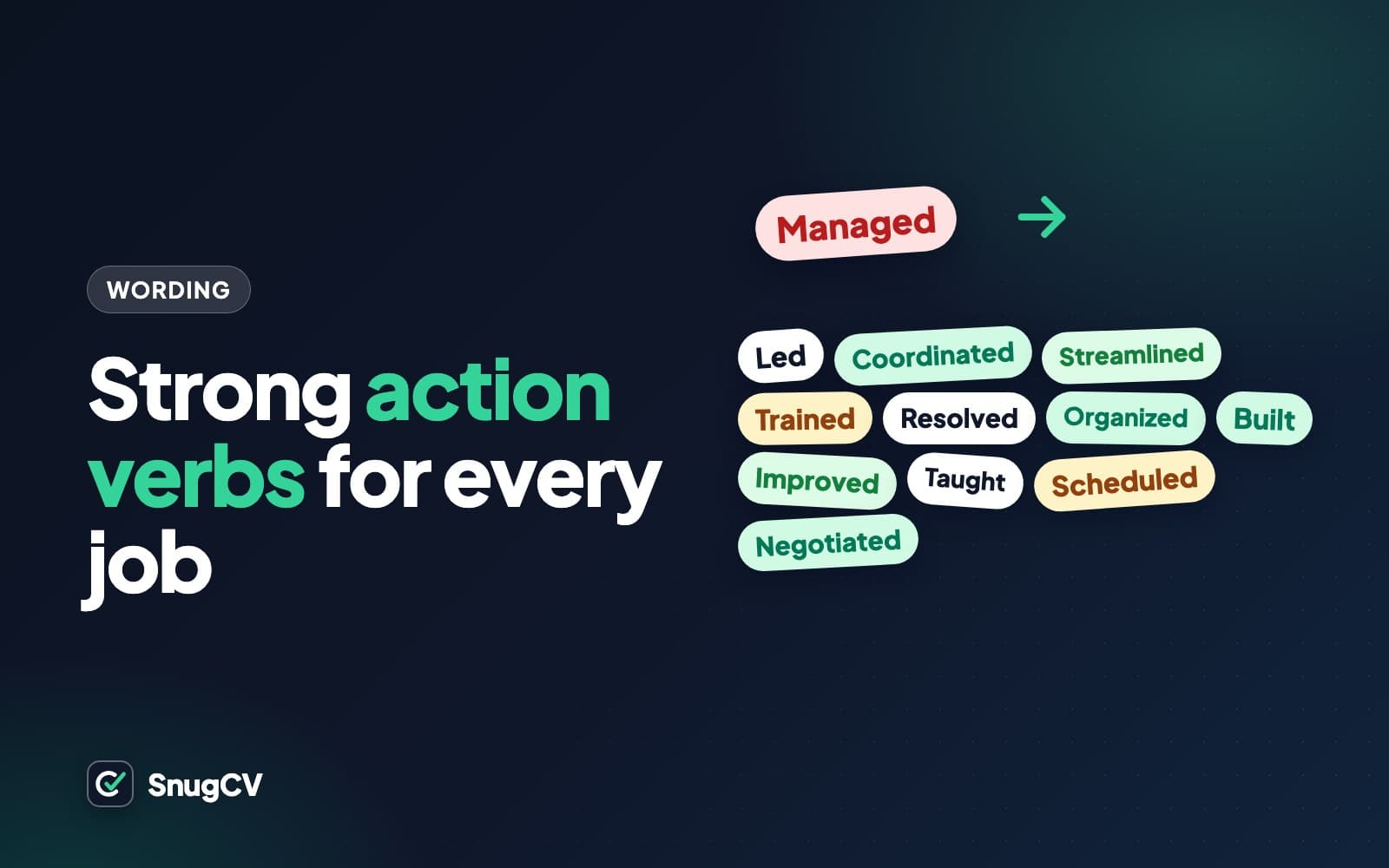
- Managed, helped, responsible for and worked on are vague, and the replace-lists show what to say once you name your part.
- Big verbs such as spearheaded and pioneered claim that you started or drove something. Use them only with a story to back them.
In this guide
- How to pick a verb that is true
- Action verbs grouped by what you did
- Replace-lists for the four weakest openers
- Weak verb, precise verb: rewrites from many fields
- Big verbs and what they claim
- When your role was support: using assisted honestly
- Starter verb sets by field
- Building a whole bullet around the verb
- Varying verbs without a thesaurus
- Mistakes and a checklist
- Where SnugCV fits
- Keep going
If you came here for a synonym for "managed", it is in here, along with more than 250 other action verbs sorted by what you actually did. The sorting is the useful part. A thesaurus can swap one word for another, but it cannot tell you which word is true of your job, and a resume verb is a small claim that an interviewer is entitled to ask about.
You will find the verbs grouped into eighteen kinds of work, a note on when each group is accurate, replace-lists for the four weakest openers (managed, helped, responsible for and worked on), and before-and-after rewrites from many fields. Pair it with resume bullet points, which covers what goes after the verb.
A good verb does two jobs. It tells the reader what you did, and it tells them how much of it was yours. Everything below is organized around those two jobs.
How to pick a verb that is true
Start with a plain question: what did I do? Write the action in your own words first, as if you were telling a friend, and then look for the closest verb in the lists. If the strongest verb on offer would make a former coworker raise an eyebrow, it is the wrong one.
- 1
What did I do?
Say it plainly, in your own words.
- 2
How much was mine?
Alone, as part of a team, or for someone who owned the task?
- 3
Could I tell the story?
If an interviewer asks, can you give an example in a minute?
- 4
Is there a more exact verb?
Choose the verb that names the action, such as reconciled in place of handled.
The table below lines verbs up by how much authority they claim. Use the left column to find where you stood, and stay in the row that matches.
| You were | Verbs that fit | Avoid unless it is true |
|---|---|---|
| Present, with someone else owning the task | assisted, supported, contributed to, shadowed | led, ran, owned |
| Doing a defined part of the work | prepared, processed, entered, drafted, tested | built, designed, developed (as a whole) |
| Doing the whole task yourself | handled, completed, delivered, produced | directed, oversaw |
| Arranging other people's work, with no authority over them | coordinated, organized, scheduled, facilitated | supervised, managed |
| Responsible for people or an outcome | led, supervised, directed, oversaw | founded, launched |
| Starting something that did not exist | founded, launched, established, introduced | pioneered, unless you were first |
Borrow the posting's verbs
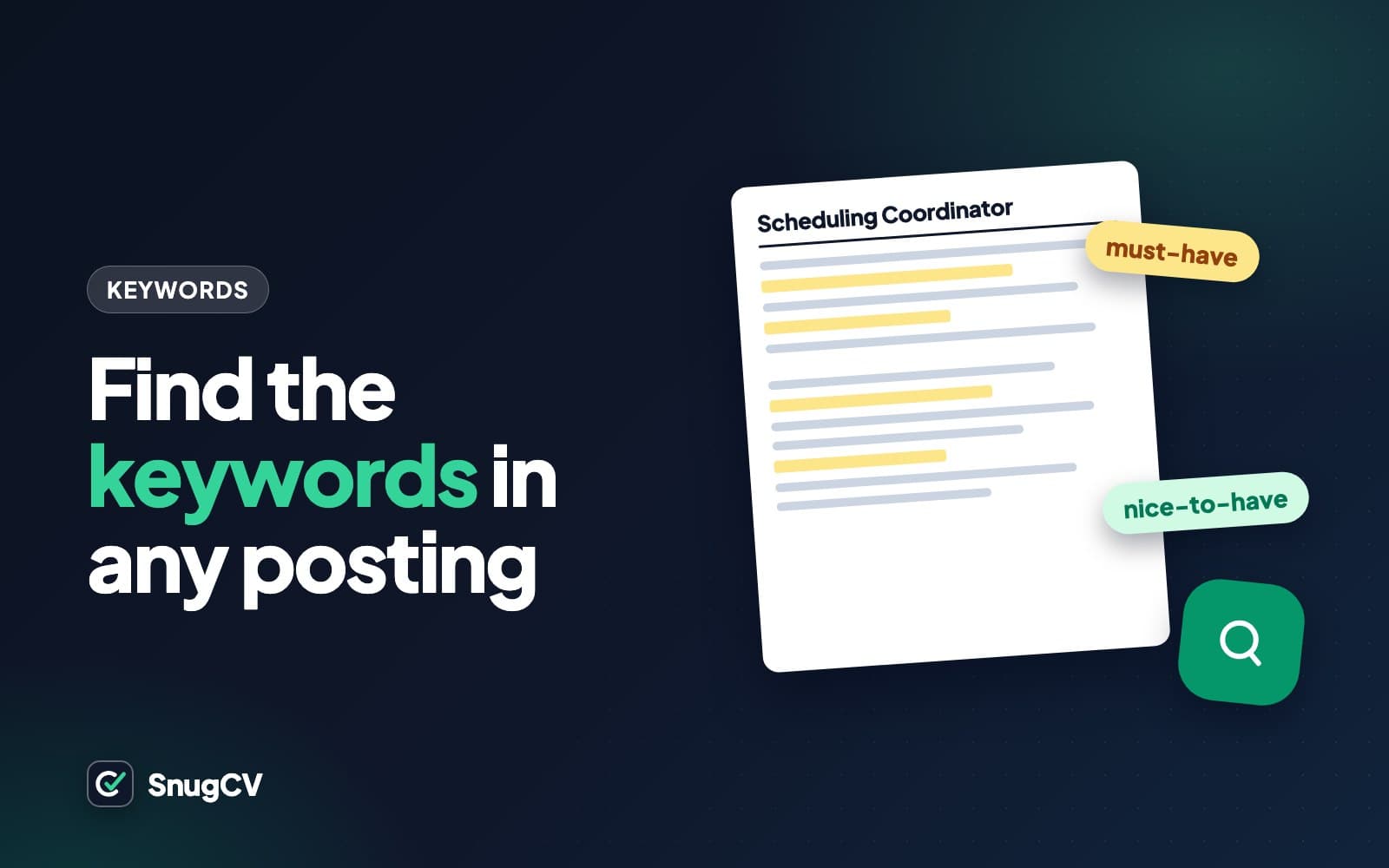
Postings are full of verbs: schedule, reschedule and confirm; reconcile; coach; dispatch. Where they describe work you really did, they are the verbs a reader is looking for, so they belong at the front of your bullets. Where they describe work you did not do, leave them out. How to find the keywords in a job description shows how to sort a posting's terms, verbs included, into what you can claim and what is a gap.
Tense and form
Resume bullets drop the "I" and begin with the verb. The tense depends on whether the work is still going on.
| Situation | Tense | Example |
|---|---|---|
| A job you hold now, and the duty continues | Present | Schedule appointments for four providers |
| A job you hold now, and the task is finished | Past | Moved the filing system to a shared drive |
| Any job that has ended | Past | Trained new hires on the point-of-sale system |
Keep one tense per job, and check the verbs when a job ends so a past role does not read as current. The lists below are in past tense. For a current duty, drop the "-ed" or use the present form. Spelling follows American English. If you are applying where British spelling is the norm, use it (organised, prioritised).
Action verbs grouped by what you did
Each group has a short note on when its verbs are accurate, then the verbs. Some verbs fit more than one kind of work. Each appears once, in the group where it is most common.
Leading and directing people
These verbs claim authority over other people, so the verb should match the authority you really had. Supervised, directed and managed mean people reported to you for the work, at least for a shift or a project. Led works for a team or project you guided, if the others would say you led. Chaired is accurate only for a meeting or committee you actually ran. If you taught someone but did not direct their work, use the teaching verbs instead.
Leading and directing
- led
- directed
- supervised
- oversaw
- managed
- headed
- chaired
- delegated
- mobilized
- motivated
- staffed
- hired
- guided
- steered
- ran
- captained
Starting and building
Verbs for beginnings claim that nothing was there before you. Founded and launched fit something you started or brought to the public. Created, designed and developed fit work you did yourself, and developed is safest when you can name the parts you wrote or drew. Introduced and instituted fit a change you brought to a place. If you joined something already underway, built, extended or added to will be more accurate than created.
Starting and building
- founded
- launched
- created
- established
- designed
- developed
- built
- initiated
- introduced
- originated
- instituted
- formulated
- drafted
- produced
- opened
- started
- devised
- prototyped
Planning and organizing
These verbs are about arranging work, time and resources. Coordinated is accurate when you arranged other people's work without being their boss, which describes many administrative, event and project roles. Scheduled and booked fit calendars. Dispatched and routed fit sending people or vehicles somewhere. Allocated is accurate when you decided how a limited thing, such as hours, stock or space, was split.
Planning and organizing
- planned
- scheduled
- coordinated
- organized
- arranged
- prioritized
- sequenced
- allocated
- mapped
- booked
- dispatched
- routed
- aligned
- structured
- staged
Improving and fixing
Improvement verbs make a promise: something was worse before and better after. Use them only when you can say what changed, ideally with a concrete before and after. Streamlined and simplified fit a process that now has fewer steps. Reduced, cut and trimmed fit a quantity that went down. Overhauled implies a large rebuild, so save it for one. Resolved fits a problem that stopped, and it is wrong for one you only reported.
Improving and fixing
- improved
- streamlined
- reduced
- simplified
- standardized
- restructured
- revamped
- modernized
- upgraded
- corrected
- resolved
- restored
- consolidated
- automated
- accelerated
- eliminated
- overhauled
- refined
- redesigned
- cut
- trimmed
- strengthened
- shortened
- reorganized
- rebuilt
Analyzing and researching
Analysis verbs are accurate when you examined information to reach a conclusion, and they overstate looking at a report. Audited and assessed suggest a method applied against a standard. Investigated fits a problem with a cause to find. Tracked and monitored are about watching over time. Reconciled is exact: two records were compared and made to agree. Forecasted and estimated both predict, and the honest version says from what.
Analyzing and researching
- analyzed
- evaluated
- audited
- assessed
- investigated
- researched
- examined
- measured
- reviewed
- tested
- tracked
- compared
- identified
- diagnosed
- surveyed
- calculated
- reconciled
- benchmarked
- inspected
- forecasted
- estimated
- validated
- quantified
- modeled
Teaching and training
Teaching verbs are accurate for any time you passed on a skill, in a classroom or at a workstation. Taught and instructed fit planned lessons. Trained fits a repeatable skill, such as how to use the till or the dispensing software. Onboarded fits a new hire's first weeks. Coached and mentored imply a longer relationship, and they are most accurate when you can name the person or group and a period. Certified is accurate only when you hold the authority to certify.
Teaching and training
- taught
- trained
- instructed
- tutored
- coached
- mentored
- onboarded
- oriented
- demonstrated
- educated
- facilitated
- advised
- briefed
- lectured
- explained
- equipped
- certified
- drilled
- cross-trained
Communicating and presenting
Communication verbs name what left your hands. Wrote and authored fit documents you made. Edited and proofread fit another person's. Presented implies an audience in a room or on a call. Negotiated is accurate only when there was something to agree and someone on the other side. Represented fits speaking for a team or organization. Translated is written and interpreted is spoken, and both imply a fluency a reader may test.
Communicating and presenting
- presented
- wrote
- authored
- edited
- proofread
- published
- translated
- interpreted
- negotiated
- persuaded
- announced
- corresponded
- represented
- moderated
- hosted
- summarized
- pitched
- clarified
- informed
- reported
- addressed
Selling and growing
Sales verbs are about money and customers moving. Sold, closed and upsold fit transactions you made. Prospected fits finding leads. Retained and renewed fit existing customers who stayed. Grew and expanded are accurate for a number that rose, and a reader will want to know by how much and over what period. Secured and won suit contracts and accounts you brought in, and are wrong for ones you inherited.
Selling and growing
- sold
- generated
- prospected
- closed
- upsold
- cross-sold
- acquired
- retained
- renewed
- cultivated
- grew
- expanded
- secured
- won
- promoted
- marketed
- converted
- raised
- solicited
- signed
- attracted
Serving and supporting customers
Service verbs describe the moment of contact. Welcomed and greeted fit front-of-house work. Answered and fielded fit calls and questions. Handled is a general verb that works when you name what you handled: complaints, returns, bookings. Escalated is honest and accurate: you passed it to the right person. De-escalated fits a tense moment you calmed down. Accommodated fits a special request you met.
Serving and supporting customers
- served
- welcomed
- greeted
- answered
- fielded
- responded
- handled
- escalated
- de-escalated
- accommodated
- supported
- attended
- recommended
- refunded
- rebooked
- followed up
Caring for people
Care verbs depend on your scope of practice, which varies by role and by place, so check yours before reaching for a clinical verb. Administered medication is accurate only if you were permitted to. "Assisted with medication reminders" is the honest form for many aides. Monitored and observed fit watching a person's condition. Triaged implies sorting by urgency under a protocol. Charted fits records you made.
Caring for people
- cared for
- nursed
- monitored
- observed
- administered
- triaged
- counseled
- advocated
- comforted
- reassured
- screened
- dispensed
- charted
- rehabilitated
- escorted
- transferred
- bathed
- repositioned
- referred
Operating, making and repairing
Hands-on verbs are the most checkable, because a reader can ask you to do the thing. Operated fits machines and vehicles you ran, and a certification may apply. Installed, repaired and serviced are different jobs: installing is putting something in, repairing is making a broken thing work, and servicing is scheduled upkeep. Fabricated fits making parts from raw material. Naming the equipment makes the verb more accurate.
Operating, making and repairing
- operated
- assembled
- installed
- repaired
- maintained
- fabricated
- welded
- wired
- calibrated
- troubleshot
- machined
- drove
- loaded
- unloaded
- stocked
- picked
- packed
- serviced
- framed
- plumbed
- mounted
- fitted
- sanded
Preparing food and serving guests
Kitchen and bar verbs are accurate to station and scale. Cooked is general, and grilled and plated name a station and a step. Expedited fits the person who called and checked tickets at the pass. Catered fits event food, and the honest scope is the size of the event. Sanitized fits a procedure, and naming the standard (ServSafe, HACCP) adds a keyword.
Preparing food and serving guests
- cooked
- baked
- prepped
- plated
- grilled
- catered
- bartended
- expedited
- sanitized
- carved
- brewed
- garnished
Managing money and records
Money verbs are exact by design. Budgeted fits setting a budget or holding to one. Invoiced and billed fit sending charges. Collected fits payments you chased. Deposited and balanced fit a till or an account. Do not use them for money you only touched in passing. "Handled cash" is an honest phrase for that.
Managing money and records
- budgeted
- invoiced
- billed
- balanced
- posted
- deposited
- tallied
- disbursed
- collected
- reimbursed
- priced
- appraised
- itemized
Administering and maintaining operations
These verbs are the backbone of office, records and supply roles, and they are rarely over-claims. Processed is the right verb for repeated transactions such as orders, claims and applications. Verified and logged fit checks, and updated fits keeping records current when the update was your task. Procured and purchased are different from ordered: procured implies sourcing and comparing, and ordered implies placing the request. Their weakness is vagueness, so name what you processed and about how many.
Administering and maintaining operations
- processed
- compiled
- logged
- catalogued
- archived
- indexed
- updated
- verified
- ordered
- purchased
- procured
- distributed
- registered
- transcribed
- sorted
- scanned
- labeled
- received
Collaborating and partnering
Team verbs are accurate when you can say what you contributed. Collaborated and partnered fit work with named groups. Liaised fits a go-between role. Contributed is honest when your part was a part. Mediated fits a dispute between people, and brokered fits an agreement you arranged. None of them should be the only content of a bullet, so follow with what the work produced.
Collaborating and partnering
- collaborated
- partnered
- liaised
- contributed
- cooperated
- consulted
- mediated
- brokered
- volunteered
- participated
- co-led
- united
- bridged
Keeping things safe and compliant
Compliance verbs are accurate when you applied or checked a standard. Enforced implies authority to act. Ensured is overused, so reserve it for cases where you made sure by a named check. Approved and authorized imply you had the sign-off power. Vetted fits a review against criteria, and upheld fits a standard you kept.
Keeping things safe and compliant
- enforced
- ensured
- protected
- safeguarded
- checked
- cleared
- approved
- authorized
- vetted
- upheld
Creating and designing
Creative verbs are accurate to the medium. Illustrated, photographed and filmed name a method. Curated implies choosing from many options. Styled and composed name a decision about the look or structure. Crafted is imprecise, so pair it with what was made. If a team made it, contributed to is more honest than created.
Creating and designing
- illustrated
- photographed
- filmed
- composed
- styled
- curated
- drew
- sketched
- crafted
- scripted
- animated
- choreographed
- painted
- decorated
- sewed
Working with technology and data
Technical verbs are the easiest for an interviewer to test. Programmed and coded name the activity, and the language and the purpose make them accurate. Configured and deployed fit setup work. Migrated fits moving data or systems from one place to another. Queried fits asking a database a question. Name the tool and the scale where you can.
Working with technology and data
- programmed
- coded
- configured
- deployed
- debugged
- migrated
- integrated
- queried
- patched
- visualized
- provisioned
- encrypted
- cleaned
Replace-lists for the four weakest openers
Managed, helped, responsible for and worked on are the openers most resumes reach for, and they say the least. Each one is accurate in some cases, so none of them needs banning. They fail when they hide what you actually did, and the fix is the same each time: name your part, then pick the verb that fits it.
Instead of managed
Managed is a fair verb when you can say what you managed. Without an object, it could mean anything from running a hospital wing to keeping a spreadsheet tidy.
| What you actually did | Better verbs | Example (made up) |
|---|---|---|
| Supervised people | supervised, led, directed, coached | Supervised six cashiers across two shifts, setting breaks and settling scheduling conflicts |
| Ran a day-to-day operation | ran, operated, oversaw | Ran the evening dining room, from the pre-shift briefing to the final cash-out |
| Kept to a budget | budgeted, tracked, controlled | Held the department's supply budget and tracked spending against it each month |
| Arranged other people's work | coordinated, scheduled, organized | Coordinated install appointments for four technicians across the county |
| Looked after accounts or clients | handled, served, retained | Handled a book of small business accounts, from onboarding to annual renewal |
| Looked after a system | administered, maintained | Administered the clinic's appointment system, including user access and templates |
| Led a project | led, delivered, ran | Led the move to a new filing system, from planning to staff training |
| Looked after stock or equipment | maintained, stocked, controlled | Maintained the tool crib and checked tools in and out against a log |
Instead of helped
Helped hides who did what. Usually the real action is one of the verbs below. When you cannot name it, you may not be describing your own work.
| What the help really was | Better verbs | Example (made up) |
|---|---|---|
| You taught someone | taught, trained, coached, showed | Trained new hires on the till and the returns process |
| You did part of someone else's task | assisted, prepared, drafted, contributed | Prepared patient charts and exam rooms before each clinic session |
| You solved a customer's problem | resolved, answered, guided | Resolved billing questions by phone and corrected account errors |
| You made something quicker or easier | simplified, streamlined, shortened | Shortened the daily opening checklist from two pages to one |
| You covered for colleagues | covered, filled in | Covered the front desk during lunches and absences |
| You advised someone | advised, recommended, consulted | Recommended shelf placements to the store manager each season |
| You gave physical care | assisted with, cared for | Assisted residents with dressing, meals and getting around the unit |
Instead of responsible for
"Responsible for" names a duty, and a reader assumes your title already covers it. Drop the phrase and begin with the thing you did.
| Weak line | Rewrite |
|---|---|
| Responsible for opening the store | Opened the store, counted the till and set up the floor for the first customers |
| Responsible for training new staff | Trained new staff on the point-of-sale system and the returns policy |
| Responsible for the weekly schedule | Built the weekly schedule for twelve staff around availability and peak hours |
| Responsible for customer complaints | Resolved customer complaints at the service desk and logged recurring issues |
| Responsible for equipment maintenance | Serviced the delivery vans on a monthly checklist and booked repairs |
| Responsible for patient records | Updated patient records after each visit and filed lab results the same day |
Keep the phrase only when the responsibility itself is the point, such as a duty that carried legal or safety weight. Even then, follow it with what you did: "Responsible for the secure handling of controlled substances, counted and logged at every shift change."
Instead of worked on
Worked on hides your part. It could mean you designed the thing or watched someone else build it. Name your part and name the thing.
| What your part was | Better verbs | Example (made up) |
|---|---|---|
| You wrote or drew part of it | drafted, designed, wrote | Drafted the section on returns for the staff handbook |
| You tested or checked it | tested, checked, verified | Tested the new intake form with front desk staff and fixed unclear questions |
| You gathered information | researched, compiled, surveyed | Compiled quotes from four suppliers for the new kitchen line |
| You kept people on track | coordinated, facilitated | Coordinated weekly check-ins between the design team and the installers |
| You did the physical build | assembled, installed, built | Installed shelving and signage for the store refit |
| You made decisions | decided, selected, approved | Selected the vendor for uniforms after comparing price and delivery times |
| You supported a team's result | contributed, supported | Contributed the budget section of the grant application |
A few more weak openers
| Weak opener | Why it says little | Try |
|---|---|---|
| Utilized | A longer word for used, with no extra meaning | used, or the verb for what you did with it |
| Handled | Fine, but every job has handled things | The exact action: processed, resolved, answered, filed |
| Did | Says nothing | The verb for the task |
| Assisted with | Accurate, and vague without the part | Assisted by plus what you did: prepared, recorded, set up |
| Dealt with | Sounds like putting up with a problem | resolved, answered, addressed |
| Involved in | Names presence only | contributed to, participated in, with the part named |
| In charge of | Claims authority without showing it | led, supervised, oversaw, with the object |
Weak verb, precise verb: rewrites from many fields
These are made-up lines from different jobs. In each case the person did the work in the second line, so the rewrite only asks them to say it.
Before
Handled patient files.
After
Updated patient records after each visit and filed lab results the same day.
Medical office. Updated and filed are two actions the old line merged.
Before
Helped customers find products.
After
Located stock for customers, recommended alternatives when an item was out and walked them to the right aisle.
Retail. Helped is split into three things a customer would notice.
Before
Managed classroom behavior.
After
Set routines and expectations in the first week, then used a points system to reinforce them.
Teaching. Managed becomes the two things the teacher did.
Before
Worked on the store refit.
After
Installed shelving and signage, then restocked each aisle to the new planogram.
Retail operations. The tasks replace the vague involvement.
Before
Responsible for deliveries.
After
Drove a daily route of scheduled drop-offs, completed pre-trip checks and logged hours as required.
Driving. The compliance duties are the part a transport employer checks.
Before
Dealt with invoices.
After
Matched supplier invoices to purchase orders, coded them and sent exceptions to the budget holder.
Accounts payable. Matching, coding and escalating are three precise actions.
Before
Involved in food prep.
After
Prepped sauces and vegetables for the dinner line each afternoon and labeled and dated every container.
Kitchen. The tasks and the food-safety habit are now visible.
Before
Assisted with patient care.
After
Took vital signs, recorded them in the chart and reported out-of-range readings to the nurse.
Nursing assistant. Named tasks show scope without claiming a nurse's duties.
Before
Supported the sales team.
After
Prepared quotes, kept the customer database current and booked site visits for three account managers.
Sales support. Each task is a thing someone could check.
Big verbs and what they claim
Some verbs sound strong because they claim a lot. That is fine when the claim is true and costly when it is not, because an interviewer can say "tell me how you did that". The table shows what a reader hears.
| Verb | What a reader hears | Use it when |
|---|---|---|
| Spearheaded | You started it and drove it | You proposed or began the effort and others followed |
| Orchestrated | You arranged many moving parts | Several teams or events needed your coordination |
| Pioneered | You were first | Nobody at the organization had done it before |
| Revolutionized | The whole approach changed | An outside observer would agree |
| Engineered | You designed and built something technical | It was your design, and you have the training the word implies |
| Architected | You set the structure of a system | You made the design decisions |
| Transformed | Before and after look different | You can describe both |
| Championed | You argued for it until it happened | You pushed for it with others and it was adopted |
When your role was support: using assisted honestly
Many jobs sit beside someone else's work, such as a dental assistant, an apprentice, an executive assistant or a teaching aide. Assisted is the accurate word for those roles, and removing it makes a resume claim more than the job was. The fix is to make assisted specific and to pair it with the things you owned.
Before
Assisted with various tasks.
After
Assisted the hygienist by preparing instruments and rooms, taking x-rays under her direction and updating patient charts.
A made-up dental assistant example. The supervised tasks are named, and the verbs show your own hands.
Before
Helped customers.
After
Answered questions on the floor, located stock and rang up sales at the front end during peak hours.
Retail. Three real actions in place of one soft one.
Before
Supported the team.
After
Prepared the weekly team agenda, took minutes and tracked each action item to completion.
Administrative support. Each verb is something you did on your own.
Starter verb sets by field
If you only have a minute, these short sets cover the work most people in each field actually do. Check each against your own history and keep only the ones that are true.
Care work
Nursing and care
Assessed, monitored, administered (if permitted), charted, educated, advocated, transferred, comforted.
Front of house
Retail and customer service
Served, greeted, processed, resolved, stocked, merchandised, upsold, reconciled.
Education
Teaching
Planned, taught, assessed, differentiated, tutored, communicated, adapted, mentored.
Hands-on
Trades and maintenance
Installed, repaired, serviced, wired, fabricated, inspected, calibrated, troubleshot.
Support
Office and administration
Scheduled, coordinated, filed, transcribed, processed, compiled, updated, verified.
Service
Kitchen and hospitality
Prepped, cooked, plated, expedited, catered, sanitized, reserved, welcomed.
Building a whole bullet around the verb
A verb opens the line, and the rest of the line proves it. A reliable shape is verb, then the thing, then how or how much, then the result if you have one.
- 1
Verb
Processed
- 2
The thing
customer returns and exchanges
- 3
How or how much
at the service desk, following the store's refund policy
- 4
Result, if you have one
and logged repeat causes so the manager could fix them
For more formulas and many more rewrites, see resume bullet points. The keywords inside the bullet matter as much as the verb, and resume keywords covers how to choose them.
Varying verbs without a thesaurus
A resume where every bullet begins with the same word reads like a template. The fix is to describe a different action in each bullet, so that each one takes a different verb without effort. Here is one made-up job, with six different tasks and six different verbs, each chosen because it names the task.
- 1
Filled and labeled prescriptions from written and electronic orders, with every order checked at the pharmacist's verification step.
Filled
The core task, named with the words the field uses.
- 2
Verified insurance coverage and resolved rejected claims by contacting plans and prescribers.
Verified
A checking verb, followed by a problem-solving one.
- 3
Counted and rotated stock weekly and flagged items near expiry to the purchasing lead.
Counted
A routine duty with its cadence and its handoff.
- 4
Trained three new technicians on the dispensing software and the cash register.
Trained
A teaching verb, because the task was teaching.
- 5
Answered patient questions at the counter and referred clinical questions to the pharmacist.
Referred
A scope-honest verb. It shows where your job ended and the pharmacist's began.
- 6
Reconciled the controlled-substance count at each shift change with a second staff member.
Reconciled
An exact verb for matching two records, used where it applies.
Repetition is fine when it is the true verb and the lines are not adjacent. A job with six tasks where three are really "processed" is a job with three "processed" bullets. Combine them or name what was processed in each.
Mistakes and a checklist
Do
- Open each bullet with the verb that names what you did
- Pair a support verb such as assisted with the part you owned
- Match the verb to the authority you really had
- Keep tense consistent within each job
- Prefer plain verbs over rare ones, and an accurate object over an impressive verb
Avoid
- Swap words from a thesaurus without checking that they are true
- Use spearheaded, pioneered or orchestrated without a story to back it
- Begin three bullets in a row with the same verb
- Use responsible for, worked on or helped with nothing after them
- Use a clinical or technical verb that your role was not permitted to claim
Verb pass, per job
0 of 7 done
Where SnugCV fits
Choosing verbs by hand is a good exercise the first time, and it gets slow across many applications.
When SnugCV tailors a resume it rewords bullets using the posting's vocabulary. It works from the profile you built once from your own resume, so a verb is changed only where the work was the same. Employers, titles, dates and education are copied unchanged, and every change has a note you can check. How to read your tailored resume explains the change log, and how to tailor your resume to a job posting in about a minute shows the steps. Your first few tailored resumes are free with no card.
Keep going
The verb is the opening of a line. What follows decides whether it is believed, and resume bullet points goes through the formulas. The terms you use inside the line are covered in resume keywords. If you are changing fields and want your old verbs to read in a new field's language, career change resume maps one to the other.
Questions people ask
What are the best action verbs for a resume?
There is no single best list. The best verb is the most specific one that is true of your work. Trained beats led if you trained people, and reconciled beats handled if you matched records. Use the grouped lists on this page and choose by what you did, not by how impressive a word sounds.
What can I use instead of managed?
It depends on what you managed. For people, try supervised, led or directed. For a process, try ran, operated or oversaw. For money, try budgeted or tracked. For other people's work, try coordinated or scheduled. For a system, try administered or maintained. The replace-list above has a row for each case.
Should I use present or past tense?
Use present tense for duties you still perform in your current job, and past tense for everything that has ended, including finished achievements at your current employer. Keep one tense within each job, and update the verbs when a job ends so a past role does not read as current.
Can I repeat the same action verb?
Repeating a verb is fine when it is the accurate one and the bullets are not side by side. Starting several consecutive bullets with the same word reads like a template. Vary by choosing the verb that fits each task, not by reaching for a thesaurus, which can swap in a word that is not true.
Are strong verbs like spearheaded worth using?
Only when they are true. Big verbs claim that you started or drove something, and an interviewer may ask for the story. A plain, accurate verb with a specific object, such as opened the pharmacy and counted the till, convinces more than a big verb with a vague object.
What if my role was entry-level and I mostly assisted?
Assisted is accurate when you assisted, so keep it and make it specific: assisted whom, with what. Pair it with the parts you owned yourself, such as prepared, processed or recorded, so the reader sees both your support role and your own work.
Do action verbs matter for applicant tracking systems?
Searches usually key on nouns such as tools, titles and skills, so keywords matter more for being found. Verbs do their work for the person reading the bullet, because they show what you did and how much authority you had. A precise verb helps the reader, and a keyword helps the search.
Was this guide helpful?
Get the free resume checklist and new guides
Twenty checks to run before you send a resume, as a one-page PDF. After that, a short email when new guides go up, at most once a week.