Key takeaways
- Leave references off the resume. Employers usually ask late, so keep a separate references page ready to send.
- List them on the resume only when the posting or form asks, or when the convention in your field or country is to.
- Choose people who saw your work and can say specific things. Ask first, then brief them each time their name goes forward.
- With no references, use supervisors, colleagues, clients, teachers or volunteer leads. Never invent a reference or list someone who has not agreed.
In this guide
Almost everyone asks the same question at some point in a job search: do I put my references on the resume? The usual answer is no. Keep them on a separate page, ready to send the moment an employer asks, and keep the space on your resume for the work that earns the interview.
This guide covers when that answer changes, who to choose, how to ask them, a references page you can copy and an email to send to the person you are asking. It also covers what to do when your list is thin. If you are still deciding what goes on the resume itself, how long a resume should be shows how to decide what stays and what goes.
The short answer
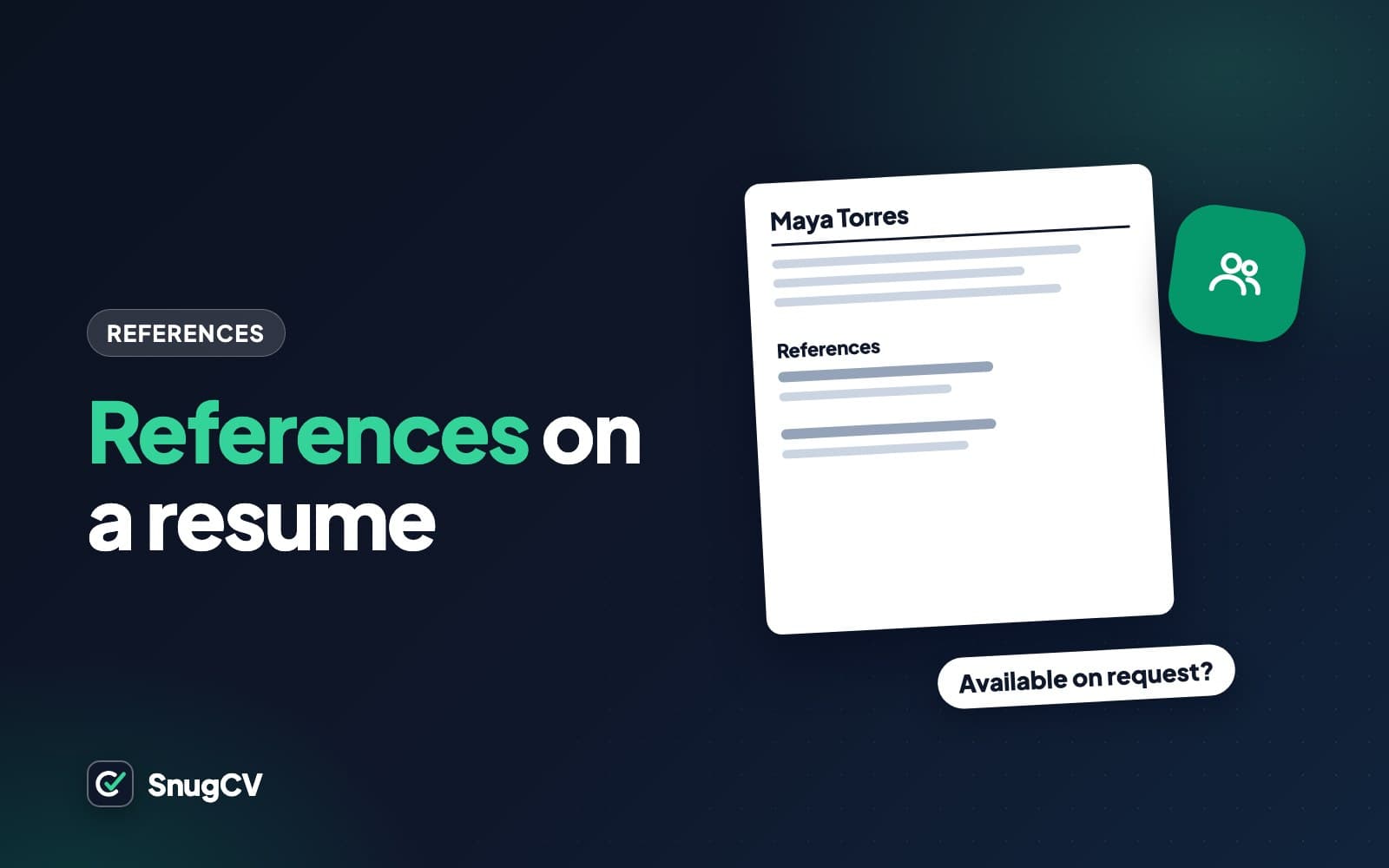
Leave references off the resume. Keep a separate page with three people on it and send it when an employer asks for it. Do not write "References available upon request" either. Employers assume it, and the line takes space that could carry a bullet.
In many hiring processes references come late, which is why they have no place on the first document an employer sees.
- 1
Application
Resume and cover letter go in. No references yet.
- 2
Screen
A recruiter or manager calls or emails. Still no references.
- 3
Interviews
One or more rounds. Near the end, an employer may say they will ask for references.
- 4
Reference request
You send your page. Your references hear from the employer.
- 5
Offer
Some offers depend on the checks coming back well.
The shape matters more than the exact timing. You have time to prepare after you know you are a serious candidate, and not before.
Why references stay off the resume
There are four reasons.
- Three references with names, titles and contact details take eight to twelve lines, which is the room of three or four strong bullets.
- A resume is uploaded, emailed, stored and passed between recruiters. Your references agreed to take a call from an employer you told them about. They did not agree to have their phone numbers sit in a job board's database.
- Different roles suit different references. A manager who can speak about your scheduling suits a coordinator job better than a colleague who watched you cover a till. If names are printed on the resume, you cannot choose.
- A person who gets a call from a stranger with no notice usually gives a worse reference than one who knew it was coming and had your resume open. With no contact details on the resume, you decide when anyone is called.
When to list them anyway
There are cases where references belong on the page or next to it. The test is whether the person reading your application has asked for them or whether your field's habit is to include them.
| Situation | What to do |
|---|---|
| The posting says to include references | Include them. A separate last page keeps the resume clean |
| The application form has reference fields | Fill them in, with people who have agreed |
| Academic CV | A short referees block is normal. Check the norms in your field |
| CVs in some countries outside the US and Canada | Some local conventions include naming referees or saying they are available. Check what is usual where you are applying |
| Freelance, consulting or contract work | Client names or short quotes, with permission, can work as proof |
| The posting says nothing | Leave them off and keep your page ready |
When a form gives you fields to complete, fill them in only with people who have agreed. Some application forms ask for supervisor names and a yes or no on whether the employer may contact them. Answer that honestly. If you do not want a current employer contacted, this is the place to say so.
Who to choose
The three tests are relevance, recency and willingness. Choose people who saw the kind of work this employer cares about, who worked with you recently enough to remember specifics, and who will say good things without hesitating.
| Your situation | Good choices | What they can speak to |
|---|---|---|
| Years in a regular job | A direct supervisor, a manager from an earlier job, a senior colleague | The work itself, reliability, how you handled problems |
| Healthcare | A charge nurse, a unit manager, a clinical supervisor, a preceptor | Patient care approach, teamwork, dependability |
| Retail, hospitality, food service | A store or general manager, a shift lead, a head chef | Attendance, pace, handling customers and rushes |
| Trades and construction | A foreman, a site supervisor, an instructor from your apprenticeship | Skills, safety habits, finishing the job |
| Warehouse and logistics | A shift supervisor, an operations manager | Accuracy, rate, safety, working a shift |
| Teaching | A principal, a department head, a cooperating teacher | Classroom practice, planning, relationships with families |
| Recent graduate | An instructor, an internship supervisor, a part-time job manager | Effort, curiosity, how you handled responsibility |
| Volunteer with little paid work | A volunteer coordinator, a coach, a community leader | Dependability, initiative, working with people |
| Freelance or self-employed | Two or three clients, a collaborator | Quality, communication, meeting deadlines |
| Career changer | Someone who saw the transferable skills, ideally also someone from the new field | The overlap between old work and new |
Choose people who will say something specific. A mid-level manager who can describe a project you ran helps you more than a vice president who knows your name and not much else.
Who to avoid
Skip family members, people you have had a conflict with and anyone who does not clearly remember your work. If you are unsure how enthusiastic someone will be, ask whether they would be comfortable giving a strong reference. The wording gives them an easy way to say no, and it is far better to hear that from them now than from an employer later. Do not list people at your current workplace unless your search is open there.
Professional, academic and character references
Most employers want these
Professional
Supervisors, managers, senior colleagues and clients. They speak to how you work, and they are the default for anyone with a work history.
When work history is thin
Academic
Instructors, professors, advisors and project supervisors. Useful for a first job or a career start, when the people who know your effort are teachers.
Only when asked or when nothing else fits
Character
A coach, a volunteer lead or a community leader. These carry less weight, so use them to fill gaps and say how you know the person.
How many to list
3
References on the page. A common ask, and a good default if the employer does not say.
4 or 5
People to have lined up so you can choose the three that fit each role.
1 page
The whole references document, in the same font and layout as your resume.
If the employer names a number, give that number. Guides vary on how many to list, from two or three up to five or more for senior roles, and the employer's request settles it.
References and letters of recommendation
The two get mixed up. A reference is a person an employer contacts, usually by phone or email, during the hiring process. A letter of recommendation is a written document that the writer prepares in advance, more common for schools, scholarships and some professional programs. A few employers accept a letter alongside or in place of contact details, and some referees are happy to write one that you can hold on to. If a posting only says "references", plan to be contacted, and keep any letter as a backup.
The references page
A references page is a one-page document in the same font and layout as your resume, so the two look like a set. It carries your name and contact details at the top, a title and one entry per person.
- 1
Your name, city, phone and email, matching the top of your resume.
Header
The same header makes the page look like part of your application, and it keeps the page from being separated from you if it is forwarded.
- 2
Professional references
Title
Plain and clear. Add a second block called Personal or Character references only if the employer asked for both.
- 3
Renee Okafor, General Manager, Blue Harbor Grill
Name and role
Full name, job title and employer. This is how the person is found and how the employer knows who they are.
- 4
Phone and email
Contact details
Preferably the details the person asked you to give, such as a work phone or a personal email.
- 5
My manager for three years, 2021 to 2024. Can speak to shift leadership and training.
Relationship
One line on how you know them and what they can speak to. It lets the employer ask the right questions.
- 6
Strongest or most relevant first
Order
Some employers only call the first one or two names.
A template to copy
Template: references page
[Your full name]
[City, State or Province] | [Phone] | [Email]
Professional references
[Reference 1: full name]
[Job title], [Company]
[Phone] | [Email]
Relationship: [How you know them, where and when. For example: Supervised my work at Company from 2021 to 2024.]
[Reference 2: full name]
[Job title], [Company]
[Phone] | [Email]
Relationship: [How you know them, where and when.]
[Reference 3: full name]
[Job title], [Company]
[Phone] | [Email]
Relationship: [How you know them, where and when.]
A filled example
This one is made up, for someone applying for a restaurant supervisor role.
Example: references page (made up)
Tomas Alvarez
Austin, TX | (555) 010 0178 | tomas.alvarez@example.com
Professional references
Renee Okafor
General Manager, Blue Harbor Grill
(555) 010 0124 | renee.okafor@example.com
Relationship: My manager for three years, 2021 to 2024. Can speak to shift leadership, scheduling and training new staff.
Luis Moreno
Kitchen Manager, Blue Harbor Grill
(555) 010 0156 | luis.moreno@example.com
Relationship: Worked beside me on the line and in prep for two years. Can speak to how I run a busy service.
Janet Whitaker
Events Coordinator, Cedar Point Catering
(555) 010 0189 | janet.whitaker@example.com
Relationship: Hired me for weekend events from 2019 to 2021. Can speak to reliability and customer service.
The mix is deliberate. Two people from the same restaurant saw him in different relationships, one as manager and one as a peer, and the third saw his work from outside the kitchen. That spread gives an employer more to work with than three managers from the same company.
A second example, for someone with little paid work
A recent graduate has a thinner list, so the relationship line does more of the work. This one is also made up.
Example: references page, recent graduate (made up)
Amara Nwosu
Denver, CO | (555) 010 0133 | amara.nwosu@example.com
References
Dr. Helen Brandt
Associate Professor of Biology, Front Range State University
(555) 010 0141 | helen.brandt@example.com
Relationship: Supervised my senior research project, 2025 to 2026. Can speak to lab work, reliability and writing.
Marcus Teller
Volunteer Coordinator, Riverside Food Bank
(555) 010 0167 | marcus.teller@example.com
Relationship: Coordinated my weekly volunteering, 2023 to 2026. Can speak to showing up, taking initiative and working with the public.
Dana Fischer
Store Manager, Pinecrest Garden Center
(555) 010 0192 | dana.fischer@example.com
Relationship: My manager at a seasonal job, summers 2024 and 2025. Can speak to customer service and handling busy weekends.
Each person saw her in a different setting, which gives an employer three views of the same person instead of one view three times.
How to ask someone to be a reference
Ask before you list anyone, and ask early. People say yes more readily when they have time, and they give better references when they have been briefed.
If you have a relationship that supports a quick conversation, ask in person or by phone. It is warmer, and you can tell right away if the person hesitates.
You
Hi Renee, do you have a minute? I'm applying for shift supervisor roles and I wondered if you'd be comfortable being a reference for me.
Renee
Sure. What kind of roles?
You
Supervisor jobs at restaurants. It would help if you could speak about the shift lead work I did last year, the scheduling and the training.
Renee
I can do that. Send me the posting when you have one.
You
I will, and I'll let you know before anyone calls. What's the best number and email to give them?
Notice that the request ends with logistics. The reference knows what to expect, and you have their preferred contact details.
An email asking someone to be a reference
Use this when you cannot call, or when you have not spoken in a while. Change the bracketed parts and keep it short.
Template: asking someone to be a reference
- To
- [Their email]
- Subject
- Would you be a reference for me?
Hi [Name],
It has been a while since we worked together at [Company], and I wanted to ask you something.
I am applying for [type of role] positions and I am putting together a short list of references. Working with you on [project, team or role] taught me a lot, and I would be grateful if you would be willing to speak about my work.
If you are happy to, I will send you my current resume and the posting for any role where your name goes forward, and I will tell you before anyone contacts you. If you would rather not, I understand completely.
Could you also let me know the best phone number and email to give an employer?
Thank you for considering it.
[Your name]
[Your phone]
Two things about this email. It gives the person an easy way to say no, which makes a yes more reliable. And it asks for their preferred contact details, so you are not guessing which email they check.
If the answer is no, or a hesitant yes
A no is information, so take it gracefully and move on. Thank them for being straightforward, and do not ask for a reason or try to persuade them. A reference who is lukewarm will come across that way on the phone.
A hesitant yes is harder to read. Listen for what they hedge on. "I can confirm your dates and title" means the person will not give an opinion, perhaps because of a company policy, and that has nothing to do with you. "I only worked with you briefly" is a sign that someone else would be a better choice. Both are worth hearing before an employer calls, so use them to pick a different person for this role, and ask them to remain a backup.
Preparing your references
A reference who has your resume open and knows what the role involves is easier for an employer to talk to and gives better answers. Preparing them takes ten minutes.
Before a reference is contacted
0 of 7 done
An email to send when a company is about to call
Template: heads-up to a reference
- To
- [Their email]
- Subject
- [Company] may contact you about me
Hi [Name],
Thank you again for agreeing to be a reference. [Company] has asked for references for the [job title] role, and I have given them your name. They may call or email you in the next few days. I have attached my resume and the posting.
The role involves [two or three main duties]. The parts of our work together that seem most relevant are [project, skill or situation].
Thank you for doing this. I will let you know how it turns out.
[Your name]
Give the person the facts about the role and let them say what they remember in their own words. A reference who sounds coached can raise doubts for the employer, and that works against you.
Keep the list current
A references list goes stale quietly. People change jobs, change numbers and forget the details of what you did. Once or twice a year, check that each name still works: phone number, email, current title. Send a short note with an update on what you are doing, and a thank-you if they have helped before. A reference who has heard from you recently is easier to reach and remembers you better than one who has not heard from you in three years.
Ask before you leave a job
The best time to secure a reference is before you resign. A manager is more willing, remembers more and is easier to reach. Ask them, get a personal phone number or email, and write down what you worked on together. If you are about to leave a job, resignation letter: how to write one, with templates covers the exit itself, and the same person is likely to be the one asked for a reference.
What a reference check covers
Employers vary in how they check. Some use a short phone call, some send an email form and some use an online questionnaire. The questions are usually along these lines.
Questions employers commonly ask a reference
- How do you know the candidate, and for how long?
- What was their role and what were their main responsibilities?
- What are their strengths?
- What could they improve on?
- How reliable were they, including attendance?
- How did they work with others?
- How did they respond to feedback or pressure?
- Would you work with them again?
Some employers route reference requests through human resources, and some have a policy of confirming only dates and job title. Policies vary, so ask your references whether their employer limits what they can say. A person who can speak as a colleague, within what their employer allows, is worth more than a bare statement of dates.
If references come up in an interview, say that you have a list ready and will send it. How to prepare for an interview covers what else to have ready, and the thank-you email after the interview is a natural place to repeat that you can send the list right away.
What to do when you have no references
Few people have a perfect list. Here are the usual gaps and what to do about each.
| Your situation | What to do |
|---|---|
| First job, no work history | A teacher, coach, tutor, school counselor, club advisor or volunteer coordinator who saw you take responsibility. See resume with no experience |
| You left a job on bad terms | Use a different supervisor, a colleague or a client from that job, or someone from another job. Do not list the person. Be ready to explain neutrally if asked |
| The company closed or your manager moved on | Reach them personally through a professional network or a personal email. A colleague who saw the work can substitute |
| Only gig or freelance work | Two or three clients who will confirm the work, or a collaborator who watched you deliver |
| A long gap | One person from before the gap, plus someone from what you did during it, such as a volunteer lead, instructor or program coordinator |
| You do not want your current employer called | Say so on the form and offer previous supervisors. Ask them to wait until after an offer, and make the request in writing |
| You worked abroad | Supervisors in other countries can be references by email. Mention the time difference and give a reliable email |
Mistakes and a checklist
The mistakes
Do
- Ask each person before you list them, and give them an easy way to say no
- Keep a current references page ready, in the same font as your resume
- Send your references the resume and the posting each time
- Choose people who saw the kind of work this job needs, and who can be specific
- Thank each reference whether or not you get the job
Avoid
- Print contact details on the resume itself
- Write references available on request, which takes space and says nothing
- List people without asking
- Give three managers from the same job when you have other options
- Forget to tell a reference that a call is coming
The checklist
References, ready to send
0 of 8 done
Where SnugCV fits
SnugCV's resume has sections for the profile summary, employment history, education, certificates, skills and languages. References are not one of them, which fits the usual advice. Keep your references page as a separate file next to your resume PDF, in the same font.
The free job tracker has a notes field for each application. It is a good place to write which references you gave to which employer and on what date, so none of them is surprised by a call. A free job application tracker shows how notes and statuses work.
Keep going
References usually matter once you are near an offer, so the next pieces are how you prepare for the interview, thank the interviewer and discuss pay. How to prepare for an interview covers the first, thank-you email after an interview the second and how to negotiate salary the third. If you are still shaping the cover letter, how to write a tailored cover letter walks through it.
Questions people ask
Should I write "references available upon request" on my resume?
There is no need. Employers assume you will provide references if they ask, so the line takes up space without telling them anything. Use that space for a bullet that shows your work. If a posting asks for references, send them as a separate page or fill in the form fields it provides.
How many references should I give?
Three is a common request, and the employer's instruction overrides any rule of thumb. Have four or five people lined up so you can send the three best matched to each role. If a form has two fields, give two. If it says up to five and you have three strong ones, give three.
Can a friend or family member be a reference?
Family rarely persuades an employer, because they are expected to be positive. A friend who worked with you, led a team you volunteered on or coached you is fine if they saw your work. Employers usually want people who supervised you or worked beside you. Use friends only when you have little else, and be honest about how you know them.
What if I do not want my current employer contacted?
Say so on the application and in the interview, and offer previous supervisors or colleagues instead. Ask the employer to contact your current manager only after an offer, if at all. Do not assume they will wait. Make the request clearly and in writing so that you are not surprised by a call to your workplace.
My old manager has left the company. Can they still be a reference?
Yes. Contact them on their personal email or phone, or through a professional network, and ask if they are willing. A manager who knew your work is a better reference than a current employee who only has your file. On the references page, give their current employer or write their former title and company with the dates you worked together.
What is the difference between a reference and a letter of recommendation?
A reference is a person an employer contacts, usually by phone or email, during the hiring process. A letter of recommendation is a written document that the writer prepares in advance, more common for schools, scholarships and some professional programs. Some employers accept letters instead of contact details. If a posting only says references, plan on being contacted.
Was this guide helpful?
Get the free resume checklist and new guides
Twenty checks to run before you send a resume, as a one-page PDF. After that, a short email when new guides go up, at most once a week.