Key takeaways
- Put education first when it is your strongest or a required credential, and below your experience once your work history has taken over.
- A complete entry is the school, the degree and field, the location and the year. Everything else is optional and has to earn its space.
- An unfinished or in-progress degree can be listed truthfully by saying what you completed or when you expect to finish. A degree you did not earn never goes on the page.
- Licenses and certifications get their own section, because readers and parsers look for them there and they carry dates.
In this guide
- What goes in an education entry
- Where education goes on the page
- Recent graduates and current students
- Experienced professionals
- GPA: whether to list it
- A degree you did not finish
- High school, GED and no degree
- Certifications and licenses
- Degrees from other countries
- Multiple degrees and more than one school
- Mistakes to avoid
- Where SnugCV fits
- Keep going
Education is usually the shortest section on a resume and the one that raises the most questions. The question is rarely whether to include it. It is the details: whether the GPA stays, what to do about the two years you never finished, where a forklift ticket goes, how to write a degree from another country.
This guide takes those situations one at a time, and each has an example you can copy and adapt. Every school, name and number in the examples is made up. Conventions shift by field and by country, so treat the advice as a sensible default and let the posting's own instructions win. If you are building a resume around study because your work history is short, resume with no experience is the companion to this guide.
What goes in an education entry
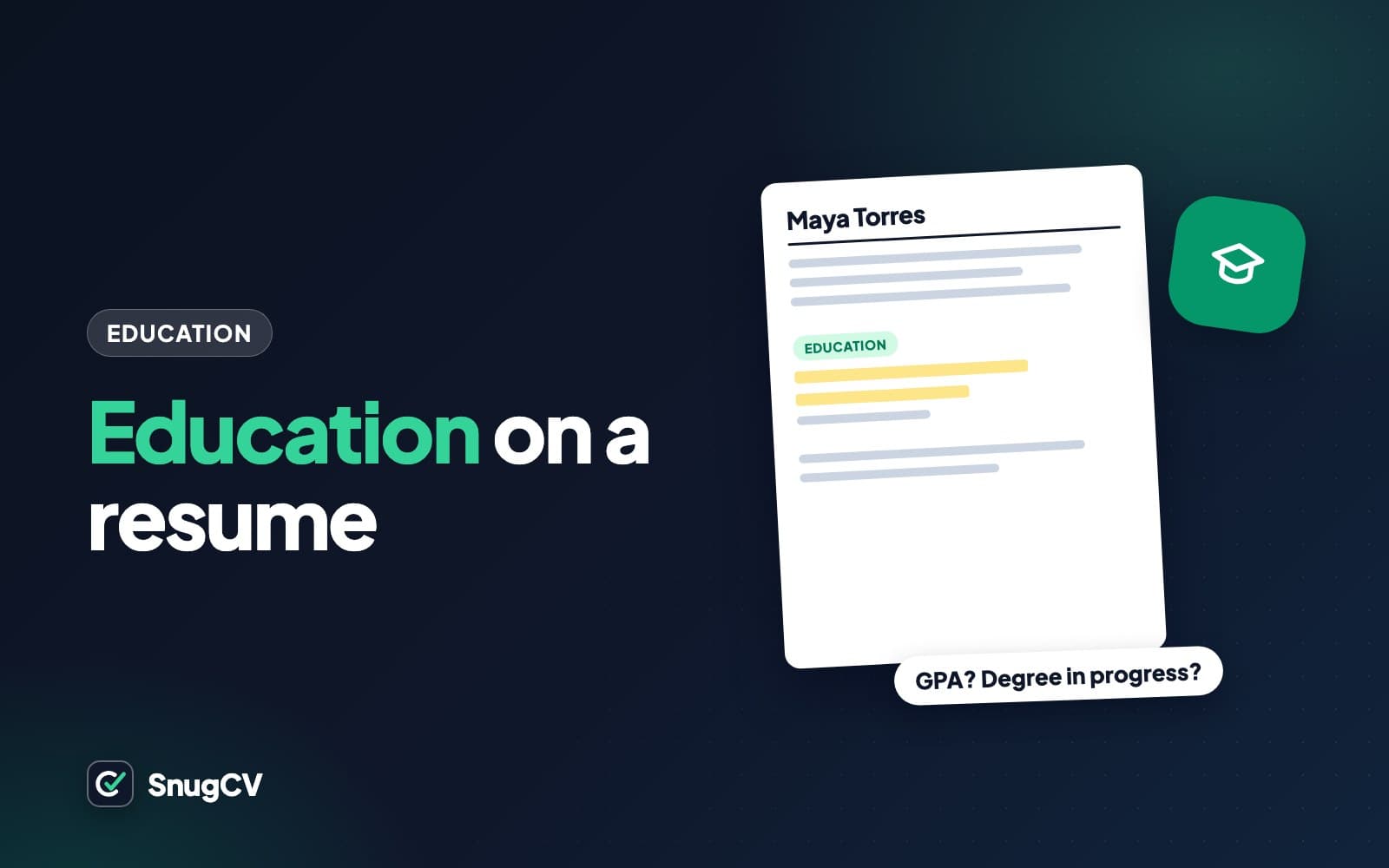
A complete entry answers four questions: what you studied, where, where that place is and when you finished. That means the degree with its field, the school, the location, and the year you finished or expect to finish. Everything else is optional, and each optional line has to earn the space it takes.
- 1
Bachelor of Science in Biology
Degree and field
Write the degree name the way the school awards it. Spelled out reads cleanly to people and software alike. An abbreviation such as B.S. is fine if every entry uses the same style.
- 2
Westbrook State University, Madison, WI
School and place
Use the name on your diploma. If the school has since merged or renamed and readers may not recognize the old name, add the current name in parentheses.
- 3
May 2021
Year
The month and year you finished, or the date you expect to finish. A year alone is also common.
- 4
Magna cum laude
Honors
Formal honors only: Latin honors, a dean's list, a named scholarship. A phrase like high achiever is not an honor.
- 5
Relevant coursework: Genetics, Biostatistics, Lab Methods
Optional detail line
Early in a career, three or four courses that match the posting. Later, this line comes off.
Pick one order for the lines and keep it for every entry. Degree first, then school, is the most common arrangement, and school first is also fine as long as the section looks the same from top to bottom.
Usually worth a line
- Honors such as cum laude or a dean's list
- A minor or a second major
- A thesis or capstone title
- Coursework that matches the posting, early in a career
- Study abroad, when it relates to a language or the role
- A leadership role in a student group, early in a career
Usually safe to cut
- GPA after a couple of years of work
- Course lists once you have experience
- High school once you have a degree
- Every club you joined
- Courses that do not connect to the posting
- Anything you would struggle to discuss for two minutes
Where education goes on the page
The rule under all the variations is simple: lead with whichever of education and experience is stronger for this job. A reader opens the page looking for evidence you can do the work, and the first third of the page is where they look.
Header
Maya Torres
Summary
Skills
Experience
Education
- 1Below experience is the usual place once your work history carries the resume. The entry here is short: school, degree and year.
- 2Above experience is better for students, recent graduates, roles that require a specific degree and anyone who has just finished a program that is the bridge into a new field.
- 3Whichever side it sits on, keep the heading plain. Education or Education and training are what a reader and a parser both expect.
| Your situation | Where education goes | Why |
|---|---|---|
| Student or recent graduate with little work history | Above experience | The degree is the strongest thing on the page |
| A role that requires a specific degree or license (nurse, teacher, engineer, pharmacist) | Near the top | A reader checks the requirement first |
| Several years of relevant work | Below experience | The work now answers the question |
| Career changer who just finished a program | Above experience, until new experience exists | The program is the bridge |
| A degree that is unrelated to the job and long ago | Below experience, short | It rarely decides anything |
| An academic CV | Top | That is the convention in academic fields, see CV vs resume |
If you move sections around often, how to choose your resume template, font and section order shows how to set an order once. Resume formats explains how the placement of education fits into the larger choice of format.
Recent graduates and current students
With little work history, your education carries the page, and you have room to add detail. Even here every line should help this reader decide. Two examples show the range, one from health care and one from a liberal arts degree.
Example: recent graduate, nursing (made up)
Education
Bachelor of Science in Nursing, Riverbend University, Dayton, OH. May 2026
- GPA: 3.7 / 4.0. Dean's list, six semesters
- Clinical rotations in medical-surgical, pediatric and community health units
- Relevant coursework: Pharmacology, Pathophysiology, Health Assessment
Example: recent graduate with a capstone, communication (made up)
Education
Bachelor of Arts in Communication, minor in Marketing, Pinegrove College, Asheville, NC. May 2026
- Capstone: designed and presented a four-week social media plan for a local food bank
- Relevant coursework: Public Relations Writing, Audience Research, Media Ethics
- Treasurer, Communication Student Association
A degree in progress
Say it is in progress and give the date you expect to finish. A date you do not plan to hit invites a question you will not enjoy answering.
Expected date
Full-time student
Bachelor of Science in Accounting, Tri-County State College, Lansing, MI. Expected May 2027
Say so
Part-time while working
Associate of Applied Science in Welding Technology, Ridgeline Technical College, Boise, ID. Evening program, expected December 2027
Credits to date
Mid-program
Master of Education in Curriculum and Instruction, Lakeshore University. In progress, 18 of 30 credits completed, expected August 2027
Words that read well here are expected, anticipated, in progress and currently enrolled. If you are not enrolled and have no plan to resume, the entry belongs in the unfinished degrees section below.
Honors, coursework, projects and activities
Extras help early in a career and fade quickly. They belong under the degree, in two or three short lines, and each should connect to the kind of work you want. Compare these.
Before
Relevant coursework: Intro to Psychology, Intro to Sociology, English Composition, College Algebra, Art History, Statistics, Research Methods, Social Psychology
After
Relevant coursework: Statistics, Research Methods, Social Psychology
A short list matched to the posting reads as a decision. A long list reads as the whole transcript.
Before
Member of several student clubs. Active in campus life.
After
Treasurer, Student Nurses Association: kept the club budget and organized two campus blood pressure screenings.
A role, a responsibility and an event a reader can picture. Add a number only if it is real.
Before
Wrote a senior thesis.
After
Senior thesis: interviewed 14 line cooks about shift scheduling and wrote a 40-page analysis of which schedule patterns they found workable.
The title or the question, how you studied it, and what came out. The figures in this example are made up.
Experienced professionals
Once you have a few years of relevant work, the job of showing you can do the work moves from the degree to your experience. The education entry shrinks to what a reader needs to confirm the credential.
First job after school
Bachelor of Science in Business Administration, Marcus State University, May 2012. GPA 3.2. Relevant coursework: Marketing, Statistics, Operations Management. Member, Business Club. Dean's list 2011.
Fourteen years later
Bachelor of Science in Business Administration, Marcus State University
Fourteen years of work have taken over the job of showing you can do it. The entry now confirms a credential and nothing more.
Should you show graduation years?
There is no single answer. Some people with long careers leave the year off so readers focus on recent work, and some leave it on. Both are common. Whichever you choose, keep everything else about the entry accurate.
Reasons
Keeping the year
A complete, consistent entry looks careful. Some applications and background checks ask for the year anyway, and a missing year on the resume can draw a question. If your degree is recent or your timeline is plain, there is little reason to hide it.
Reasons
Leaving it off
After decades of work, the year of a degree says little about what you can do now, and some people prefer readers to see recent work first. Others leave it off so readers do not estimate their age from it. If you leave it off, leave it off every entry for consistency, and expect to give the year when an application form asks.
Whatever you decide, the school and the degree must be exact. A reader or an employer may check them.
GPA: whether to list it
A GPA is a number that makes sense early in a career and loses meaning as results from real work take over. There is no universal rule, and fields differ, but a few conventions hold up across most advice.
3.0 to 3.5
The range of cutoffs that career guides and university career centers quote for listing a GPA on a 4.0 scale. A rule of thumb that varies by field.
1 to 2 years
A common point to drop the GPA and let work results speak. A rule of thumb, not a firm line.
Always
State the scale next to the number: 3.8 / 4.0, or 8.4 / 10.
| Situation | List it? | How |
|---|---|---|
| First job after school, strong GPA | Usually yes | GPA: 3.8 / 4.0 |
| First job, modest GPA | Your call. Leave it off if it does not help, and be ready if asked | A higher major GPA can stand in, if labeled Major GPA |
| Two or more years of relevant work | Usually drop it | Let the experience speak |
| An application, scholarship or graduate program that asks for it | Yes, exactly as asked | Use the scale they request |
| A degree with Latin honors | The honors can stand in for the number | Magna cum laude |
| A non-U.S. scale | Yes, with the scale | CGPA 8.1 / 10 |
A degree you did not finish
Many people have some college, and it can help. The rule is to say exactly what happened. Readers respect a partial degree that is described accurately, and they lose trust in one that turns out to be inflated.
Example: credits completed (made up)
Education
Coursework toward a Bachelor of Arts in Psychology, Harlan State University, Louisville, KY. 2019 to 2021
- Completed 78 of 120 credits
- Coursework in research methods, statistics and developmental psychology
Short version
Dates and field only
Studied nursing, Harlan Community College, 2019 to 2021
Use this when you did not complete much, or when the credit count would not add anything.
Credit what you finished
A certificate earned on the way
Certificate in Early Childhood Education, Eastfield Community College, 2020
Completed within the Associate of Arts program, 2019 to 2021
Use this when you did finish something with a name.
Say
- Coursework toward, studied, completed 78 of 120 credits
- The years you attended and the school's real name
- Relevant courses that match the posting, early in a career
- Any certificate or credential you did complete
Avoid
- The degree name on its own, as if it were finished
- A graduation date you did not earn
- Degree candidate when you are not currently enrolled
- Wording that suggests completion, such as BA, 2021, with no qualifier
Degrees are easy to verify, and an entry that does not match the school's record can cost you an offer. Say what is true, and then give the reader the reason to care: the knowledge, the projects, the part of the work the courses prepared you for.
High school, GED and no degree
High school goes on a resume when it is your highest level of education, or when a posting asks for a diploma or equivalent. Once you hold a college degree or a completed trade program, it comes off.
Example: high school with a vocational program (made up)
Education
High school diploma, Eastfield High School, Fresno, CA. 2023
- Two-year automotive technology program at the district career center
- Shop safety certificate, 2023
Example: GED plus training (made up)
Education and training
- High school equivalency diploma (GED), State of Ohio, 2021
- Commercial driver training program, Valley Driving Academy, 2023. Class A CDL issued
When you have no degree, lead with your experience and your credentials, and let education sit below them. Outside the U.S., school-leaving qualifications such as A-levels in the UK or the Abitur in Germany are often listed with grades early in a career. Follow local examples, and see CV vs resume for regional naming.
When a posting asks for a degree you do not have
Read the exact wording before you decide. The same word, degree, means three different things in postings.
Posting excerpt (made up)
Purchasing Coordinator, Harborline Foods
Requirements: Bachelor's degree in business, supply chain or a related field, or equivalent experience. Three or more years in purchasing or inventory control. Proficiency with spreadsheets and an ordering system.
Apply
Degree preferred
The employer would like one and may take other strengths. Apply if the rest fits and lead with your experience.
Apply and show the equivalent
Degree or equivalent experience
Equivalent experience is a stated way in. Make the years and the relevant work easy to find, and list any credits or training.
Read the rest
Degree required
Some employers use it as a hard filter, and some licensed roles need a specific degree for the license itself. Weigh whether to apply, and never list a degree you did not earn.
For the middle case, a line in your summary does the work of the missing degree.
Example: summary line that stands in for a degree (made up)
Purchasing and inventory specialist with eight years of experience in food distribution, plus coursework in business administration.
Certifications and licenses
Certifications and licenses get their own section. Readers and parsers look for them by name, they carry dates, and a posting often treats them as requirements. A section called Licenses and certifications also keeps them from being buried under your degree.
For each one, list the name, the body that issued it, and the year earned or the year it is valid through. Many people leave license numbers off the resume and enter them on the application, where the employer asks for them.
Licenses and life support
Healthcare
- Registered Nurse (RN), State of Texas, active through 2028
- BLS for Healthcare Providers, American Heart Association, valid through 2027
Class and endorsements
Driving and logistics
- Commercial Driver's License (CDL), Class A, Tanker endorsement, State of Georgia, valid through 2028
- Forklift operator certification, Northline Safety Training, 2025
Food safety
Food service
- ServSafe Food Protection Manager, valid through 2029
- Food allergen awareness course, 2024
State license
Teaching
- Professional Educator License, Elementary Education (grades 1 to 6), State of Illinois, valid through 2029
- ESL endorsement, 2023
License and safety card
Skilled trades
- Journeyman electrician license, State of Oregon, 2022
- OSHA 10-hour construction safety card, 2024
Professional credentials
Office and finance
- Certified Public Accountant (CPA), State of Colorado, active
- Project Management Professional (PMP), Project Management Institute, 2023
Template: licenses and certifications section (made up)
Licenses and certifications
- Registered Nurse (RN), State of Texas, active through 2028
- Basic Life Support (BLS), American Heart Association, valid through 2027
- Advanced Cardiac Life Support (ACLS), American Heart Association, valid through 2027
- Medical-surgical nursing certification (in progress), exam scheduled for March 2027
Bootcamps, short courses and training
Training belongs on the resume when it is recent and relates to the role, or when it stands in for formal education you do not have. A short section called Training or Professional development works well, with two to four items.
Examples of training entries (four different people, made up)
Training
- HVAC Technician Certificate Program, Pinecrest Trade Institute, 2024 (six months, evenings)
- Web Development Bootcamp, Harbor Code School, 2025 (24 weeks, full time)
- Medical Spanish for Health Care Workers, Eastfield Community College, 2025 (40 hours)
- Excel for Business, intermediate, community college continuing education, 2025
Two habits keep this section honest. Label what you actually have: course completed for a course, certified for a credential that required an exam. And list fewer, better items.
Before
Completed many online courses on leadership, communication, Excel, time management, customer service and more.
After
Excel for Business, intermediate, community college continuing education, 2025. Built pivot tables and lookup formulas for a monthly inventory report.
One course you can name and describe beats a list of six you could not discuss in an interview.
Degrees from other countries
A reader in another country may not know your school, your grading scale or what your degree level equals. Your job is to make the entry easy to place without changing what it is.
Licenciatura
Mexico
Licenciatura en Contaduría Pública (Bachelor's degree in Public Accounting), Universidad Regional del Norte, Monterrey, Mexico. 2017
The original name first, with a plain description in parentheses, lets a reader place it.
Honours degree
United Kingdom
BSc (Hons) Biomedical Science, 2:1 (upper second-class honours), University of Eastvale, England. 2020
Give the classification in words once. A reader outside the UK may not know what 2:1 means.
Marks scale
India
Bachelor of Technology in Mechanical Engineering, Westgate Institute of Technology, Pune, India. 2019. CGPA 8.1 / 10
Always state the scale. A number with no scale invites a wrong guess.
Vocational training
Germany
Ausbildung as a warehouse logistics specialist (Fachkraft für Lagerlogistik), three-year vocational apprenticeship, Hamburg, Germany. 2016
A vocational apprenticeship is a real qualification. Name the trade and the length so a reader outside the system understands it.
A plain, accurate description is safer than a claimed equivalency. A formal credential evaluation, which some employers and licensing bodies ask for, gives an official equivalency, and if you have one you can mention it beside the entry. If you do not, give the degree name, the school and the country, and let the reader place it.
Multiple degrees and more than one school
List degrees in reverse chronological order, which usually puts the highest first. Add every school that awarded a degree. You do not need to list every school you attended.
| You have | How to list it |
|---|---|
| Degrees at different levels | Reverse chronological, so master's above bachelor's |
| Two degrees at the same level | Most recent or most relevant first |
| A double major | One degree entry naming both fields |
| A minor | A short line under the degree |
| A transfer between schools | The school that awarded the degree. Name the first school only if it also gave a degree or the name matters to the role |
| An associate degree earned on the way to a bachelor's | Keep it if it adds a different field. Otherwise it can come off |
Example: two degrees (made up)
Education
Master of Public Health, Lakeside University, Chicago, IL. 2024
Bachelor of Science in Nursing, Northfield College, Duluth, MN. 2019
Bachelor of Arts in Economics and Spanish (double major), Brookdale State University, 2015
Mistakes to avoid
Do
- Check names and dates against your diploma or transcript
- Use one style for every entry: the same order, the same date format
- Put whichever of education and experience is stronger for this job first
- State what you completed when the degree is unfinished
- List licenses and certifications with the issuing body and a date
Avoid
- A degree, a major or a date you did not earn
- A rounded-up GPA, or a number without its scale
- High school once you have a degree
- A long list of courses you could not discuss
- A lapsed credential presented as current
A last check before you send it
Education check
0 of 8 done
Where SnugCV fits
SnugCV builds a profile from your uploaded resume and copies your education, along with your employers, titles and dates, into every tailored resume unchanged. Tailoring never adds a degree, a GPA or a date. Check that your education came through right when you build the profile, and edit an entry before you download the PDF if it needs a change.
Certificates have their own section, and the section order is a setting, so a student can move Education above Employment history once and have every new resume follow. How to edit your tailored resume and download it as a PDF shows where to fix an entry.
Keep going
Education is one block of a larger page. Resume formats explains how the whole resume is ordered, and skills for a resume covers the section that sits next to it. If your degree is in a different field from the work you want, career change resume shows how to make the move make sense. If you are in high school and looking for a first job, jobs for 16 year olds covers where to start.
Questions people ask
Should education go first or last on a resume?
Lead with whichever is stronger for this job. Students, recent graduates and people applying to roles that require a specific degree usually put education first. Once you have several years of relevant work, move it below your experience and shorten it to the school, degree and year.
Should I put my GPA on my resume?
Only if it helps and you are early in your career. A common rule of thumb puts the cutoff between 3.0 and 3.5 on a 4.0 scale, and many people drop it after a couple of years of work. Always show the scale, never round up, and give it exactly if an application asks.
How do I list a degree I did not finish?
State what is true: the school, the field, the years you attended and the credits you completed. Words such as coursework toward or studied are accurate and still show the learning. Never write the degree name alone, a graduation date you did not earn, or candidate when you are not enrolled.
Do I need to list high school on my resume?
Only if it is your highest level of education, or if a posting asks for a diploma or equivalent. Once you have a college degree or a completed trade program, high school can come off. If you have no degree, a short entry with the school and year is enough, plus any vocational program you completed there.
Should I include my graduation year?
It is a personal choice. Many people with long careers leave the year off so that readers focus on recent work. Others keep it for consistency, and some applications ask for it regardless. If you do omit it, do so on every entry, and never change a date. The school and degree must stay accurate.
Where do certifications and licenses go?
In their own section, usually titled Licenses and certifications, placed after education or even above it when a license is the first thing a reader checks. List the name, the issuing body or state, and the year earned or the year it is valid through. In-progress credentials can be listed with an expected date.
How do I list a degree from another country?
Give the degree name as awarded, add a plain-English description in parentheses, then the school, city, country and year. If you list marks, state the scale. A formal credential evaluation can give a U.S. equivalency, and you can mention one if you have it. Licensed professions have their own recognition process outside your resume.
Was this guide helpful?
Get the free resume checklist and new guides
Twenty checks to run before you send a resume, as a one-page PDF. After that, a short email when new guides go up, at most once a week.