Key takeaways
- The question asks whether what you do well matches what this employer needs. Answer with a claim, evidence and a reason for this employer.
- Evidence beats adjectives. One real example with a visible result is stronger than a list of qualities, and a number belongs only if it is true.
- With little experience, say so in one sentence, then show the closest work you have done and how quickly you learn.
- Twenty minutes of research gives you the specific detail that turns a generic answer into one that fits this employer, and it answers 'why do you want to work here' as well.
In this guide
- What the question is really asking
- The three-part answer
- Build yours in three steps
- Example answers by field
- When you have little or no experience
- Why do you want to work here?
- A 20-minute company research routine
- Handling follow-ups and pushback
- Mistakes, rewritten
- A template and a checklist
- Where SnugCV fits
- Keep going
Few questions make people squirm like this one. It sounds like an invitation to boast, and it often arrives while you are still replaying the last answer. Take the pressure off by reading it as a plain business question: this employer has a problem to solve, and the interviewer wants to know whether you are the person to solve it.
Your answer is a match: what they need, what you have done that fits, and why you want to do it here. This guide builds one in three steps, with 20 made-up example answers from retail to nursing to the trades, answers for when your experience is thin, the "why do you want to work here" version, and a 20-minute routine for researching the employer. If you have not read the posting closely yet, how to find the keywords in a job description is the place to start. For the rest of your preparation, see how to prepare for an interview.
What the question is really asking
Underneath the wording, the interviewer is working out three things.
The job
Do you understand what we need?
An answer that starts with the employer's problem is ahead before it says anything about you. A candidate who describes the job accurately sounds like someone who has already started doing it.
The evidence
Can you show me?
Adjectives cost nothing, and almost everyone offers "hard worker". An example costs something, because it can be checked and followed up.
The reason
Why us, and why now?
An employer would rather hire someone who wants this job than someone who wants any job. A specific reason shows you looked.
The question wears many costumes, and the answer has the same shape in all of them.
Versions of the same question
- What can you bring to this role?
- What makes you the best candidate?
- Why should we choose you?
- What sets you apart?
- Why are you the right person for this job?
- Why should we take a chance on you?
- What can you do for us?
- Why do you want to work here?
You cannot know who else applied, and the interviewer knows you cannot, so a claim to be the best does not help. Describe what you bring, and let them do the comparing.
The three-part answer
Every strong answer has the same three parts, in this order. A common rule of thumb is that the whole thing runs 45 to 90 seconds, with the middle part getting the most room.
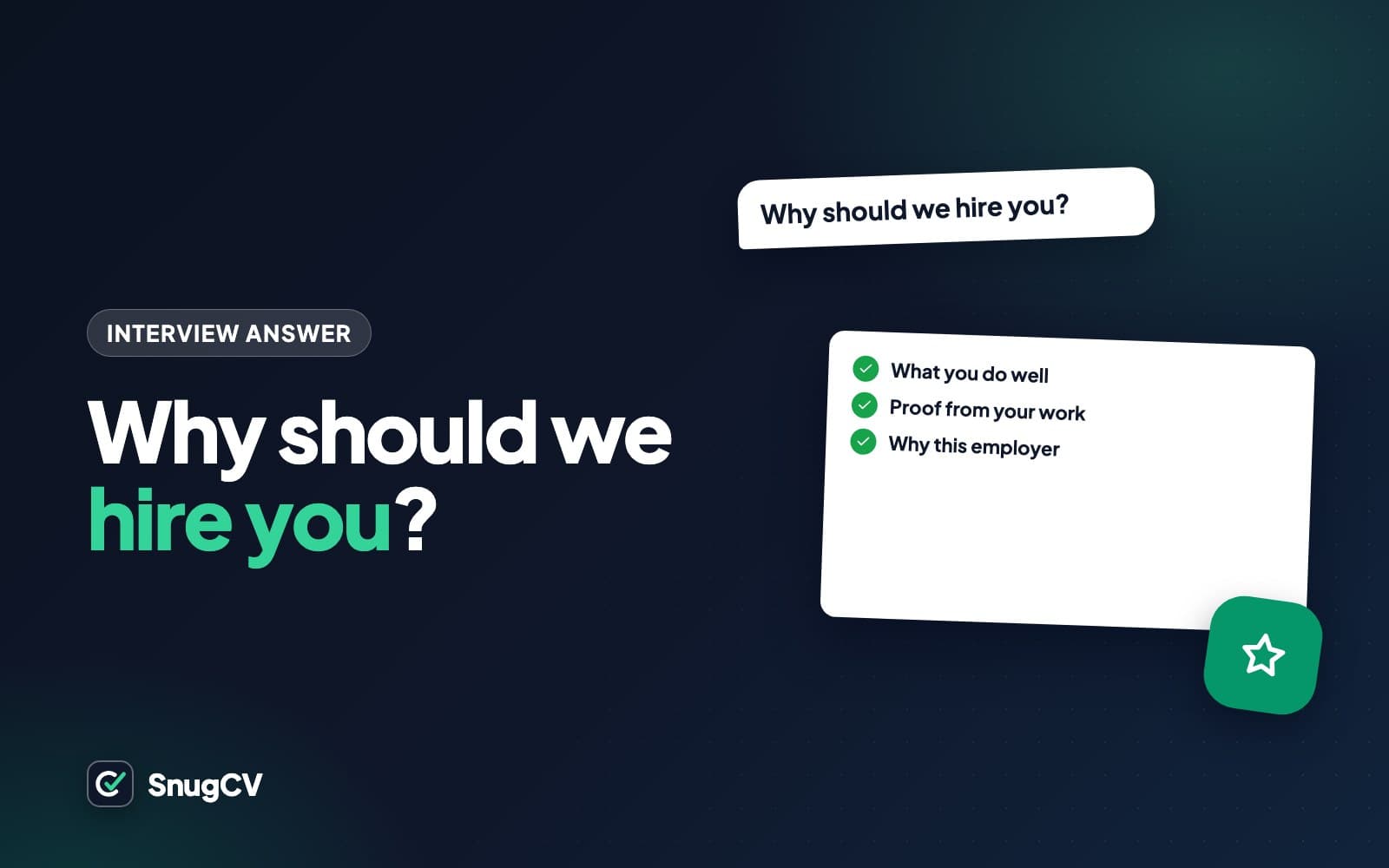
- Claim. What they need most, and that you have done it. One or two sentences, in the posting's own words.
- Evidence. One real example: what you did, where, and what changed.
- Why here. One true, specific reason for this employer.
Here is one made-up answer split into its parts, for a front desk job at a dental clinic.
- 1
You need someone who keeps a full schedule running and patients at ease, and that is the work I have done for three years.
Claim
Starts from their need and uses the posting's language. The interviewer hears their own priority first.
- 2
At Brightwater Dental I managed the bookings for five providers, called every patient the day before and filled cancelled slots from a waitlist. Same-day gaps in the schedule became rare.
Evidence
A specific habit, a place and a visible result. No invented percentage. The result can be checked with a reference.
- 3
I also noticed you run a children's morning on Saturdays. I would like to work somewhere that sees whole families.
Why here
One true detail that only fits this employer, and why it matters to you.
Build yours in three steps
Step 1: find what they need most
Start with the posting, because it is where the employer has written their problem down. Mark the duties and requirements it repeats, puts first or calls required. You cannot cover everything in 90 seconds, so choose the top two or three.
Here is a made-up posting for an assistant manager at a hardware store.
Job posting (made up for this guide)
Assistant Manager, Fairhaven Hardware
Open and close the store and keep the floor running on busy weekends. Coach a team of six to ten associates. Handle returns and special orders with patience. Keep aisles stocked and help customers choose the right product for their project. Two years' retail experience, ideally in building supplies.
| The posting stresses | What they need | What you could show |
|---|---|---|
| Keep the floor running on busy weekends | Someone who stays level and organized when the store is full | A rush you ran, and what you did about the queue and the stock |
| Coach a team of six to ten | Someone who can teach and set a good example | A new starter you trained, even if you were not officially their lead |
| Help customers choose for their project | Someone who asks questions before recommending | A customer you matched to the right product, and what you asked |
| Handle returns with patience | Someone who defuses, not escalates | A return that began badly and ended well |
The claim for this posting is easy to see: the floor, the team and the customer. Everything else is supporting detail.
Step 2: choose your evidence
For each of the top needs, find one example you can describe in two or three sentences. It should have a place, an action and something that changed. An example gives the interviewer something to write down.
Before
I am a hard worker and very reliable.
After
In three years at the garden center I covered nine call-outs without a missed delivery, and I was asked to train the new seasonal staff.
Reliable is a claim. Covering call-outs and being asked to train others is the evidence for it.
Before
I have excellent customer service skills.
After
At the service desk I fixed the problem first and took the details afterwards. Regular customers started asking for me by name.
Describes what you actually do, and shows the result as something a person saw.
Before
I am a fast learner.
After
When the clinic changed its booking system, I learned it from the manual over a weekend and then showed three colleagues on Monday.
A single event that shows how fast, and that you shared it.
When you do not have a number, there are other ways to show size. None of them require inventing anything.
Ways to show scale without a figure
- Scope: five providers, forty tables, a class of twenty-six
- Frequency: every shift, every Monday, twice a week
- Before and after: late invoices stopped, the queue cleared
- Reaction: asked to train new starters, asked for by name
- Trust: given the keys, the cash drawer, the first prep list
Step 3: add why this employer
One sentence of research that only fits them. The formula is a thing you noticed plus the reason it matters to you or to the work. Generic reasons ("a leader in the industry") could be said to anyone. A specific one could only be said to them. The 20-minute routine later in this guide shows where to find it.
Example answers by field
These are made-up answers for made-up people. Take the shape rather than the sentences. Each one should end up in your words, with your facts, and about 60 to 90 seconds when spoken. If you have not yet written your opening answer, tell me about yourself covers it.
Customer-facing work
Example answer: retail sales associate (made up)
Your posting says associates help people decide, and that is the part of retail I like best. For two years at a furniture store I worked the weekend floor, and most of my sales came from asking what room it was for before I showed anything. I also ran the returns desk through the holiday rush, with no complaint reaching the manager. I have been in your store a few times, and the staff asked what I was working on before they showed me anything. That is the kind of floor I would like to work on.
The strength of this answer is the habit: asking before showing. Anyone can say they like people.
Example answer: call center agent (made up)
Your posting describes resolving problems on the first contact, and that is how I have worked. In my last role in a utility call center I handled about sixty contacts a shift, and my routine was to repeat the problem back before I touched the account, so people knew I had understood. My supervisor asked me to sit with new hires on difficult calls. I am applying here because agents can escalate straight to a specialist, which means fewer people repeating themselves, and that is a goal I would like to work toward.
A routine is more convincing than a trait, and the last line shows the candidate read the posting beyond the first paragraph.
Example answer: medical front desk (made up)
You need someone who keeps the schedule full and patients at ease, and that has been my work for three years at a dental office. I booked five providers, called every patient the day before, and filled cancellations from a waitlist, so same-day gaps were rare. I also handled insurance checks at check-in, which I understand matters with your two new clinics. I have used practice software every day, though not Epic, and I pick up new systems quickly.
Naming the gap (not Epic) and the closest thing is more credible than skipping past it.
Example answer: restaurant server (made up)
From the posting, you have a busy dinner service and a tight team, and I do my best work in exactly that. I have served a Friday floor of eleven tables for three years. I know the menu well enough to suggest pairings and allergen alternatives, and I am the one other servers ask when a table goes wrong. I live ten minutes away and I am looking for a place I can stay in. Your late opening hours suit me.
Care and education
Example answer: registered nurse, medical-surgical unit (made up)
Your unit is described as a busy medical-surgical floor with many new graduates, and I have spent four years on a similar floor, the last two as the person new nurses were paired with. I am comfortable with a full assignment, with noticing early when a patient is going downhill, and with calm handovers. I am applying here because of the preceptorship program on your site. I would like to keep teaching while I keep working at the bedside.
Example answer: elementary teacher (made up)
Your school describes small-group reading as its core, and that is how I have taught for six years. I run guided reading groups every day, and last year I moved eight students up a reading level by regrouping them every three weeks using short checks. I also hold an ESL endorsement, which your posting lists as a plus. I would like to teach in a school with a plan for reading, and I would like my classroom to be part of it.
Example answer: home care aide (made up)
The posting asks for someone patient and reliable, and my references can speak to both. For three years I have been the main carer for my father, and before that I worked in a care home for two years, so I am used to personal care, medication reminders and notes for the family. I am calm when plans change, and I enjoy working one to one. I would like to work with a team that has regular supervision and training, which your site says you provide.
Example answer: teaching assistant, early years (made up)
For two years I have worked with children aged four to six at an after-school club, running a homework hour and a craft table. I hold a current first aid certificate and I enjoy the small moments, like a child reading a sentence on their own. Your school describes learning through play, which is how I have worked, and I would like to learn from teachers who do it well.
In care and education, answers that describe a routine and a relationship tend to land better than ones that describe a feeling. Say what you do, then why you care.
Hands-on work and logistics
Example answer: warehouse associate with a forklift certificate (made up)
You need people who hit pick rates and keep accuracy, and I have done both. I spent two years in a distribution center on a sit-down forklift, with my certification current, and my accuracy was good enough that I was moved to the high-value aisle. I am on time, I follow the safety procedures, and I am happy to work the peak-season hours you mention. I would also like to learn cycle counting. I have seen it done and have not yet had the chance.
Example answer: electrical apprentice (made up)
I am finishing the first year of an electrical course and have passed every practical so far. For eight months I have also helped a residential electrician on weekends, pulling cable, fitting boxes and labelling panels. I arrive early, I keep the work area tidy, and I ask before I touch something I do not know. I am applying because your crews do commercial fit-outs, which I have not seen yet, and I want to learn from a company that trains people properly.
An apprentice has few years to count, so this answer leans on habits and on a willingness to be taught.
Example answer: local delivery driver (made up)
You need a driver who gets there on time and treats the customer's property with care. I have driven a box truck on local routes for four years with a clean record and a CDL Class B. I keep a notebook of gate codes and delivery notes, so repeat stops go quickly. I am applying because your routes are local and I can be home most nights, and I would like a stable employer.
Example answer: line cook (made up)
You run a busy lunch from a short menu, and I like speed with consistency. For three years I worked grill and sauté at a hotel restaurant, doing about 150 covers on a Saturday lunch, and I was trusted to open the kitchen and write the first prep list. I follow food safety rules because I have seen what happens when people do not. I would like to work in a kitchen that is building its own menu, which is how you describe yours.
Example answer: building maintenance technician (made up)
The posting describes a mix of preventive maintenance and emergency repairs in a residential building. I have done both for five years: filter changes and boiler checks on a schedule, and after-hours calls for leaks and lock-outs. I keep a log of every call so a repeat problem shows up. I am comfortable talking to residents during a repair. I am applying because you manage buildings across the city, and I would like the variety.
In hands-on jobs, the strongest evidence is often a habit that prevents problems: the log, the notebook, the tidy work area. Employers hire for it because it is what makes the rest of the team's day easier.
Office, finance and technical work
Example answer: administrative assistant (made up)
You need someone who keeps a busy director's day running, and that is what I have done for four years for a regional operations manager. I managed a calendar across three time zones, prepared the monthly meeting packs, handled the travel bookings, and kept a running list of open items so nothing depended on memory. I would like to work for a smaller team where I can see the result of that work, and your posting says the director travels often, which is the kind of calendar I enjoy.
Example answer: bookkeeper (made up)
The posting asks for accuracy at month-end, and I have worked that cycle for five years for small businesses, reconciling accounts weekly instead of leaving it to the close. I am comfortable with accounts payable and receivable and with accounting software. Your clients are small trades businesses, whose records are often a box of receipts, and I enjoy the cleanup that makes the numbers usable.
Example answer: project coordinator (made up)
A coordinator keeps a project's moving parts visible, and I have done that for three years. On my last project I tracked forty tasks across four teams in a shared tracker, ran a 20-minute check-in each week and sent a one-page update every Friday. We delivered on the revised date. I am drawn to this role because the posting stresses handovers between design and installation, and that is where I have seen most delays.
Example answer: data analyst (made up)
Your posting asks for someone who can turn messy data into something a manager can act on, and that is the core of my last role. I combined three weekly reports into one dashboard that the operations team used to set daily staffing, replacing a spreadsheet that took a morning to produce. I work in SQL and Excel daily and I am comfortable explaining findings to people who do not work with data. Your team supports the stores directly, so the numbers meet the people who use them.
Across all of these, one sentence in the middle is a result or a habit, and one sentence at the end could only be said to this employer. Remove those two and the answer could belong to anyone.
When you have little or no experience
Every candidate meets this question at some point: a first job, a change of field, a return after time away. The temptation is to hide the gap behind big words. It works better to name it in one sentence and then build a bridge.
- 1
Name it plainly
One sentence. No apology, no excuse.
- 2
Show the closest thing
Work, study or volunteering that overlaps with what they need.
- 3
Show how you learn
One example of picking something up quickly, and a plan for this job.
Interviewer
You have not worked in a hospital before. Why should we hire you?
You
That is true. What I have done is four years of front-of-house work in a busy restaurant, where I learned to stay calm when several people need something at once and to be accurate with orders. I also finished a medical terminology course this summer. I learn systems quickly, and I would like to start in a role where I can build from there.
Interviewer
How do you learn a new system?
You
I ask for the manual, make my own cheat sheet on the first day, and ask one person to check it. At my last job I did that with the booking system, and I was training a colleague on it by the end of the second week.
Here are four made-up situations, each with a model to adapt.
Example answer: new graduate (made up)
I will be honest that this would be my first full-time job in the field, so let me tell you what I can show. In my final year I ran the student society's newsletter, which meant a monthly deadline, writing to about two hundred members and learning the email tool by myself. I also worked two years at a bookshop, so I am used to customers and to turning up on time. I would bring that, and I would like to be trained properly. I applied here because your team writes for local groups, which is the writing I would like to do.
Example answer: career changer, retail supervisor to customer success (made up)
My last six years were in retail, supervising a team of nine. The part I liked most was fixing a problem for a customer and following up afterwards, and that is what this role is. I handled escalated complaints, trained new starters on our systems and reported weekly figures to the store manager. I have not used your software yet. I have learned three point-of-sale systems over the years. I would like to do the same work in a role where I can follow a customer for longer than one visit.
Example answer: returning after time away (made up)
I was out of paid work for four years raising my children. Before that I spent seven years in payroll administration. In the last year I have taken a short course in current payroll software and served as treasurer of the parents' association, so my skills with numbers are up to date. I am looking for a role where I can use those seven years, and your posting for a payroll administrator is the closest match I have seen.
Example answer: laid off after long service (made up)
My position was one of forty eliminated when the plant closed. I had been there eleven years, starting as a line operator and finishing as a team lead. Since then I have renewed my forklift certification, completed a workplace safety course and done temp work on two sites. I am looking for a permanent team where the experience I have is useful, and your posting asks for exactly the lead experience I had.
In all four, nothing is claimed that cannot be explained, and the person says what they bring and what they are looking for.
Why do you want to work here?
This question comes from the same place but starts from the other side. "Why should we hire you" starts with what they need and what you bring. "Why do you want to work here" starts with what draws you to them. Many interviewers ask one in the form of the other, so prepare both.
| Question | What it asks | Where to start |
|---|---|---|
| Why should we hire you? | What you bring that they need | The employer's need |
| Why do you want to work here? | What draws you to this employer | Something specific about the employer |
| Why do you want this job? | What attracts you to this work | The work itself |
| Why are you leaving your current job? | Whether you would leave them for the same reason | A neutral, forward-looking reason |
A good answer to "why here" has three short parts: one thing you noticed about them, how it connects to what you do or want, and what you would bring. It is allowed to be honest about practical reasons, such as location or steady hours, as long as it is not the only reason.
Before
I have always admired your company, and you are a leader in the industry.
After
I live a few streets away, and your store is where my neighbors shop, so I know regulars matter here. I read that you start people on the deli counter and train them across departments, which is how I would like to learn the business.
Generic praise could be said to any company. Specific details and a local reason could only be said to this one.
Before
I need a job and you are hiring.
After
I am looking for steady hours with a team that values showing up. Your posting mentions set shifts and a paid training period, which is what I need to do this well.
Needs are fine to name. A reason that connects to what they offer, and to what you would do with it, is stronger than the need alone.
Before
It looks like a great opportunity.
After
Your hospital's page describes a stroke recovery unit with nurse-led daily huddles. I trained on a neurology ward, and the recovery stage was the part I liked best, so this is the work I would like to do.
Names what they do, connects it to your own training, and says why it matters to you.
Before
I am passionate about technology.
After
Your product is used by independent shop owners, and in my last role I supported that kind of customer. I have seen how much time a small booking tool saves them, and I would like to work on something people like them use every day.
Turns a general interest into a link between your past work and their customers.
A 20-minute company research routine
You do not need a long evening to get a specific detail. Twenty minutes, in this order, is enough to find one.
- 1
Minutes 1 to 4
What they do, in one sentence. The home page and the about page. Who do they serve?
- 2
Minutes 5 to 8
How they describe themselves. Mission, values, careers page. Write down the three words they repeat.
- 3
Minutes 9 to 12
What is new. News, blog and social posts: a new site, a product, an award, a hiring push, a change.
- 4
Minutes 13 to 16
The job in their words. Go back to the posting and the team page. Who would you work with?
- 5
Minutes 17 to 20
Write three lines. What they do, one thing that appeals to you, and how it connects to your work.
Write your findings on a single card. Write down the words they repeat. They often match the language of the posting, and you can use them in your answer where they describe your own work accurately.
Template: research notes
What they do, in one sentence: [ ]
Words they repeat: [ ], [ ], [ ]
One recent thing: [ ]
One thing that appeals to me, and why: [ ]
How it connects to what I have done: [ ]
When there is little to find
A small local business, a family firm or a very new company may have almost nothing online. A few ways to get a detail anyway:
- Look at the map listing and photos, and read what customers say about it, as a customer would
- Read the menu, the price list or the services page closely, because the choices they make say what they care about
- Visit as a customer if it is a shop, a café or a clinic you can walk into, and notice how people are served
- Ask the recruiter, "What do you enjoy most about working here?" Honest answers give you a detail you could not find
Handling follow-ups and pushback
The first answer is rarely the last. Interviewers push to see how you hold up, and the pushback is usually mild.
Interviewer
We have other candidates with more years in this field. Why you?
You
I cannot speak for the others, so I will tell you what I would bring. Three years of managing a similar schedule, and a habit of checking each week's gaps on Monday so they do not reach Friday. I would also be learning your systems from scratch, and I would ask for the manual on my first day.
Interviewer
What would you need to learn most quickly?
You
Your insurance codes and your referral process. At my last job I had that in my first two weeks, with a one-page cheat sheet.
A related question is "Why shouldn't we hire you?" The interviewer wants to see composure and honesty. Name a real limitation that matters little to this job, and say what you do about it: "My experience is in dental offices, not hospitals, so I would need to learn your systems. I learn them fast, and I have shown that." Do not use a strength in disguise ("I work too hard"). It sounds rehearsed.
For the "tell me about a time" questions that often follow, behavioral interview questions and the STAR method covers how to structure the stories.
Mistakes, rewritten
| Mistake | What it sounds like | Better |
|---|---|---|
| Vague adjectives | "I am a hard worker and a people person." | One example that shows it |
| Resume recital | A tour of every job you have had | The two things that match what they need most |
| Making it about you | "This would be a great step for my career." | Their need first, your reasons second |
| Claiming to be the best | "I am the best candidate you will see." | What you offer, and nothing about the others |
| Running too long | Three minutes with no end point | 60 to 90 seconds, then stop and invite a follow-up |
| Overselling | A claim you cannot back up | An example you could talk about for two minutes |
| Criticizing a past employer | "My last place was a mess." | The role you want and what you would bring |
| Reciting a script | Perfect sentences that fall apart under a question | The shape, in different words each time |
A template and a checklist
Here is a fill-in version to build from. Replace every bracket with your own true facts, then say it aloud until it sounds like you.
Template: a three-part answer
You need [what the employer needs most, in their words]. That is the work I have done for [time, or place].
For example, [one specific thing you did, with a result you can stand behind or a detail that shows it].
I am also drawn to [one true thing about this employer], because [a reason that connects to your work or goals].
I would bring [the one thing you would do from week one].
Before you walk in
0 of 7 done
Where SnugCV fits
Your answer to this question rests on a list of what the posting wants and what you can show. SnugCV builds that list when it tailors your resume: it marks the keywords your profile supports, which are your claims, and lists the gaps, which are where an interviewer may probe. Employers, titles, dates and education are copied unchanged, so the resume in the interviewer's hand matches what you say in the room. How to read your tailored resume explains the matched keywords and gaps, and how to tailor your resume to a job posting in about a minute shows the steps.
Keep going
This answer sits beside a few others in nearly every interview. Tell me about yourself is usually the first, and behavioral interview questions and the STAR method covers the stories in the middle. At the end, questions to ask the interviewer and the thank-you email after an interview finish the job. The whole plan is in how to prepare for an interview. Two close cousins of this question are strengths and weaknesses and where do you see yourself in 5 years.
Questions people ask
How long should my answer be?
A common rule of thumb is 45 to 90 seconds, which is roughly 100 to 200 spoken words. That is long enough for a claim, one piece of evidence and a reason for this employer, and short enough that the interviewer can ask a follow-up. If you pass two minutes, you are probably reciting your resume.
What if I have less experience than the posting asks for?
Say so in one plain sentence, then show the closest work you have done and an example of learning something quickly. Postings are wish lists, and few candidates match every line. Do not claim experience you lack, because the next question will be for an example. Describe what you have and what you would bring.
Is 'why do you want to work here' the same question?
It comes from the same place but starts from the other side. 'Why should we hire you' starts with what they need and what you bring. 'Why do you want to work here' starts with what draws you to them. Prepare both, because many interviewers ask one in the form of the other, and the research behind them is the same.
Should I compare myself to the other candidates?
No. You cannot know who else applied, and the interviewer knows you cannot. Claiming to be the best sounds like a line you prepared. Describe what you bring and let them do the comparing. If an interviewer asks how you compare, say that you can only speak for yourself and then give your evidence.
Do I need numbers in my answer?
Only if they are true. A number is easy to remember and to check, so it helps when you have one. When you do not, use scope, frequency, a before and after, or someone's reaction: five providers, every shift, late invoices stopped, asked to train the new starters. Never round up or invent a figure.
What if I freeze on this question?
Ask for a moment: 'Could I take a second to think about that?' Then start with what the job needs most, which you will already have worked out from the posting. Say that in one sentence, add one thing you have done that matches it, and stop. A short, accurate answer beats a long, nervous one.
Was this guide helpful?
Get the free resume checklist and new guides
Twenty checks to run before you send a resume, as a one-page PDF. After that, a short email when new guides go up, at most once a week.