Key takeaways
- Behavioral questions ask for a real example from your past. Prepare six to eight stories and you can answer almost any of them.
- STAR means Situation, Task, Action, Result. Spend most of your time on what you did and what happened.
- Build your story bank from your resume bullets, tag each story with the themes it can serve, and say them out loud.
- If you have no example, use a smaller one from another setting or say honestly how you would handle it. Never invent a story.
In this guide
- What a behavioral question is
- The STAR structure
- Build a story bank before you need one
- 35 common questions, grouped by theme
- How the questions sound in your field
- One story can answer many questions
- Seven full STAR answers
- Adjusting length and level of detail
- Follow-up questions to expect
- When you do not have an example
- The failure question
- Mistakes that weaken a good story
- How to practice
- Where SnugCV fits
- Keep going
Behavioral questions all ask the same thing in different words: show me. Instead of asking what you would do, the interviewer asks what you did, on a particular day, with a particular person. The questions are easy to understand and surprisingly hard to answer on the spot, because most people have never written down their best moments at work.
This guide fixes that. You will learn how the STAR method structures an answer, how to build a small bank of stories from your own resume, 35 common questions grouped by what they test, and seven full sample answers from retail to nursing to IT support. If you are just starting your interview preparation, how to prepare for an interview covers the whole process, and tell me about yourself covers the opening question.
What a behavioral question is
A behavioral question asks you to describe something you actually did. The interviewer cannot watch you work, so they ask for a sample from your past and listen for judgment, how you treat people and what you count as a good result.
Employers say why they ask them. The US Office of Personnel Management, which sets hiring practice for federal agencies, describes behavioral questions as resting on "the behavioral consistency principle that past behavior is the best predictor of future behavior" (OPM on structured interviews). Its training slides for federal interviewers tell them to use the STAR model when they write the questions (OPM's structured interview slides), so the order you answer in is often the order the question was built around.
How behavioral questions usually begin
- Tell me about a time when...
- Give me an example of...
- Describe a situation where...
- Walk me through how you handled...
- Have you ever had to...
- What did you do when...
- How did you deal with...
Behavioral questions turn up in every field. A restaurant asks about a Saturday rush, a warehouse asks about a safety concern, a school asks about an upset parent and a bank asks about a mistake you caught. Recognizing the type tells you what kind of answer to give.
| Type | Sounds like | What to give |
|---|---|---|
| Behavioral | Tell me about a time you handled an angry customer | A real past story, told in STAR order |
| Situational | What would you do if two coworkers disagreed about a schedule? | Your approach and your reasoning, with a past example if you have one |
| Standard | What are your strengths? Why this job? | A direct answer with one example behind it |
Many interviews mix all three. If you hear a hypothetical, you can still pull in a real example with the words, "I haven't had exactly that, but the closest was..."
The STAR structure
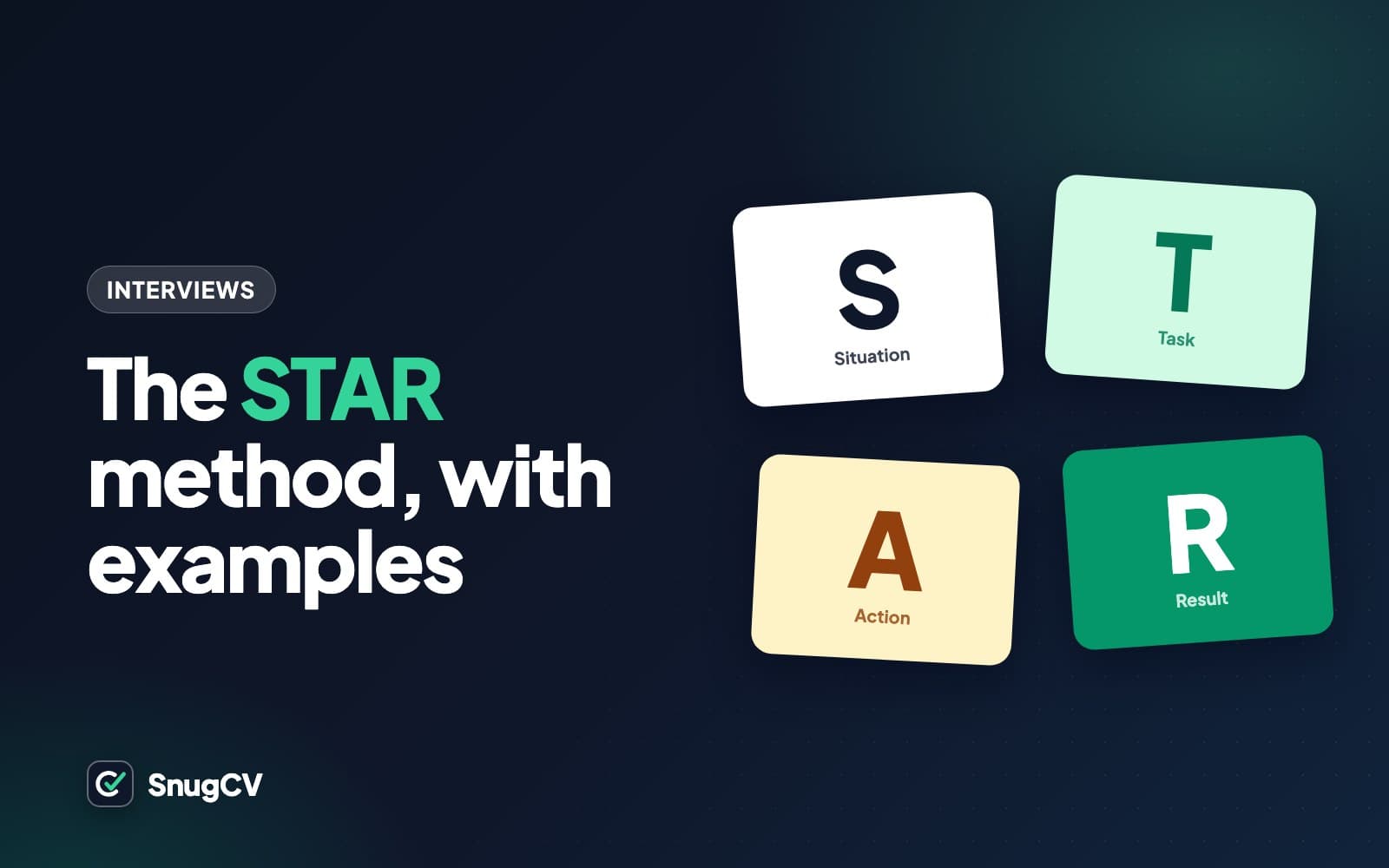
STAR stands for Situation, Task, Action and Result. It is a way to put a story in an order the listener can follow.
- 1
Situation
Where and when, in a sentence or two.
- 2
Task
What your job was in that moment.
- 3
Action
The specific steps you took.
- 4
Result
What happened because of them.
Each part answers one question, and each has a common way of going wrong.
| Part | Answers | Sounds like | Common slip |
|---|---|---|---|
| Situation | Where and when? | At a three-clinic dental group last spring, our scheduling system changed over a weekend. | Starting with a long backstory |
| Task | What was your job in it? | I had to keep the front desk running without double bookings. | Skipping it, so nobody can tell which part was yours |
| Action | What did you do? | I wrote a one-page cheat sheet and sat with each receptionist for their first ten bookings. | Saying we, or describing what the team did |
| Result | What happened? | Double bookings stopped by the second week, and the other two clinics used the sheet. | Ending on the action with nothing after it |
The balance matters more than most people expect.
- Situation. One or two sentences
- Task. One sentence
- Action. The steps you took, and why
- Result. What changed, and what you learned
Say what you did, even in a team story
Most work is done in teams, and interviewers know it. They still need to hear your part, because they are hiring one person. Team credit belongs in the situation and the result. The action should be yours.
Before
We reorganized the stockroom and it went a lot faster after that.
After
Our team of four reorganized the stockroom. I proposed grouping items by how often they sold, drew the new layout, and moved the fastest sellers to the front shelves. Pick times dropped in the first week, and the team kept the layout.
The team still gets credit. The listener can now see what you contributed.
Build a story bank before you need one
You cannot invent a good story in the middle of an interview. You can recall one, if you have already looked for it. A story bank is a short list of six to eight real moments from your work, each written out in four lines and tagged with the themes it can serve.
- 1
List moments
Scan the last three to five years and jot ten to fifteen: a hard shift, a mistake, a change you suggested, a conflict, a person you taught.
- 2
Mine your resume
Every bullet with a verb and a result is a story seed. Ask what happened just before and after it.
- 3
Write four lines
One line each for situation, task, action and result. Do not write a script.
- 4
Tag the themes
Most stories serve three or four themes: teamwork, pressure, a mistake, a customer.
- 5
Check the spread
Make sure you have different jobs, recent examples, and at least one mistake and one conflict.
- 6
Say them aloud
Tell each one in under two minutes, to a person or a recording.
Start from your resume
Your resume is already a list of things you did. Each strong bullet is a story seed, because behind every result there was a situation and a set of choices. Resume bullet points covers how to write the bullet. Here the job is the reverse: take a bullet and ask what happened.
| Resume bullet (made up) | Story seed | Themes it can serve |
|---|---|---|
| Cut average ticket time on the prep line by reorganizing station layout | The Saturday the line backed up and I moved the stations | Problem solving, initiative, pressure |
| Trained six new hires on the pharmacy system | The new technician who froze at the register | Coaching, patience, communication |
| Resolved billing disputes across a 300-account portfolio | The customer who had been overcharged for three months | Conflict, ownership, customers |
| Passed twelve consecutive safety audits at the warehouse | The near-miss with a pallet jack that I reported | Integrity, safety, speaking up |
The posting tells you which themes to cover first. The method in how to find the keywords in a job description works for competencies as well as skills: if a posting mentions handling difficult customers and covering short staffing, those are the two stories to be sure of.
What a finished bank looks like
Here is a bank for a made-up restaurant shift supervisor. The one-line summaries are enough to jog the memory, and the last column shows how few stories it takes to cover a wide range of questions.
| Story | One line | Result | Serves |
|---|---|---|---|
| Holiday call-outs | Four people called out on the busiest Saturday of the year | Every station covered, no overtime, plan reused | Pressure, problem solving, leadership |
| The wrong order | I sent a large catering order out with the wrong sauce | Remade within the hour, added a check | Mistake, ownership |
| Coaching Sam | A new cook kept missing his prep counts | He passed counts within a month and trained the next hire | Coaching, patience |
| Pushing back on the owner | I disagreed with a menu cut that slowed service | We tested my version for two weeks | Disagreeing with a boss, influence |
| The new tablets | The restaurant moved to tablet ordering mid-season | Servers were comfortable in a week | Change, learning |
| The angry regular | A regular was loud about a long wait | He apologized and kept coming | Customers, composure |
35 common questions, grouped by theme
Interviewers rarely use these exact words, but most behavioral questions are variations on a handful of themes. The right-hand column is a reasonable reading of what each question tests, which is useful for picking your story. Replace customer with patient, student, guest, client or caller to suit your field.
Teamwork and collaboration
| Question | What it probes |
|---|---|
| Tell me about a time you worked with a team to reach a shared goal | Whether you contribute and give credit |
| Describe a time you helped a coworker who was struggling | Whether you support others without taking over |
| Give an example of working with someone whose style was very different from yours | Flexibility and respect |
| Tell me about a time your team was short-staffed | Reliability under strain, without resentment |
Conflict and difficult people
| Question | What it probes |
|---|---|
| Tell me about a disagreement with a coworker and how you handled it | Whether you address problems directly and respectfully |
| Describe a time you disagreed with your manager | Whether you can raise a concern, then commit to the decision |
| Tell me about a difficult customer, patient or student | Composure, empathy and limits |
| Describe a time you had to deliver bad news | Honesty and tact |
| Tell me about criticism you disagreed with | Openness, and how you process feedback |
Problem solving and judgment
| Question | What it probes |
|---|---|
| Tell me about a problem you solved that nobody asked you to look at | Whether you notice things |
| Describe a decision you made with incomplete information | How you weigh risk and act anyway |
| Give an example of spotting a problem before it got big | Attention and follow-through |
| Tell me about a time you had to learn something fast to fix a problem | Speed of learning and resourcefulness |
Pressure, time and priorities
| Question | What it probes |
|---|---|
| Tell me about a time you had several deadlines at once | How you rank and communicate |
| Describe your most stressful day and how you got through it | Coping, and whether you ask for help |
| Tell me about dropping a task to handle something urgent | Flexibility, and whether you tell people what slips |
| How do you decide what to do first when everything is urgent? | Your reasoning, ideally with a real example |
Initiative and going beyond
| Question | What it probes |
|---|---|
| Tell me about a time you went beyond your job description | Ownership and motivation |
| Describe an improvement you suggested and what happened | Whether you see better ways and follow through |
| Tell me about taking charge of something nobody owned | Willingness to step up without being asked |
Failure, mistakes and feedback
| Question | What it probes |
|---|---|
| Tell me about a mistake you made at work | Honesty, and what you changed |
| Describe a goal you set and did not meet | How you handle a miss |
| Tell me about critical feedback and what you did with it | Whether you act on feedback |
| Describe a project that did not go as planned | Judgment in hindsight |
Leadership and influence
| Question | What it probes |
|---|---|
| Tell me about leading others without being their manager | Informal leadership |
| Describe how you trained or coached someone | Patience and teaching |
| Tell me about persuading someone to try your idea | Influence, and listening first |
Customers and service
| Question | What it probes |
|---|---|
| Tell me about going out of your way for a customer | Care, and a sense of what matters to them |
| Describe a time a customer asked for something you could not give | Boundaries, kindness and alternatives |
| Tell me about turning around an unhappy customer | Recovery and follow-up |
Adaptability and change
| Question | What it probes |
|---|---|
| Tell me about a time something changed at the last minute | Calm and re-planning |
| Describe learning a new system or process | Willingness and method for learning |
| Tell me about working outside your comfort zone | Self-awareness and growth |
Integrity and ethics
| Question | What it probes |
|---|---|
| Tell me about a time you saw something that was not right | Whether you speak up, and how |
| Describe a time you were asked to bend a rule | Judgment, boundaries and tact |
How the questions sound in your field
The wording shifts with the job, and the themes stay the same. These are made-up variations so you can recognize the shape of the question when it arrives in the vocabulary of your field.
Floor and counter
Retail and hospitality
Tell me about a time you had a long line and a customer with a complicated request. Describe covering a shift when someone did not show up.
Clinical and support
Healthcare
Tell me about a time you advocated for a patient. Describe catching an error before it reached the patient.
Site and floor
Trades and warehouse
Tell me about spotting a safety hazard. Describe a job that did not go to plan once you were on site.
Classroom and school
Education
Tell me about a student you struggled to reach. Describe how you handled a disruption in your class.
Desk and team
Office and admin
Tell me about juggling requests from several managers. Describe catching a mistake in a report before it went out.
Road and dock
Driving and logistics
Tell me about a delivery that went wrong. Describe how you handled a delay you could not control.
One story can answer many questions
You do not need thirty stories. Take the holiday call-outs story from the bank above: four people called out on the busiest Saturday of the year. The facts do not change from one question to the next. The emphasis does.
Lead with the stakes
Asked about pressure
Open on the numbers: four of eleven staff gone, a full reservation book and a banquet at seven. Spend the action on how you stayed calm and what you chose to cut. End on how the night went.
Lead with the people
Asked about leadership
Open on who you asked to stay and why, how you reassigned stations around strengths, and what you said to the team before doors opened. End on how they felt and what you changed in the call-out plan.
Lead with the options
Asked about problem solving
Open on the options you weighed: close a section, call the part-timers, move the banquet prep. Explain why you chose what you did and what you tried first that did not work.
Only if it fits
Asked about a mistake
If something really went wrong that night, such as a station running late because you underestimated a role, use that part. Otherwise pick another story. Do not manufacture a mistake.
If you notice halfway through that your story answers a slightly different question, you can steer back with one sentence: "The part that matters most here is how I handled the team."
Seven full STAR answers
These are made up, from seven fields. They are models. Your own versions need real facts, so use the structure, the pacing and the level of detail, and replace the content with your own. Each answer runs about 90 seconds when spoken.
Retail: a difficult customer
The question: Tell me about a time you dealt with a difficult customer.
- 1
I was working the returns desk on a Saturday. A customer brought in a tile saw that was a month past its warranty and wanted a full refund. There were eight people in line, and he was getting louder.
Situation
Where, when and the pressure, in three sentences. The line behind him is the detail that makes the stakes clear.
- 2
Policy said no refunds after the warranty. I also needed to keep the line moving and keep him from leaving feeling brushed off.
Task
It names two goals that pull against each other, which is why the story is interesting.
- 3
I stepped out from behind the desk so we were side by side, said I could see how frustrating a broken saw was, and asked what happened. The blade guard had broken in normal use. I called the manufacturer from the desk phone, explained, and got them to agree to a goodwill replacement part. I offered him store credit toward a rental in the meantime and asked a coworker to take the next person in line.
Action
Every verb is an I. It shows listening first, then a concrete, policy-respecting solution.
- 4
He left with a part on the way and a rental credit, and he thanked me. The line cleared in about ten minutes. I wrote what I did in the returns log so the next person at the desk knew who to call at the manufacturer.
Result
An outcome for the customer, one for the line and one for the team. The log entry shows you made it repeatable.
Nursing: several urgent things at once
The question: Tell me about a time you had to juggle competing priorities.
- 1
On a night shift we were one nurse short and I had six patients. Around 2 a.m., one patient's blood pressure dropped, another pulled out an IV, and a third patient's family was asking for an update.
Situation
Three things at once, named in one breath. The listener can see the problem immediately.
- 2
I had to decide what could wait and what could not, and make sure the patient with the drop got attention first.
Task
A one-line task that frames the story as a decision.
- 3
I went to that patient first, took a full set of vitals, and called rapid response as our protocol says. While we waited, I asked the aide to sit with the patient who had pulled the IV and hold pressure on the site, and I asked the unit clerk to tell the family I would be out in ten minutes. Then I told the charge nurse what I had triaged and where I was stretched.
Action
Prioritizing, delegating and communicating up. It also shows you used the protocol and the team instead of acting alone.
- 4
The patient moved to a higher level of care and stabilized. I replaced the IV within the half hour and spoke to the family before they had waited twenty minutes. The charge nurse pulled in a float nurse for the rest of the shift, and I now give that same quick status update any time I have more than one thing going wrong.
Result
The last sentence is the lesson, stated as a habit you still have.
Teaching: a disagreement with a parent
The question: Tell me about a time you disagreed with someone and how you resolved it.
- 1
A parent emailed me, copying the principal, upset that her son had failed a unit test in my fifth-grade math class. She said I had not taught the material.
Situation
Includes the detail that the principal was copied, which shows the stakes.
- 2
I needed to understand the concern, check whether she was right, and rebuild the relationship so we could help her son.
Task
Three goals in order, with the relationship named as the real aim.
- 3
I called her instead of writing back and listened for the first few minutes. Then I pulled his work. He had done fine on the practice sets but missed the word problems. We met with his work in front of us, I showed her where the points were lost, and I suggested two things: a small group on word problems twice a week, and a short weekly note home. She chose both.
Action
A call, evidence, and a choice for the parent. Letting her pick makes it a partnership.
- 4
His next unit test was a pass, and she emailed to thank me. I also started sending a short progress note home before big tests, which has cut down the surprise emails.
Result
A result for the student and a change in how you work.
Warehouse: a mistake
The question: Tell me about a mistake you made and what you did about it.
- 1
I was a receiving clerk. One Tuesday I scanned an inbound pallet of baby formula into the wrong location. I had keyed one digit of the bin number wrong.
Situation
It states the mistake plainly and takes ownership in the second sentence. No excuses.
- 2
The pickers would not be able to find the pallet, and that formula was on a customer order due out the next morning. It was my error, and I needed to fix it before it became a missed shipment.
Task
The task is to own it and prevent the consequence.
- 3
The cycle count report flagged the discrepancy that afternoon. I told my supervisor right away instead of waiting to be asked, walked the aisles to find the pallet, rescanned it and confirmed the order could ship. Then I changed my own process: I now read the bin number back from the label before I scan.
Action
Two kinds of action, the fix and the prevention. The second is what makes a mistake story worth telling.
- 4
The order shipped on time. My supervisor asked me to show the read-back habit to the other two receivers, and we had no repeat location errors on that shift for the rest of the quarter.
Result
A small mistake with a visible improvement. The listener now trusts you more than before the story.
Admin and finance: an improvement nobody asked for
The question: Tell me about a time you took the initiative.
- 1
I was an accounts payable clerk at a small construction supply company. Vendor invoices came in by email, mail and fax, and every month about thirty of them were paid late because they sat in someone's inbox.
Situation
A concrete scale for the problem, so the improvement can be measured.
- 2
Nobody owned the problem. The late fees were small, but two vendors had called to say they might hold orders. I wanted to fix the intake step.
Task
It says the problem was unowned, which is the definition of initiative.
- 3
I set up one shared mailbox for invoices and asked the vendors to send them there. I made a simple tracking sheet with the due date and who approved each one, and I checked it for ten minutes every morning. After the first month I showed the controller the results.
Action
Specific, and modest in scale. It does not claim a system rollout. It describes what one person did.
- 4
Late payments dropped to three in the first month and none by the third. The controller made the shared mailbox the official process and asked me to write the instructions for the other branch.
Result
A number with a before and an after, followed by proof that others adopted it.
Restaurant: a conflict with a coworker
The question: Tell me about a time you had a conflict with a coworker.
- 1
I was a line cook at a busy restaurant. On Friday nights another cook and I kept clashing because he fired steaks before my sides were ready, and plates were dying in the window.
Situation
A familiar problem told in kitchen terms. Any listener from the industry will nod.
- 2
We needed to work as a unit during service, and I wanted to raise it before it turned into a fight in front of the kitchen.
Task
It frames the aim as the shared outcome and names the risk of letting it fester.
- 3
I asked him for five minutes before Saturday's shift, at the back. I said what I had noticed and asked how it looked from his side. He said the tickets were hitting the grill before the sides, so he thought he was being asked to hurry. We agreed on a call: I would say sides in two, and he would fire on that call.
Action
A private conversation, a question and a small agreement. It credits the other person's view fairly.
- 4
Plates came out matched, and the chef noticed the window clearing faster. We kept the call on every weekend afterward, and he and I started covering each other's breaks.
Result
A service result and a relationship result, both modest and believable.
IT support: priorities that moved
The question: Tell me about a time priorities changed suddenly.
- 1
I was the IT support technician at a 60-person accounting firm. A week before the tax deadline, management decided to replace fifteen laptops. The rollout had been planned for the month after.
Situation
The timing is the whole story, so it opens the answer.
- 2
I had to get fifteen laptops set up and handed over during the firm's busiest week, without losing client data or staff time.
Task
States both constraints, data and time.
- 3
I wrote a one-page plan: five laptops a day, in order of each person's schedule, with their files copied the night before. I asked managers for a thirty-minute slot per person and told staff exactly what to expect. When the second batch arrived with the wrong software image, I flagged it on day one and reimaged them overnight instead of waiting.
Action
Planning, communicating and catching a problem early. Three small decisions that show how you work.
- 4
All fifteen were done by Friday, nobody lost a file, and I kept the checklist so the next rollout started from a template.
Result
Done, safe, and reusable. A short result is fine when it is complete.
Adjusting length and level of detail
A typical STAR answer runs about 90 seconds to two minutes. A phone screen wants less, and a final-round conversation can go longer with follow-ups. The skill is knowing what to cut, and it is almost always the situation.
Before
So this was last March, right after we switched to the new scheduling system, which was already a bit controversial because the old one had worked fine for years and the previous manager had picked the new one, and anyway there was a lot going on that week.
After
Last March our clinic switched scheduling systems, and in the first week double bookings started showing up.
Cut the backstory. One sentence sets the scene, and the listener still has everything they need.
Before
I talked to the team and we worked on it together and got things sorted out.
After
I met with the three front desk staff, listed the five most common booking errors, and wrote a one-page cheat sheet we taped beside every monitor.
Vague actions are the most common weakness. Name the people, the steps and the thing you made.
Before
I think it went pretty well in the end.
After
Double bookings stopped by the second week, and the other two clinics asked for the cheat sheet.
A result is something that happened, not a feeling about it.
For a short version, keep one sentence each for situation and task, two or three sentences for the action, and one for the result. Here is the returns-desk answer from above cut to about 30 seconds.
Short version: returns desk (made up)
A customer came in with a tile saw a month past its warranty, wanting a full refund, with eight people in line behind him. I stepped out from the desk, listened, and found the blade guard had failed in normal use. I called the manufacturer and got a goodwill replacement part approved, and gave him rental credit in the meantime. He left satisfied, the line cleared in ten minutes, and I logged the manufacturer contact for the next person on the desk.
The questions the interviewer asks next will pull out the detail you left behind, which is a better use of their time than a long first answer.
Follow-up questions to expect
A good story survives the second question. Interviewers often ask a follow-up to see whether the story is real and whether you have thought about it. If you can answer all six of these about a story, it is ready.
| Follow-up | What they are checking |
|---|---|
| What was the hardest part? | Whether you are honest about difficulty |
| What would you do differently? | Whether you reflect and learn |
| How did the other person react? | Whether your account is fair to them |
| What did your manager say about it? | Whether the result was real and visible |
| Who else was involved? | Whether you can name the team and your part in it |
| How did you know it worked? | Whether there was any evidence |
When you do not have an example
Sooner or later a question will land on something you have not faced. The honest options are better than a made-up story, and they work.
Same skill, lower stakes
Use a smaller version
You may never have led a team of ten. You may have organized a shift swap or coached one person, and the skill is the same. Say the scale honestly.
School, volunteering, family
Use another setting
Coaching a youth team, running a fundraiser, caring for a relative or leading a class project can all show conflict, planning and follow-through.
And say that is what it is
Say how you would handle it
Name that you have not faced it, give the closest thing you have done, and walk through how you would approach it and why.
Silence is fine
Take a moment
Asking for ten seconds to think reads as composed. A pause is far better than a rambling start that you cannot finish.
Here is the third option in action.
Interviewer
Tell me about a time you had to fire or let someone go.
You
I haven't had to do that yet. I've been a shift lead for a year, and I haven't had a case that reached that point. The closest I've done is a hard conversation with a team member who kept coming in late. I met with him privately, asked what was going on, found out his bus schedule had changed, and we adjusted his start time by fifteen minutes. If it had come to termination, I would follow the documentation process with my manager and HR, and I'd want the person to have heard it coming.
Interviewer
Why would they have heard it coming?
You
Because a termination should never be the first time someone hears there's a problem. I'd want at least one clear conversation and a written note before it got that far.
The failure question
Questions about a mistake or a missed goal are often the ones people fear most. They can also be among the easiest to answer well, because the interviewer is mostly checking that you can be honest and that you learned something.
A good failure story
- A real mistake with small to moderate stakes, where you can say what went wrong
- A fix that happened because of something you did
- A visible change in how you work afterward
- Said in a plain tone, without excuses or drama
A weak one
- A strength in disguise, such as I work too hard or I care too much
- A story where the cause was someone else's error
- A mistake so serious it raises questions about your judgment in the job
- A story with no change afterward, so it reads as a one-off
Mistakes that weaken a good story
Do
- Say I for the action and we only for the context
- Give the action the most time and the situation the least
- End on a result, even a modest one, and on what you would do again
- Choose a story that matches the theme the question tests
- Keep names and private details out of it
Avoid
- Telling a story from ten years ago when you have a recent one
- Describing what the team did without saying what you did
- Blaming a coworker or a past employer for the outcome
- Using the same story for every question
- Reciting a memorized script word for word
Two other habits help. First, listen for what the question is really testing, then lead with the part of your story that answers it, instead of beginning at the beginning. Second, keep an eye on the interviewer. If they look satisfied after the action, give the result in one sentence and stop.
How to practice
A practice routine that takes about an hour
0 of 7 done
The questions are only half the interview. Tell me about yourself is the opener, and the questions you ask at the end matter too. Questions to ask the interviewer covers that.
Where SnugCV fits
SnugCV builds your profile once from your uploaded PDF resume: your employers, titles, dates and bullets, in one place. Reading through it is a quick way to find story seeds, and the matched keywords for a posting show which duties it cares about, so you know which stories to rehearse first. It does not write your stories, because those have to come from what actually happened.
Keep going
If a question comes up about why you are the right person for the job, why should we hire you is the one to read next. Once the interview is over, a short thank-you email is the last step, and it is a good place to add a detail from one of your stories that you did not have time to share.
Questions people ask
What is a behavioral interview question?
It asks you to describe something you actually did, usually starting with tell me about a time, give me an example or describe a situation. The interviewer wants a specific past story and not a general statement about how you work. A STAR answer gives them that story in a clear order.
How many STAR stories should I prepare?
Six to eight is enough for most interviews, as long as they cover different jobs, different themes and at least one mistake and one conflict. Each story can answer three or four different questions with a change of emphasis, so you are building a small set you know well and not memorizing thirty answers.
How long should a STAR answer be?
A common rule of thumb is about 90 seconds to two minutes. Keep the situation to a sentence or two, give the action the most time, and end with the result. Shorten it on a phone screen or when the interviewer is clearly working through a list, and expect follow-up questions on the details.
Do I need numbers in the result?
Numbers help when you have true ones, such as hours saved, orders shipped on time or customers served. When you do not, a concrete outcome works as well: a policy that changed, a process other people adopted, a complaint that was resolved, praise from a supervisor. Never estimate a figure you cannot defend.
What if I have no work experience?
Use school, volunteering, sports, family responsibilities or community projects, and choose a moment where you faced a real problem and made choices. The interviewer wants to see how you think and act, and that can show up outside paid work. Explain the setting in one sentence and then tell the story as you would any other.
Should I say I or we?
Use we for the situation and I for the action. Interviewers hire one person, so they need to hear what you did, even when the work was a team effort. You can still give the team credit in the result, as long as your own part is clear and specific.
What if the result of my story was bad?
A story with a poor outcome can still work, particularly for questions about failure or a goal you missed. Describe what happened, what you took from it and what you changed afterward. A real lesson with a visible change in how you work is more convincing than a story that wrapped up too neatly.
Was this guide helpful?
Get the free resume checklist and new guides
Twenty checks to run before you send a resume, as a one-page PDF. After that, a short email when new guides go up, at most once a week.