Key takeaways
- Dress for the workplace, then go one step neater than what people there wear on an ordinary day. A formal outfit that looks out of place does not help you.
- Find the dress code by asking the recruiter, looking at the company's own photos and the people in the role, or visiting. Asking is normal.
- Clean, pressed, well-fitting clothes you can sit, stand and walk in matter more than price. Free and low-cost sources exist in many places.
- Religious and cultural dress, mobility aids and other parts of who you are belong in the interview. Choose pieces by what they are, not by who is expected to wear them.
In this guide
- How to dress for an interview
- Find out the dress code first
- What to wear by type of workplace
- What to wear to a video interview
- Fit, comfort and the try-on test
- Dress for who you are: inclusive guidance
- If you do not have interview clothes, or the budget is tight
- The week before
- If you misjudged the dress code
- Other stages and formats
- Mistakes people make
- Where SnugCV fits
- Keep going
The right outfit for an interview depends on where you are interviewing. A blazer helps in an office and looks odd in a kitchen. Clean work boots help on a construction site and are wrong for a bank. The guide you need is one that starts from the workplace, so that is how this one is organized.
It shows how to learn the dress code before you choose anything, then goes through each kind of workplace from offices to warehouses to clinics. It also covers video calls, stretching a small wardrobe or budget without judgment, and inclusive guidance that describes clothes by what they are. If you want the whole picture of preparing, with questions and logistics, start with how to prepare for an interview, which has a short table of outfits by field that this guide expands on.
How to dress for an interview
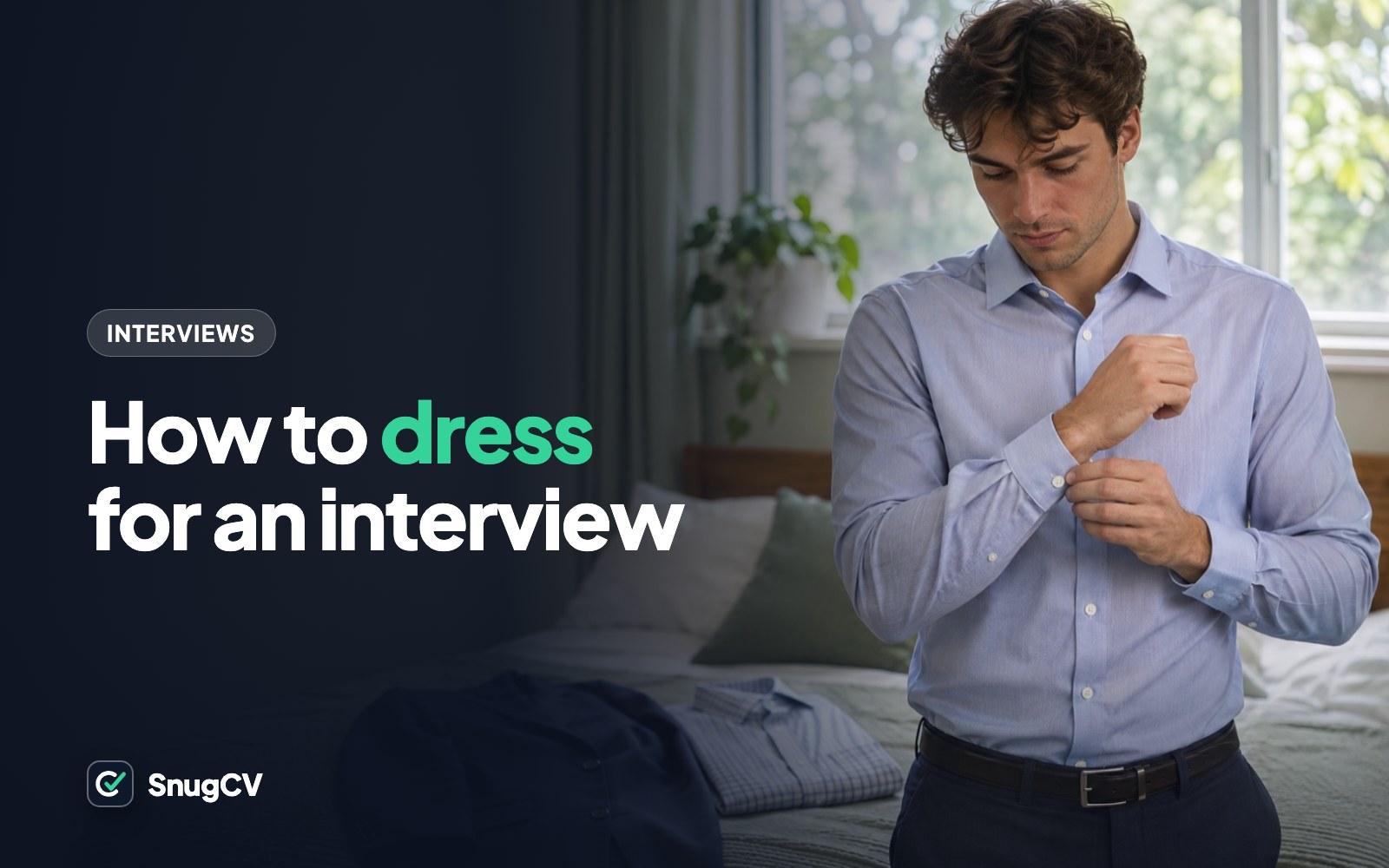
Dress for the workplace, then go one step neater than what people there wear on an ordinary day. Clean, pressed, well-fitting clothes in the style of that workplace beat a formal outfit that looks out of place. If you are unsure, ask the employer, and pick comfort you can sit, stand and walk in.
"One step neater" is easier to apply with a ladder in front of you. Find the rung that matches the workplace, then move up one.
| What people wear on an ordinary day | What to wear to the interview | Example |
|---|---|---|
| Uniform, scrubs, work clothes, hi-vis | Clean, plain, neat clothes in the style of the work, with sturdy shoes | Plain trousers, a collared top, clean boots for a warehouse |
| Casual: jeans, t-shirts, sneakers | Neat casual: tidy jeans or chinos, a collared shirt or sweater, clean shoes | A coffee shop or a small retail store |
| Smart casual: chinos, shirts, blouses, sweaters | Business casual with a layer: tailored trousers or a skirt, a pressed shirt or blouse, a jacket or cardigan | An office with no formal dress code |
| Business casual: collared shirts, blazers sometimes | Business professional: a matching or coordinated jacket with trousers, a skirt or a dress, and polished shoes | A bank, a law office or a school district office |
| Business professional: suits | Business professional, with care over fit and polish | Corporate and formal client-facing work |
There are two exceptions to the rule. At workplaces where formality could look out of touch, such as a construction site, a farm or a tattoo studio, one step neater means neat versions of what people wear. And in places that dress extremely casually, there is no reason to go up the whole ladder. Take the single step.
Find out the dress code first
You do not have to guess. A few minutes of looking usually answers it.
- 1
Ask
Whoever scheduled the interview can tell you what people wear.
- 2
Look
Check the company's own photos, posts and website.
- 3
See the role
Find people in the same job and note what they wear.
- 4
Visit
If you can, go past at a busy time or be a customer.
- 5
Decide
Choose the outfit and a layer you can add or remove.
Ask
Asking about dress is a normal question. A short message is enough, and it shows you are preparing.
Email asking about dress (made-up example)
- Subject
- Quick question before my interview on Thursday
Hello Ms. Halvorsen,
I'm looking forward to speaking with you on Thursday at 10:00. Is there a dress code I should follow for the interview, or something people usually wear in the department? I'd like to arrive dressed in a way that suits the team.
Thank you, Kai Whitlock
If you are talking by phone instead, ask in the same words: "What do people usually wear on a normal day there?" The answer to that question is more useful than the formal code, because it tells you where to start on the ladder.
Look
Employers show you their dress code all the time without saying it. Check:
- The careers page and the "meet the team" page on the company's website
- The company's social media, especially posts from events and ordinary days
- Photos of the entrance or reception on map listings and review pages, where customers and staff appear
- Job videos or recruiting videos, which often show real shifts
Treat headshots with care. People usually dress up for a profile photo, so a LinkedIn photo of someone in a blazer does not prove they wear one every day.
Visit
If you can, go in as a customer. Order a coffee, browse the store or have lunch at the restaurant. For an office or a site, a walk past at the start or end of the day shows what people arrive and leave in. You are looking for a general picture, and you do not need to go inside or talk to anyone about the interview.
When you cannot find out
Choose smart casual with one extra layer: plain trousers or a skirt, a collared shirt, blouse or sweater, clean closed shoes and a jacket or cardigan. You can remove the layer if the room is casual or keep it if it is formal.
What to wear by type of workplace
These are common conventions and not rules. Employers differ, and the steps above settle any doubt. Each section below names the things to put on, and the one or two things to avoid.
Office, finance and administration
Business casual is the common base, and business professional is the choice for banking, law and many client-facing roles. A pressed shirt or blouse, tailored trousers or a skirt, a blazer or cardigan, and closed shoes in good condition cover most offices. A suit is correct for formal workplaces and optional elsewhere. Keep the outfit simple, because the interviewer should remember what you said and not what you wore.
Retail and customer service on the floor
Dress close to the store's own style but a notch tidier. A fashion store may expect a look that shows you know the brand, and a hardware store may expect plain, practical clothing. Closed, comfortable shoes matter because the interviewer may walk you around the floor. Skip anything with a competitor's logo, and anything that could be read as the store's own uniform.
Trades, construction and warehouse
Wear clean work clothes or neat casual clothes, such as work trousers or plain jeans, a collared shirt or a clean plain top, and sturdy closed shoes or boots. You may be asked to walk a site or shop floor, so wear footwear that is safe there. Bring protective equipment if the employer asked for it, and ask beforehand if you are not sure. Hair tied back, no dangling jewelry near equipment, and no suit.
Healthcare
Clinical interviews tend to be conservative. Wear neat, plain clothes that you could imagine under a lab coat, closed shoes you can walk in and a layer for chilly buildings. Keep jewelry minimal and nails tidy and short. Some hospitals and clinics ask staff and visitors to keep scent light, so go easy on fragrance. Scrubs are rarely the right interview outfit unless the employer asks for them.
Food service and kitchens
Interview in clean, plain clothes with closed, non-slip shoes you could work in, and hair tied back if it is long. A front-of-house interview can lean smarter, with a collared shirt and dark trousers. For a cooking job, the employer may ask for a working trial, sometimes called a stage, and will tell you what to bring. Ask whether to bring your own knives, whites or apron.
Creative and design work
The dress code here is wide, and the aim is to look considered. Show your taste with one deliberate piece, such as a good jacket or distinctive shoes, and keep the rest quiet. Wearing a costume invites the wrong conversation. Your portfolio carries the creative message, so the outfit just has to look like it belongs to the same person.
Education and childcare
Wear business casual with layers, and shoes you can stand in for a classroom walk-through. If you will teach a short demonstration lesson, wear something you can move and write on a board in. In early years and childcare settings, choose clothes you could sit on the floor in without a second thought, and keep jewelry simple.
Uniformed and security roles
In uniformed work, neat and polished is a safe choice. Choose business casual or a little smarter, with polished shoes. If a uniform or specific boots are provided later, you do not need to match them now. Security guard resume covers the paperwork side of that field.
Outdoor, seasonal and gig work
Wear clean, practical clothes for the weather, and shoes you can walk a site in. If you will meet in a public place such as a park or a lot, dress for it. Nobody expects a tie at a landscaping interview. Clean work clothes and closed shoes are enough.
What to wear to a video interview
On a video call the interviewer sees a small rectangle, so a few things matter more than they would in a room.
- 1
A solid, mid-tone or darker color with a plain neckline.
Your top and its color
Tight stripes and small patterns can shimmer on camera. A top that contrasts with the wall behind you keeps you from fading into it.
- 2
A window or lamp in front of you, not behind.
Light
Light behind you turns you into a silhouette. Sit facing it and check how glasses catch it.
- 3
A plain, tidy wall or a clean corner of a room.
Background
Remove anything personal or distracting. A blurred background works if it does not flicker around your hair or shoulders.
- 4
Head and shoulders, with the camera at eye level.
Frame
Stack books under a laptop if you need to. Keep your hands free to gesture.
- 5
A complete outfit, shoes included.
Below the desk
If you need to stand to fetch something or the call moves to a phone, you should not have to apologize.
Check the sound too. Jewelry that clinks on a desk, a loud watch and a scarf that rubs a microphone all carry through headphones. Do a test call with a friend a day before, and look at yourself on your own camera at the time of day of the interview. A phone interview is the one case where nobody sees you, so wear whatever helps you sit up and sound ready.
Fit, comfort and the try-on test
An outfit can be perfect on the hanger and wrong after an hour. Put the whole thing on a day or two beforehand and treat it like a dress rehearsal.
The try-on test
0 of 6 done
Fixable problems are common. A loose button, a hem that has come down and a missing shoelace can all be repaired in minutes. A lint roller, a steamer or an iron, a small sewing kit and shoe polish cover most of the rest.
Grooming and small details
Keep your hair, beard and nails tidy in the way you would keep them for work. Keep jewelry modest and scent light, since some workplaces ask staff to avoid it. A clean bag or folder, a coat that is not covered in lint and shoes that are cleaned will be noticed more than a brand. Tattoos and piercings are accepted in many workplaces and discouraged in some. If you are not sure, a covered tattoo is a small, temporary choice for one meeting, and you can decide how to handle it after you see the place.
Dress for who you are: inclusive guidance
Dress codes are written in many styles, and some are worded around who is supposed to wear what. A more useful way to read them is to ask what items they describe. A suit is a jacket paired with trousers, a skirt or a dress. Business casual might be a collared shirt, a blouse or a sweater with tailored trousers, a skirt or a dress. Nothing about the clothes says who should choose them.
| Piece | Choices | Notes |
|---|---|---|
| Top | Shirt, blouse, knit top, sweater, polo | Pressed or smooth, and in a color that suits you |
| Bottom | Tailored trousers, chinos, a skirt or a dress at or below the knee, plain dark jeans in casual settings | Choose a length and fit you can sit and move in |
| Layer | Blazer, jacket, cardigan, vest | Gives you something to add or remove |
| Shoes | Leather shoes, flats, loafers, boots, clean plain sneakers in casual settings | Closed, clean and comfortable for walking |
| Extras | Belt, watch, simple jewelry, scarf, tie | Optional, and fewer is easier |
Fit matters more than size. A tailor can adjust a jacket, hem trousers or take in a waist, and the clothes should be sized for you instead of for a number.
Religious and cultural dress
If your faith or culture asks you to wear a head covering, keep your hair or beard a certain way, or wear traditional clothing, wear it to the interview as you would to work. In the United States, the Equal Employment Opportunity Commission's guidance on religious garb and grooming says employers generally must make exceptions to their dress and grooming rules for religious practice unless doing so would cause undue hardship, and that the protection covers applicants as well as employees. Its page notes that the standard for undue hardship has changed since it was written, so treat it as a starting point. Laws in other countries are different, and workplaces with safety equipment may need to talk it over with you. This is general information, not legal advice, so check the rules where you live.
Disability, medical needs and gender
Wear your mobility aid, hearing devices, prosthetics or medical equipment. They are not something to hide for an hour. If you need a seat, a break or an adjustment to the dress code for a medical reason, you can raise it in whatever way suits you, before or after the offer. If a dress code names genders in a way that does not fit you, ask the recruiter what the actual items are, as in "Are tailored trousers and a collared shirt fine?" The question is practical and almost always gets a practical answer.
If you do not have interview clothes, or the budget is tight
A small wardrobe is a normal starting point and workable for most jobs. Many interviews need less than people fear: clean trousers, a plain top that fits, tidy shoes and a layer.
Start with what you own
Go through your closet with the ladder in mind. Plain dark trousers or a skirt, a top without a logo, and shoes that are clean cover a wide range of jobs, particularly in retail, food service, warehouses and care work. You do not need to buy a formal outfit for a job where nobody wears one.
Free and low-cost sources
Free interview clothing exists in many places, and what each program offers differs a lot, so call before you go. The kinds of places to look:
- Career closets, often run by colleges and universities, that lend or give professional clothes. Some are open to the public and some are for students and alumni only
- Local workforce or career centers, community organizations, faith groups and charities that run clothing drives or interview-clothing programs
- Thrift and consignment stores, where a good jacket or pair of trousers can cost little
- Clothing swaps with friends, family or neighbors, including borrowing a jacket for one day
- A local tailor, because altering a jacket or hemming trousers often costs less than a new item and fits better than anything off the rack
If you are buying, pick pieces you can wear to work afterward, such as plain trousers and a layer, and choose one color family so everything goes together.
An outfit that works twice
Five pieces
The capsule
- One pair of plain trousers or a skirt
- Two tops in compatible colors, one with a collar
- One layer, such as a cardigan or jacket
- One pair of clean, comfortable shoes
- A belt or simple accessory if you like
Small and cheap
The care kit
- A lint roller
- An iron or a steamer, or a hot shower to loosen wrinkles
- Shoe polish or a damp cloth
- A needle, thread and a safety pin
- A stain pen for the morning of the interview
You do not have to explain a limited budget to anyone. If the posting says "business casual" and you have only a clean work shirt, wear it with your neatest trousers and say nothing. Hiring managers are looking for a person who looks ready for the job, and neat plain clothes do that.
The week before
Seven days before
Find the dress code and choose an outfit. Check what you own and what you need to borrow or buy.
Five days before
Try the full outfit on, including shoes, and run the try-on test. Fix or replace anything that fails.
Two days before
Wash, press and polish. Pack a spare layer, a lint roller and a stain pen.
The night before
Lay out the outfit with the documents you are bringing. Check the weather and your route.
The morning
Dress, check yourself in a mirror and carry your coat. Eat something and leave with a margin.
On arrival
Change shoes if you walked in other ones, check your teeth and collar, and silence your phone.
If you misjudged the dress code
It happens, and interviewers usually move on quickly. Walking in smarter than the room is common and forgiven quickly. Walking in more casual than the room is worth a sentence of acknowledgment, and then you move on.
Interviewer
Please excuse how casual we all are today. You didn't need to dress up.
You
That's good to know. I wasn't sure what the day-to-day looks like, so I went on the neat side. I'll take my jacket off.
Interviewer
Please do. Shall we get started?
For a spill or a tear on the way, a stain pen and a spare layer in your bag fix most problems. If something cannot be fixed, arrive on time and mention it in a sentence. A coffee stain is easier to forgive than being late.
Other stages and formats
- A second interview usually calls for the same outfit or a notch smarter if you saw the workplace and felt you were under. Second interview questions covers what changes in that round.
- A group interview or open hiring day can have you standing, moving between stations and filling in forms, so choose comfortable shoes and an outfit that works for long hours.
- A working interview or trial shift needs work clothes, so ask what to wear and what to bring. What to bring to an interview has a checklist for each format.
- A site visit may need closed shoes and your own safety gear, so ask before you go.
Mistakes people make
Do
- Find out what people wear and go one step neater
- Wear the outfit once beforehand, shoes included
- Keep it clean, pressed, mended and comfortable
- Carry a layer you can add or remove
- Wear religious and cultural dress as you would to work
- Check how you look on camera for a video interview
Avoid
- Buy a new outfit that you have never sat in
- Wear anything with a visible stain, tear or missing button
- Choose new shoes on the day of the interview
- Go heavy on scent, jewelry or accessories
- Wear a costume or a loud pattern that pulls attention from you
- Skip checking the weather and the route
Most outfit mistakes come from picking clothes for the wrong audience. The person reading you is a manager from that workplace, so a clean pair of work boots is the right answer for a warehouse and a quiet blazer is the right answer for a bank.
Where SnugCV fits
SnugCV helps with the resume side of preparing. You build a profile once from an uploaded PDF resume, and when you paste a posting it rewrites the summary, reorders the skills and rewords the bullets in the posting's own language in about a minute. The posting is also a good clue for dress, since the words it uses for the work, the setting and the customers tell you which rung of the ladder you are on. Employers, titles, dates and education are copied unchanged, so the resume in your folder matches what you say in the room.
Keep going
Once the outfit is settled, the rest of the day is about what you say. How to prepare for an interview gives you a full plan, and what to bring to an interview covers the folder in your hand. Tell me about yourself and questions to ask the interviewer are the two pieces almost every interview contains. Afterward, a short thank-you email is worth sending.
Questions people ask
Should I wear a suit to an interview?
Only if the workplace dresses that way, or you cannot find out and the role is formal, such as law, banking or senior office work. For stores, kitchens, warehouses and many trades, a suit looks out of place. A neat version of what people wear there is better. When unsure, wear smart casual with a jacket or cardigan you can take off.
Can I wear jeans to an interview?
At a casual workplace, plain dark jeans in good condition, with a neat top and clean shoes, are fine. Skip jeans with rips, fading or heavy distressing, and anything you would wear to paint a fence. If you are unsure, ask the recruiter what people wear on a normal day and choose trousers if the answer is mixed.
What if I do not know the dress code?
Ask whoever scheduled the interview, which is a normal question. If you cannot get an answer, look at the company's website and social posts, then pick neat smart casual with an extra layer: plain trousers or a skirt, a collared shirt, blouse or sweater, and clean closed shoes. You can then adjust on the day by removing or adding the layer.
What do I wear to a video interview?
Wear a complete outfit, shoes included, in case you need to stand. On camera, solid mid-tone colors usually read better than tight stripes or busy patterns, and a top that contrasts with your background helps you stand out. Test the full look on your camera a day before, with the light you will use, and check how glasses and jewelry behave.
How do I dress for an interview with no money?
Start with what you own: clean trousers, a plain top and shoes that are tidy, then add a layer if you can. Free interview clothing exists in many places, such as college career closets, workforce centers and community organizations, and availability and eligibility vary, so call first. Thrift stores, clothing swaps and borrowing from friends work well too.
Can I wear religious or cultural dress to an interview?
Yes, wear what you would wear to work. In the United States, federal guidance from the Equal Employment Opportunity Commission says employers generally must make exceptions to dress and grooming rules for religious practice unless that would cause undue hardship, and it covers applicants as well as employees. Laws in other countries differ, so check your local rules if you are outside the US.
Does the color of my clothes matter?
Mostly for how you look on camera and for comfort. Choose colors that suit you and the workplace, and avoid anything so bright or patterned that it draws attention away from you. Plain, mid-tone and darker colors are a safe base. Fit, cleanliness and condition affect the impression more than the shade, so spend your effort there first.
Was this guide helpful?
Get the free resume checklist and new guides
Twenty checks to run before you send a resume, as a one-page PDF. After that, a short email when new guides go up, at most once a week.